
Reviewed · POMPEII TOURS
Herculaneum: Skip-the-Line Guided Tour with Archaeologist
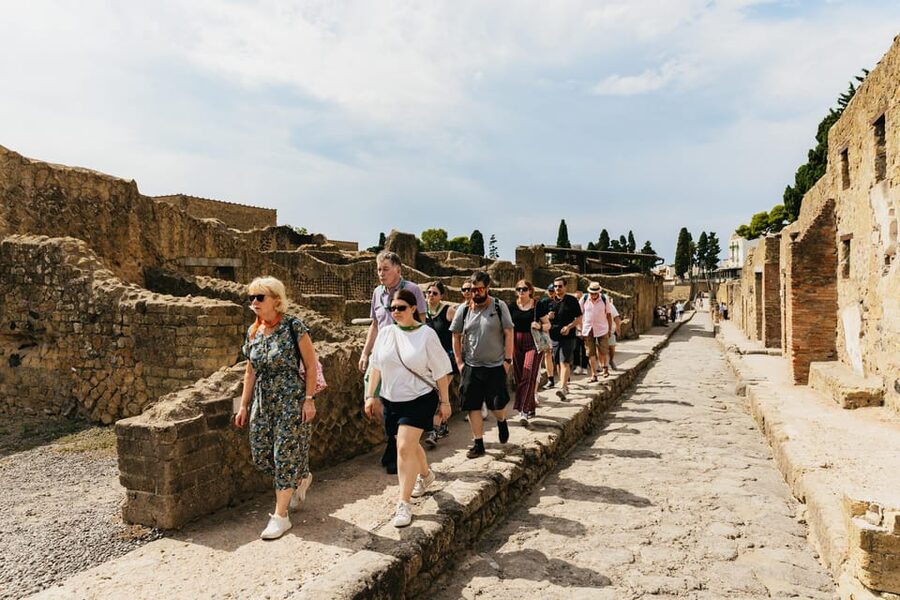
Herculaneum gives you a sharper picture of Roman daily life than many ancient sites. The town’s painted walls, mosaics, shops, carbonized wood, and high-end homes survived under volcanic material from Mount Vesuvius. With an archaeologist such as Luciano, Diego, Teresa, or Angelo leading the way, the ruins become a place where real people lived, worked, bathed, and fled.
I like the skip-the-line entry, which saves precious time at a major archaeological site. I also like the way the tour uses the town’s houses and public buildings to explain social class, trade, food, and family life. The main drawback is pace: two hours is enough for the key sights, but a lively guide can cover a great deal, and a group of up to about 20 may make it harder to hear or linger.
Key points at a glance
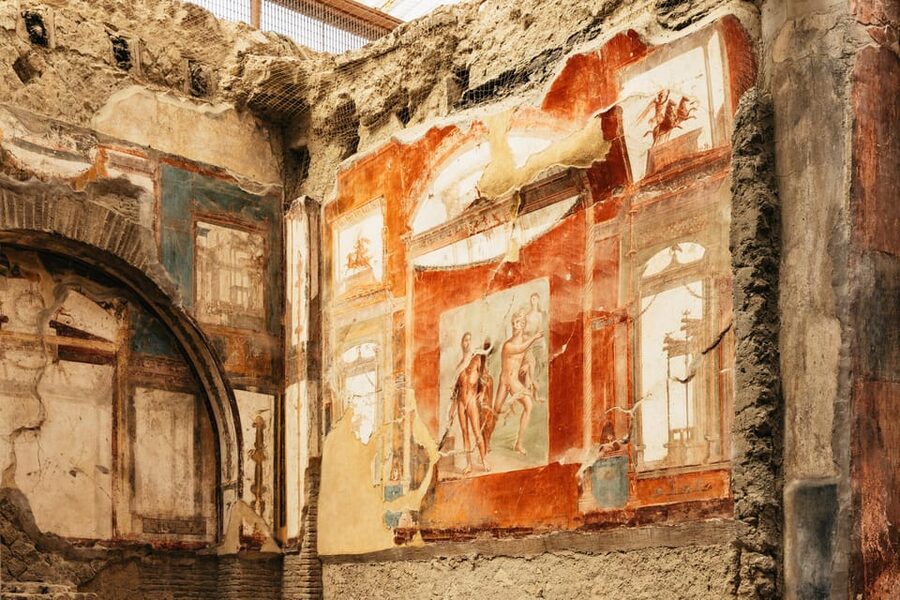
- Herculaneum is compact but remarkably preserved: See mosaics, wall paintings, ceramics, marble, and carbonized timber in their original setting.
- An archaeologist leads the walk: Guides including Luciano Leone, Diego, Teresa, and Angelo have been praised for clear explanations, humor, and visual aids.
- The waterfront is emotionally powerful: Boat sheds contain the remains of more than 300 people who tried to escape toward the sea.
- The tour covers the essential buildings: Expect the thermal baths, Samnite House, Temple of the Augustales, Forum, Gymnasium, and several grand homes.
- The $53 price includes more than admission: A regular adult ticket costs 16 euros, so the rest pays for the guide, headset, organization, and the chance to make sense of a complex site.
- Plan for sun, rain, and uneven ground: Wear closed-toe shoes, bring sunscreen and a hat, and leave large bags behind.
Why Herculaneum feels different from Pompeii

Many people pair Herculaneum with Pompeii, and I think that is a good plan if your schedule allows. Pompeii is much larger and gives you broad streets, public spaces, and a sense of a whole city. Herculaneum is smaller, but its preservation can feel more intimate and immediate.
The eruption did not treat both towns in the same way. Herculaneum was covered by a fast, hot flow of volcanic material that sealed rooms and preserved materials normally lost to time. That is why you can see carbonized wood, delicate household objects, painted decoration, and mosaics in such striking condition.
The difference is not just visual. A guide can explain how Herculaneum was a port town with wealthy merchants and noble residents. The houses here often show a high standard of living, and their decorative details make it easier to picture the people who owned them.
If you have already visited Pompeii, this tour helps you compare the two sites rather than repeat the same experience. If you have not visited Pompeii, Herculaneum still works well on its own. Just know that the two-hour route is designed to show the main story, not every corner.
More Ancient Ruins in Pompeii
- From Naples: Pompeii Ruins & Mount Vesuvius Day Tour
★ 4.3 · 11,459 reviews - Pompeii: Archaeological Park Tour with Ticket on request
★ 4.5 · 2,283 reviews - Discover the Ancient Ruins of Pompeii: Day Trip from Rome
★ 3.5 · 2,247 reviews
Meeting at the Via dei Papiri Ercolanesi entrance
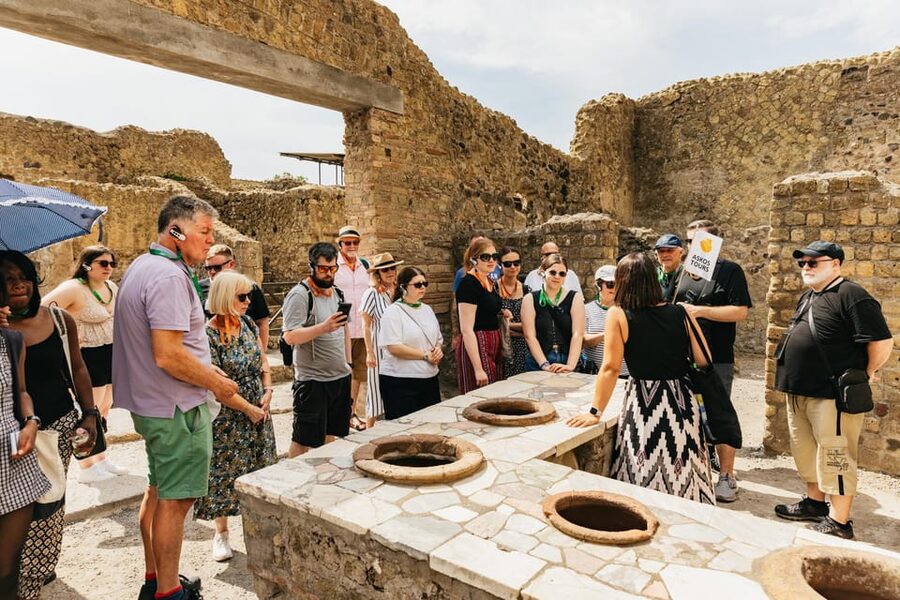
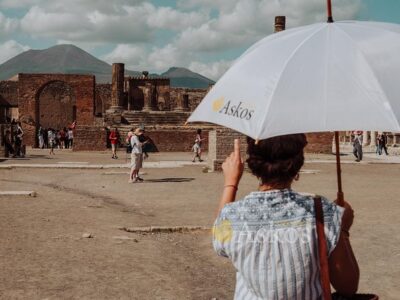
You meet at the ticket office of the Herculaneum ruins on Via dei Papiri Ercolanesi. Look for the guide holding an Askos Tours sign. This sounds simple, but check your meeting instructions carefully because one booking map has been reported to place the meeting point roughly 300 meters away from the actual ticket booth.
Transportation is not included. You need to arrange your own way to the site, even though the activity is promoted as a tour from Naples. Build in time to find the entrance and ticket office, especially if you are connecting from another part of Campania.
The guide provides a headset. That matters here. Herculaneum’s streets are uneven, the group moves between rooms, and it is easy to lose the guide’s voice when you stop to look at a mosaic. Headsets are useful, though one practical limitation has been reported: if the guide walks ahead quickly, the audio can become faint at the back of the group.
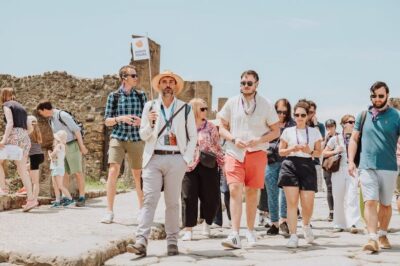
The usual group size appears to be around 15 to 20 people, although it can vary. A group of that size is manageable, but you will get more from the tour if you stay near the guide and speak up when you have a question.
The waterfront and the violent end of the town
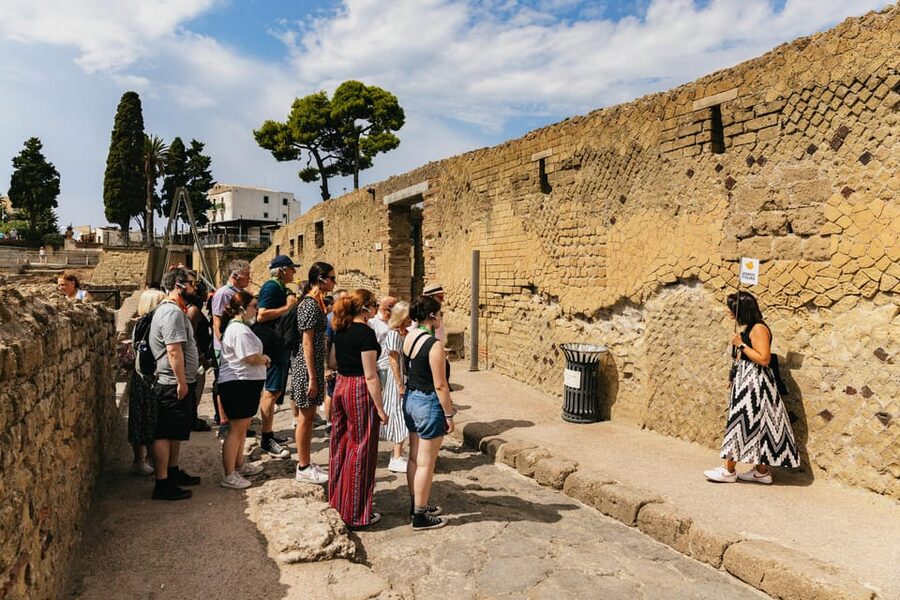
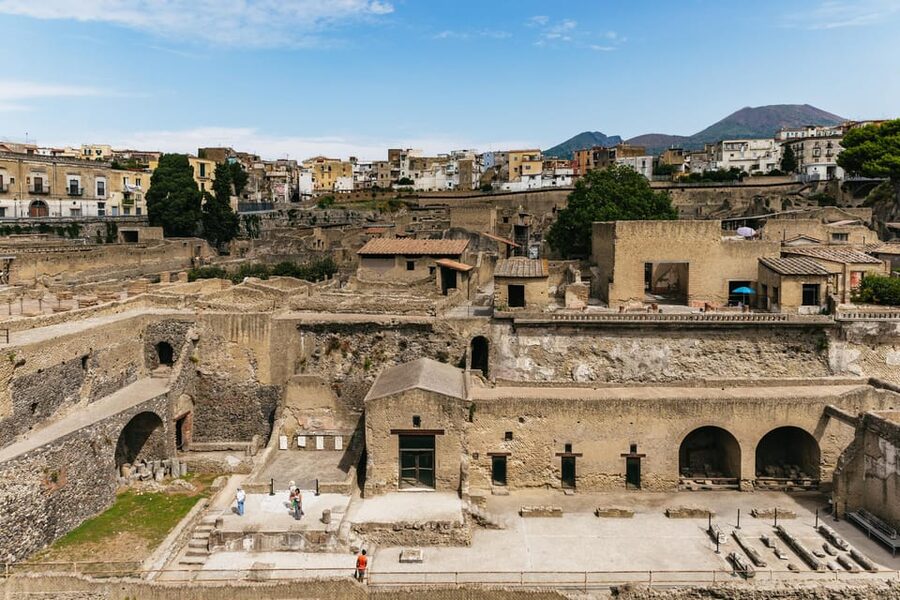
The route may take you toward the old waterfront, one of the most moving areas in Herculaneum. The remains of more than 300 people were found here, among those who tried to escape toward the sea.
This is not a quick photo stop. The waterfront gives the eruption a human scale. Elsewhere, you see houses and decorative walls. Here, you confront the people who were caught at the edge of town. A good guide can explain what happened without turning the site into a spectacle.
The setting also helps you understand Herculaneum’s role as a port town. Its connection to the sea supported merchants, visitors, and local trade. That commercial life sits beside evidence of wealth, private homes, public bathing, and religious activity.
The waterfront area can be especially difficult for anyone with limited mobility. The site is not suitable for wheelchair users or people with mobility impairments, and the ruins require walking over uneven surfaces.
Casa dei Cervi and the homes of the wealthy
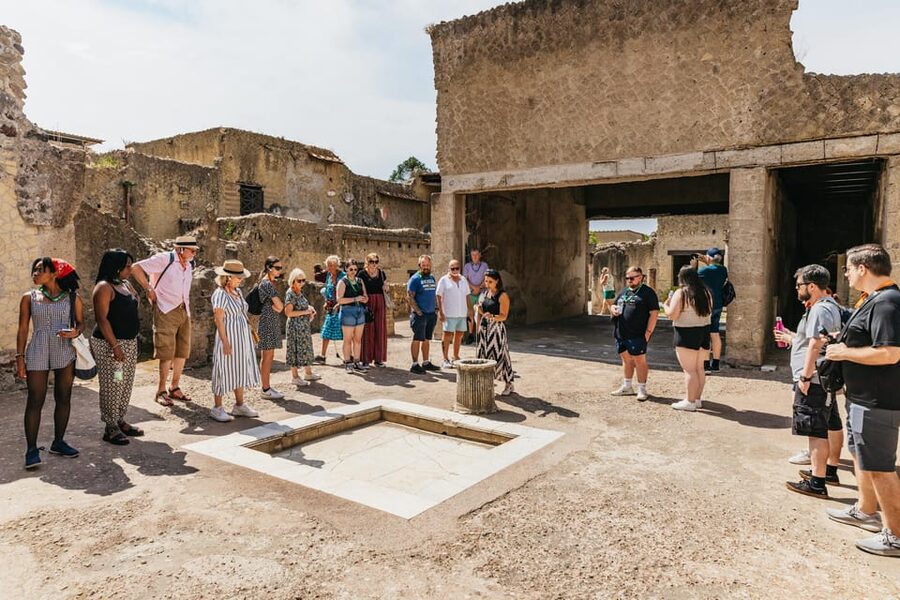
Casa dei Cervi, or the House of the Deer, is one of the major private residences included in the route. Its name comes from decorative deer sculptures, and the property helps show the lifestyle of Herculaneum’s upper class.
This is where the guide’s archaeological training earns its keep. Instead of simply pointing out an attractive room, the guide can connect the layout, decoration, and building materials to the owner’s wealth and social position. The stone and marble details are not random decoration. They tell you how the house was meant to impress.
The home also gives you a useful contrast with more modest residences. Herculaneum is not only a collection of grand villas. Its streets once held people with different incomes and jobs, and the tour uses the surviving buildings to explain that social mix.
You may want to return here after the guided portion ends. Two hours moves at a steady pace, so you will not always have time to study every wall or photograph each room.
More Guided Tours in Pompeii
- Pompeii: Entry Ticket and Guided Tour with an Archaeologist
★ 4.8 · 19,459 reviews - Pompeii: Guided Walking Tour with Entrance Ticket
★ 4.3 · 1,423 reviews - Rome to Pompeii Guided Tour with Wine & Lunch by High Speed Train
★ 5.0 · 1,379 reviews - From Naples: Pompeii Guided Tour with Skip-the-Line Tickets
★ 4.8 · 1,171 reviews
The House of Neptune and Amphitrite
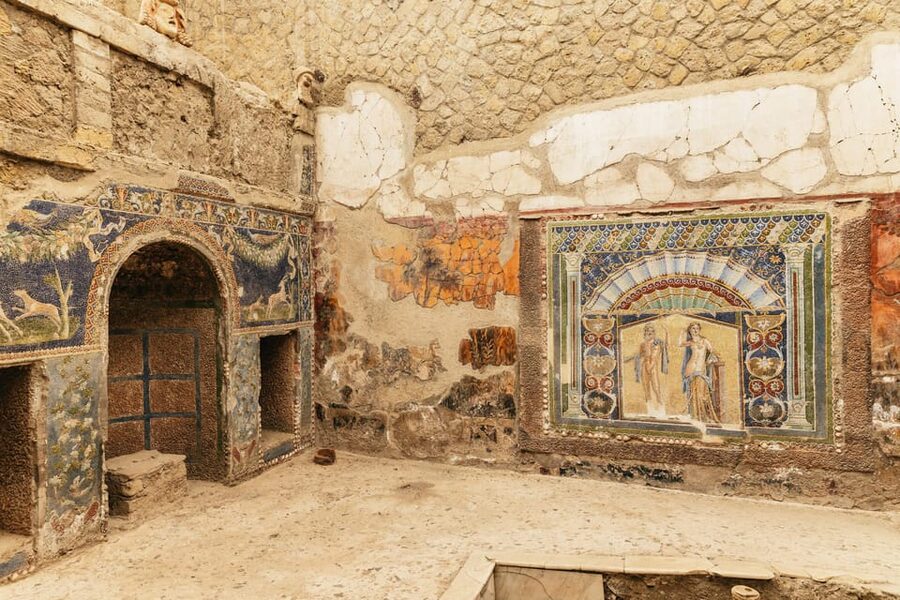
The Casa di Nettuno ed Anfitrite is one of the most memorable stops. Its mosaic decoration, including the famous image of Neptune and Amphitrite, shows how much color and craft survived the eruption.
I find this house useful because it makes Roman interior design feel less abstract. You are not looking at isolated pieces in a museum case. You are seeing mosaics and painted surfaces where they formed part of a home’s rooms and atmosphere.
The preserved decoration also supports the guide’s larger explanation of daily life. Wealthy residents used mosaics, marble, and painted walls to signal taste and status. A guide can point out how rooms were arranged and why certain spaces were designed to impress guests.
The House of Neptune and Amphitrite can become crowded around its best-known details. Stay close enough to hear the headset, then step aside when the guide finishes so you can take a quieter look.
The House of Skeletons and Casa dell’Albergo
The House of Skeletons carries a darker name and adds another layer to the story of the eruption. It is part of the route because Herculaneum’s remains are not limited to pretty mosaics and grand rooms. The site preserves evidence of death, sudden destruction, and the force of the volcanic event.
Casa dell’Albergo, despite its modern-sounding name, is another important building on the walk. Together, these stops show the range of structures found in the ancient town. The point is not simply to collect house names. It is to see how homes, commercial spaces, and public buildings fitted together.
A guide can help you read details that are easy to miss on your own. You might notice a doorway, a fragment of wall decoration, or a change in floor level without knowing what it means. The tour gives those remains context and helps you connect one building to the next.
Casa del Salone Nero and the Temple of the Augustales
Casa del Salone Nero, or the House of the Black Room, is another private residence where decoration takes center stage. The name refers to its dark-colored room, and the building offers another look at how Roman homeowners used painted interiors.
The Temple of the Augustales is different in purpose and mood. It was linked to the Augustales, a group connected with the imperial cult and civic life. The building helps explain how religion, public identity, and loyalty to Rome appeared in the town’s architecture.
These stops are especially useful if you want more than a disaster story. Herculaneum was a functioning community before the eruption. People worshipped, traded, entertained themselves, and invested in attractive homes. The guide’s job is to keep that ordinary life in view while explaining the town’s sudden end.
Several guides have used books, photographs, and before-and-after images to show how the site looked before the eruption and how excavation changed it. Those visual aids can be helpful because ruins often require imagination. You are asked to picture roofs, furniture, plaster, people, and color where only foundations may remain.
The Samnite House, baths, Forum, and Gymnasium
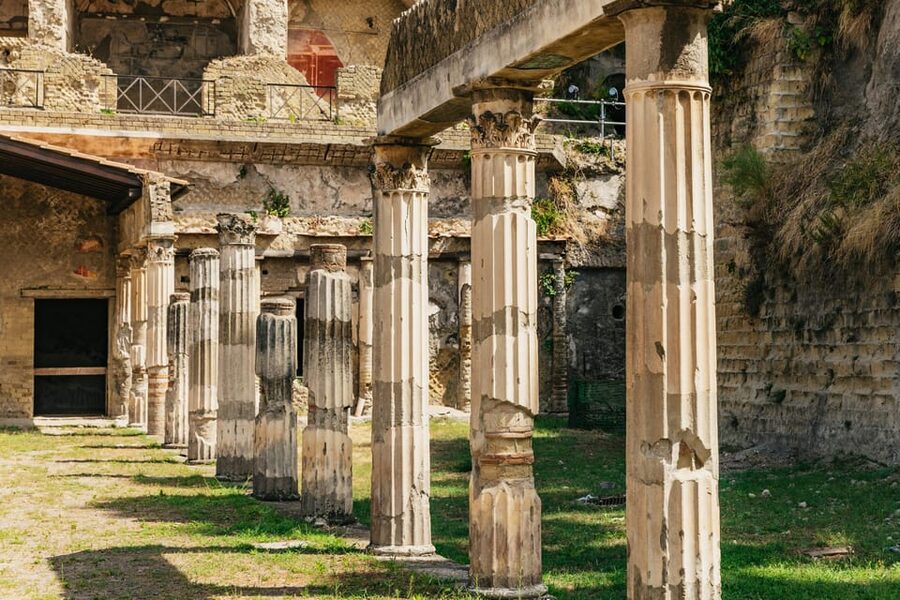
The Samnite House provides an earlier architectural layer and helps show that Herculaneum changed over time. The thermal baths reveal the public side of Roman life, where bathing was about social routine as well as cleanliness.
The Forum was the civic heart of the town. It is a useful place to pause and picture public business, religious events, and local administration. Herculaneum’s Forum is not as vast as Pompeii’s, but its importance becomes clearer with explanation.
The Gymnasium adds another major public building to the route. One guide has taken the group into a tunnel at the center of the Gymnasium, where a swimming pool would have been. Access can depend on site conditions and the guide’s route, so treat this as a possible highlight rather than a guaranteed feature.
Taken together, these buildings give you a well-rounded visit. You see private luxury, public bathing, civic life, religious practice, and the remains of people who tried to flee. That balance is one reason the tour works better than simply wandering from one attractive house to another.
What the two-hour pace is really like
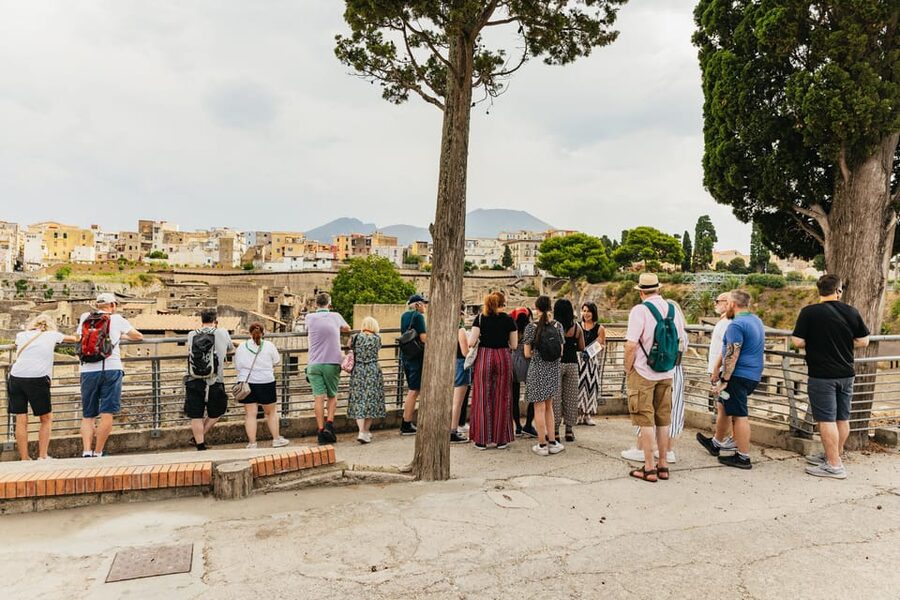
Two hours is a sensible introduction, but it is not a leisurely study visit. The guide has to cover many buildings and explain the eruption, excavation, social structure, and Roman daily life in a short time.
Several guides, especially Luciano Leone, have been praised for packing a large amount of material into the visit while keeping the tone lively. Luciano is known for using humor, comparisons, books, and photographs. Diego has been praised for enthusiasm and for making the site easy to follow in English. Teresa has been singled out for explaining the ruins clearly to families, including children. Angelo has used current images and overlays to show what the town looked like before it was buried.
Guide quality can vary by departure, but the archaeologist format is the important point. You are not just receiving a list of dates and names. You are getting explanations of what the buildings reveal and how archaeologists interpret the remains.
The pace may be demanding for children. An eight-year-old has enjoyed the tour with a strong guide, while an older child who had already visited Pompeii became bored. If you are traveling with children, an early visit may help while everyone has more energy.
Is $53 good value?
The price is $53 per person. Adult admission to Herculaneum is listed at 16 euros, with a 2 euro rate for EU citizens aged 18 to 25. That means the tour costs much more than a basic entry ticket, but the comparison is not quite like for like.
You are paying for an archaeologist guide, skip-the-line access, a headset, and a planned route through a site that can be confusing without context. If you would otherwise buy a guidebook or spend time trying to identify the most important buildings, the added cost can be reasonable.
Admission appears to cover the full day, so you can continue exploring after the two-hour walk. This is a major value point. Book a morning slot if you want time to revisit favorite houses, see areas covered quickly, or visit the site at your own pace afterward.
The value is weaker if you already have strong archaeological knowledge or prefer to read signs independently. It is also less appealing if your schedule allows only a very short visit and you cannot use the extra admission time.
Sun, rain, shoes, and bags
Herculaneum is exposed, and there is limited shelter from strong sun. Bring sunscreen and a hat. The site operates in rain as well as fair weather, so carry a raincoat when the forecast looks uncertain.
Wear closed-toe shoes. Open sandals may be uncomfortable on uneven ancient paving and rough surfaces. Large bags and luggage are not allowed, so arrive with only what you need for the visit.
Bring a valid passport or ID card. Children must be accompanied by an adult, and unaccompanied minors are not accepted. The tour is not suitable for wheelchair users or people with mobility impairments.
The activity offers free cancellation up to 24 hours before the start time, and you can reserve now and pay later. Those options help if your Campania schedule is still shifting.
Who should book this Herculaneum tour?
I would book this tour if you want the site to make sense rather than simply see it. It suits first-time visitors, history fans, families with an engaged older child, and anyone comparing Herculaneum with Pompeii.
I would also choose it if you value a strong storyteller. Guides such as Luciano, Diego, Teresa, and Angelo have shown that an archaeologist can explain technical material in plain language, with humor and visual examples.
I would hesitate if you dislike group tours, need a slow pace, or have mobility problems. You should also consider a self-guided visit if you already know the site well and want to spend most of your time photographing or studying individual rooms.
Should you book it?
For most first-time visitors, yes. Herculaneum rewards careful interpretation, and this two-hour route covers the houses, public buildings, waterfront, and eruption story that give the site its power.
Book a morning departure if you want to stay afterward, and arrive at the ticket office rather than relying blindly on a map pin. Wear sturdy shoes, keep your bag small, and stay near the guide so you do not lose the headset audio.
If Pompeii is on your itinerary, do both. Pompeii gives you scale. Herculaneum gives you preserved rooms, household detail, and a more focused look at Roman life.
FAQ
How long does the Herculaneum guided tour last?
The guided portion lasts two hours. Admission is included, and you may continue exploring the site afterward.
What is included in the price?
The price includes guided entry to Herculaneum, admission fees, an archaeologist guide, and headsets.
Does the tour include transportation from Naples?
No. Transportation is not included. You must make your own way to the Herculaneum ticket office.
Where is the meeting point?
Meet at the ticket office of the Herculaneum ruins on Via dei Papiri Ercolanesi. The guide will hold an Askos Tours sign.
Which languages are available?
Live guides are available in English, Italian, German, Spanish, and French.
What should I bring?
Bring a valid passport or ID card, comfortable closed-toe shoes, sunscreen, and a hat. A raincoat is useful because the tour runs in wet weather too.
Can I bring luggage or a large bag?
No. Luggage and large bags are not allowed at the site.
Is the tour suitable for wheelchair users?
No. The activity is not suitable for wheelchair users or people with mobility impairments. Children must also be accompanied by an adult.
More Skip-the-Line Tickets in Pompeii
- Mount Vesuvius: Skip-the-Line Ticket and Smart Digital Guide
★ 4.2 · 2,780 reviews - From Naples: Pompeii Skip-the-Line Entry Ticket and Tour
★ 4.4 · 2,753 reviews - Pompeii: Skip-the-Line Entrance Ticket with Audio Guide
★ 4.0 · 2,509 reviews - Sorrento: Skip-the-Line Pompeii Express Tour by Train
★ 4.8 · 2,038 reviews
Just added around Pompeii
- Vesuvius National Park Skip-the-Line Ticket★ 3.8 · 221 reviews
- From Rome: Sorrento & Pompeii Day Tour with Hotel Pickup★ 4.2 · 257 reviews
- From Rome: Day Trip to Pompeii with Tickets★ 4.4 · 1,161 reviews
- Pompeii Ruins Private Tour with Optional Skip-the-Line Entry★ 4.9 · 732 reviews
- From Rome: Pompeii All-Inclusive Tour with Live Guide★ 4.3 · 261 reviews
- Pompeii: Exclusive Tour with Archaeologist and Entry Tickets★ 4.9 · 634 reviews
- Pompeii 3hours Villa of Mysteries tour with an Archaeologist★ 4.8 · 486 reviews
- Pompeii and Vesuvius Full-Day Tour from Amalfi Coast★ 4.4 · 319 reviews
Pompeii Tours, compared.
Entry Ticket and Guided Tour with an Archaeologist
Read our review →
From Naples: Pompeii Ruins & Mount Vesuvius Day Tour
Read our review →
From Rome: Pompeii, Amalfi Coast, and Sorrento Day Trip
Read our review →
From Rome: Pompeii, Amalfi Coast and Positano Day Trip
Read our review →Pompeii Small Group Tour with an Archaeologist
Read our review →
Pompeii, Amalfi Coast and Positano Day Trip from Rome
Read our review →Browse the lists this tour appears in