
Reviewed · POMPEII TOURS
Pompeii: Small Group Tour with an Archaeologist
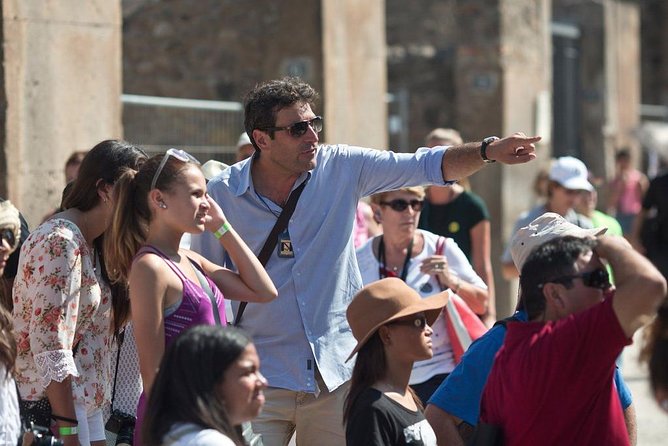
Pompeii makes far more sense with an archaeologist beside you. The ruins are huge, the streets can look repetitive, and a trained guide helps you spot small clues such as cart tracks, handprints on fountains, shop entrances, household details, and painted signs. The Forum, theaters, houses, and brothel become parts of a real Roman town rather than a spread of old stones.
I like the choice between a two-hour shared tour and a private visit, and I like that your ticket lets you remain inside afterward. Guides including Roxanne, Nicoletta, Mario, Paolo, Teresa, and Alessandra have been praised for clear storytelling, humor, and useful advice about what to see next. The main drawback is simple: two hours can feel short in a site that may take half an hour to cross from one side to the other.
Key points to know before booking
- An archaeologist leads the walk: Expect context about daily life, art, buildings, burial practices, and the eruption rather than a simple list of dates.
- The three-hour option adds the Villa of the Mysteries: Its famous frescoes make the extra hour worthwhile for many people.
- You can keep exploring after the guide leaves: This is one of the tour’s best features, especially if you start early.
- The route covers Pompeii’s major landmarks: You’ll see the Forum, temples, Basilica, baths, houses, theaters, and Lupanar.
- The ground is uneven: Steps, ramps, slopes, and ancient paving make this a poor fit for wheelchair users or people with serious mobility limits.
- The price is reasonable at $40 per person: Entry, guiding, and the freedom to continue alone make it a useful introduction to a very large site.
Why an archaeologist helps at Pompeii
Pompeii is not a compact monument where you can understand everything from one viewpoint. It is a full ancient city, with streets, homes, shops, public buildings, temples, theaters, baths, bakeries, and drainage systems spread across a broad archaeological park.
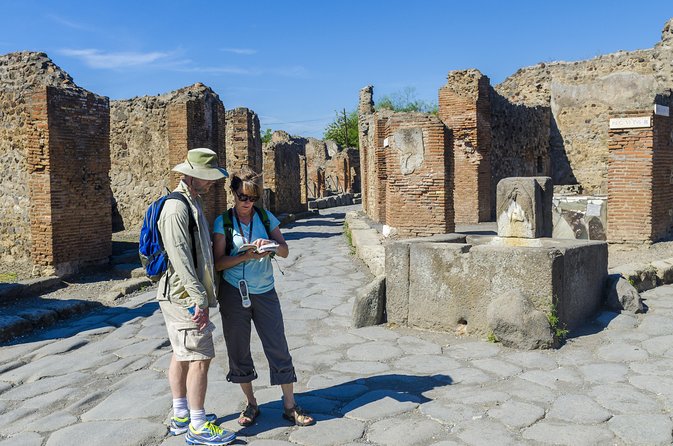
You can wander without a guide, but you will miss plenty. A trained archaeologist can point out how to tell a commercial doorway from a private entrance, explain how the Forum worked, and show you details that would otherwise blend into the walls. One guide highlighted handprints on fountains and wheel marks left by carts. Those small signs help you picture people using the city instead of treating it as a silent ruin.
The guides also bring different strengths. Roxanne and Nicoletta are praised for warmth, humor, and lively explanations. Paolo and Mario are known for enthusiasm and strong command of the site. Teresa has worked on excavations, while one guide, Alessandra, has a specialty in burial items. Your guide will vary, but the central advantage remains the same: you get an informed introduction from someone who works with the subject rather than a generic audio recording.
A few more Pompei Campania half-days worth a look
- Pompeii: Entry Ticket and Guided Tour with an Archaeologist
★ 4.8 · 19,459 reviews - Pompeii: Skip-the-Line Entrance Ticket with Audio Guide
★ 4.0 · 2,509 reviews - Naples: Pompeii and Mt. Vesuvius with Lunch and Wine Tasting
★ 4.5 · 2,454 reviews
Entering through Porta Marina Superiore
The walk generally begins at Porta Marina Superiore, one of Pompeii’s ancient gates. The exact meeting point can change with the booking option, and the listed meeting locations include several spots along Via Villa dei Misteri, Via Roma, and near Hortus Pompei. Check your confirmation carefully before setting out.
The gate gives you an immediate sense of Pompeii’s scale. You are not entering a single building. You are entering the edge of a city that once served homes, businesses, public squares, religious sites, and entertainment venues.
The opening section is useful for getting your bearings. Expect a short introduction to the eruption of Mount Vesuvius in AD 79 and to the way volcanic material preserved parts of the city. The guide may also explain what you are seeing in terms of excavation and conservation, since not every wall or object is preserved in the same condition.
Bring identification, or a copy. Large bags and luggage are not allowed, although a free cloakroom near Porta Marina Superiore may be available. It is offered subject to availability, so do not treat it as a substitute for arriving with a light day bag.
The Forum, temples, and civic Pompeii

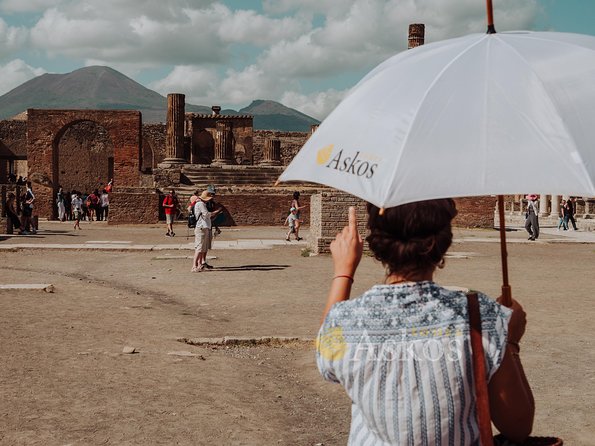
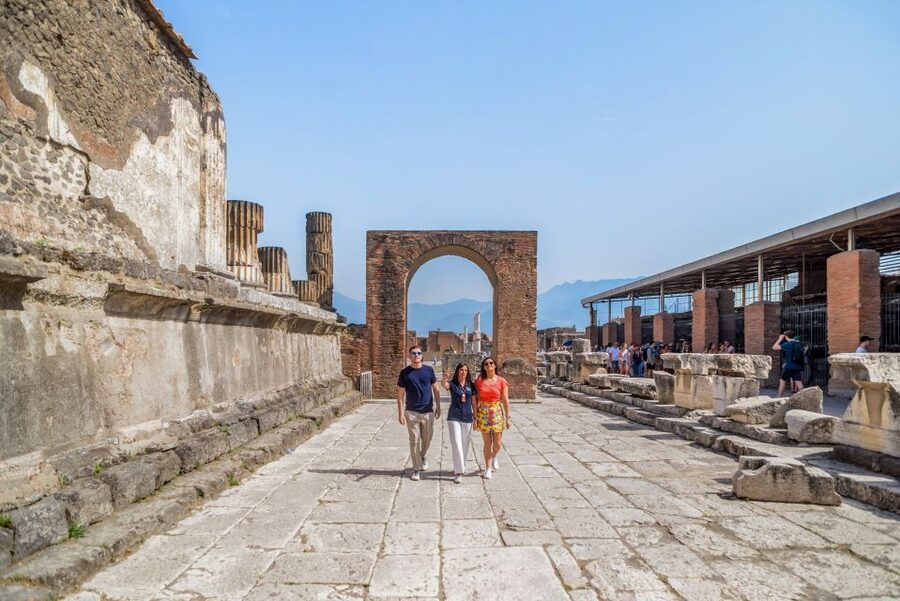
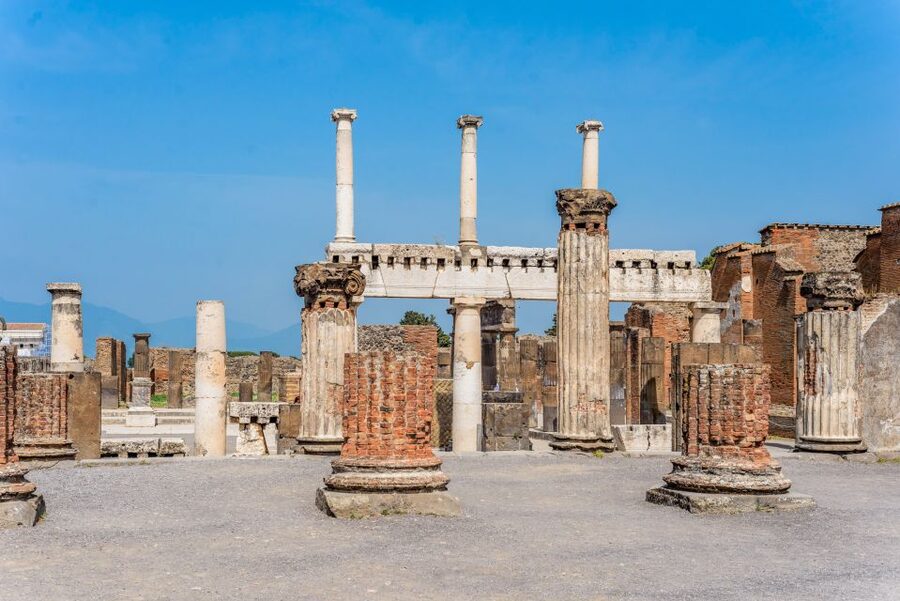
The Forum was the heart of public life. It is one of the most important stops because it gives you the broad civic picture before you move into private homes and smaller streets.
From here, you can look toward Mount Vesuvius, the force that shaped Pompeii’s fate. The open square also makes it easier to understand the relationship between religion, business, law, and public ceremony in Roman society.
The route includes the Temple of Apollo and the Temple of Jupiter. These stops help explain the religious side of the city, but they are also good places to listen to your guide’s comments about layout and power. The Temple of Jupiter anchors one end of the Forum, while the Temple of Apollo offers a different view of Pompeii’s religious life.
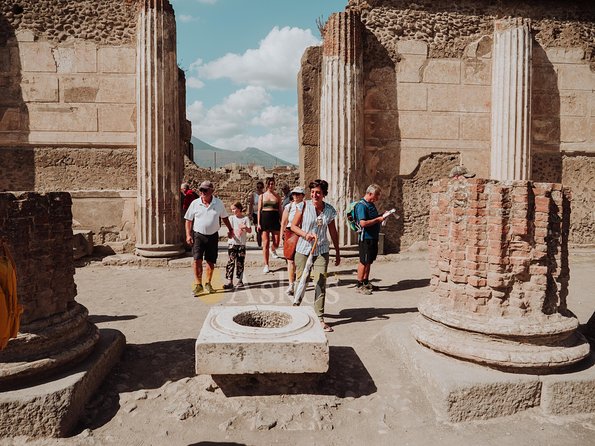
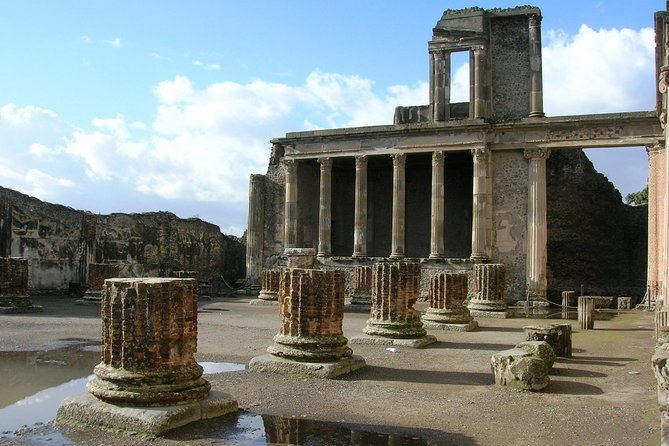
The Basilica was the city’s business and legal center. It is easy to walk past the remains without knowing what happened there, so this is exactly the kind of stop that benefits from guided interpretation. Rather than seeing only columns and walls, you can begin to picture legal disputes, commercial dealings, and the public business of Roman citizens.
The route can change slightly because of crowding or temporary closures. That is not necessarily a bad thing. Several guides have been praised for adjusting their path to avoid packed areas and spending time in quieter corners.
Homes, baths, and the details of daily life
Pompeii becomes especially absorbing when the tour moves from public monuments into homes. The House of Menander, House of the Faun, and House of the Vettii show different sides of domestic life, wealth, decoration, and status.
The House of the Faun is one of Pompeii’s best-known residences. Its size gives you a sense of how wealthy families lived, while its layout shows how homes were organized around courtyards and rooms intended for different uses.
The House of the Vettii is especially rewarding for its decoration. Preserved frescoes and mosaics show that Roman interiors could be highly polished and theatrical. Your guide can help you look at the artwork as part of a home, not just as isolated museum pieces.
The Forum Baths provide another angle on ordinary life. Roman baths were not simply places to wash. They were social spaces, and their design reflects the engineering and routines of the city. The route also includes a bakery, where the remains connect the grand public world of Pompeii to the practical work of feeding its residents.
This is where the archaeologist’s eye matters most. A guide may point out thresholds, wall paintings, water features, street fountains, or the signs of commercial activity. You might walk past these details alone without realizing what they reveal.
Same city, a completely different sort of day:
- Pompeii: Skip-the-line-Ticket and Guided Tour
★ 4.6 · 1,152 reviews - Pompeii: Small-Group Tour of Pompeii and Herculaneum
★ 4.8 · 867 reviews - Pompeii: Guided Tour with Skip-the-Line Entry
★ 4.9 · 812 reviews - Pompeii: Skip-the-Line Entry Ticket with Digital Guide App
★ 4.1 · 770 reviews
The Lupanar and Pompeii’s adult side
The Lupanar is one of Pompeii’s most famous stops. Its name is linked to the Latin word for she-wolf, and the building is associated with prostitution. Inside, you can see preserved stone beds and erotic frescoes.
This part of the tour includes adult themes. The guide handles the subject as part of Pompeii’s social history, but parents should know what to expect. One family found that a ten-year-old largely missed the context, yet the material is still not aimed at very young children.
The Lupanar is valuable because it shows a less polished side of Roman life. Pompeii was not only temples, villas, and formal public squares. Its walls and buildings also reflect trade, sex, food, entertainment, household labor, and the everyday concerns of people living in a working city.
The theaters and the best visual moments
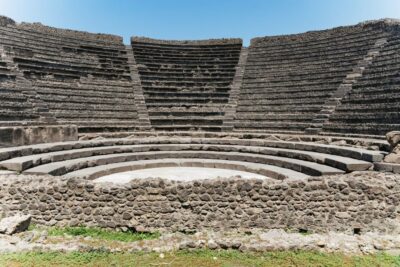
The Large Theatre is a major highlight. Walking into the theater gives many people a clear wow moment, because the shape is easy to read and the building feels more complete than some of the surrounding ruins.
The Great Theatre also helps you picture how entertainment fitted into public life. Your guide may connect the building’s structure to the people who gathered there, giving the stones a human purpose.
The route includes preserved frescoes, mosaics, and other artwork. Conditions vary, and access can change, but seeing these surfaces in their original setting is one of the strongest reasons to visit Pompeii rather than view Roman art only in a museum.
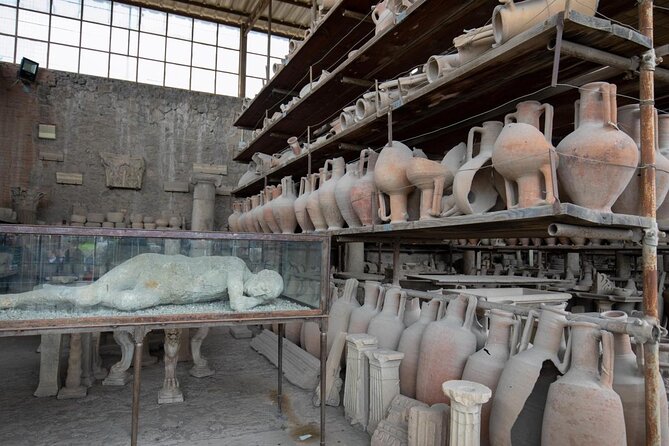
Plaster casts of eruption victims are another emotionally difficult part of the site. The current display arrangement can change. Recent information indicates that three casts are shown in sealed glass cases rather than being placed inside the dwellings, so do not expect to find casts in every house mentioned in older guidebooks.
The Villa of the Mysteries and the three-hour choice
The three-hour option adds the Villa of the Mysteries. It is located toward the edge of the archaeological area, so the extra time is not simply another hour in the same central streets.
The villa is known for its remarkable frescoes. A guide can help you read the painted scenes and explain why the room is so important. One three-hour tour guide, Mario, was especially praised for explaining the frescoes with care and enthusiasm, and the added visit was a favorite part of that longer route.
I would choose three hours if you want a fuller introduction and have enough time for Pompeii afterward. The Villa of the Mysteries is one of the places most likely to justify paying for the longer version.
Choose two hours if you want a brisk orientation and prefer to explore independently. A two-hour introduction can cover major highlights without exhausting you, and you can then choose your own priorities. The tradeoff is that you will not see as much with the archaeologist, and Pompeii is large enough that the remaining area may still feel unfinished.
How long to stay after the tour
The included ticket gives you freedom to continue inside the archaeological site. This changes the value of the tour at $40. You are not paying for only two or three hours of access. You are paying for a guided introduction, entry, and a useful starting plan for the rest of your visit.
Several guides give suggestions before you leave. That advice matters because it can save you from wandering aimlessly through a very large site. Ask which nearby houses, streets, or public buildings are open and where to go next.
Timing is important. If you take a 2 p.m. tour and the park closes at 5 p.m., you may have only about an hour afterward, and some areas may already be closing. An earlier tour gives you more flexibility. A morning start also gives you a better chance to continue at your own pace while there is still plenty of daylight and access.
Do not assume you can see all of Pompeii in one day. The site is large, and walking from one side to the other can take about half an hour. Wear supportive shoes, carry water, and expect uneven ancient paving, steps, ramps, inclines, and declines. Smoking is not allowed, and dogs over 10 kilograms cannot enter.
Group, private, and language choices
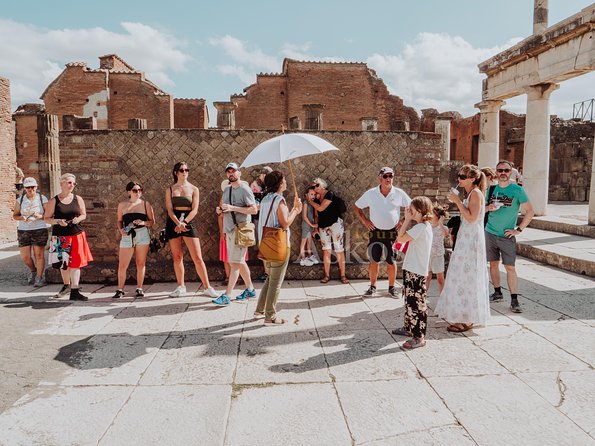
The shared tour is the better value for most visitors, particularly solo travelers and couples who want expert context without paying for a guide alone. A private group costs more in principle, but it gives your party greater control over questions and pace.
Language options include English, Italian, French, Spanish, German, and Portuguese. Shared and private departures do not always offer the same languages, so check the specific option before booking. Do not assume that selecting a language on one departure guarantees it on another.
Headsets are available for groups of 16 or more. In a busy archaeological park, this can help you hear the guide while standing a few steps away. One person found the earpieces less easy to use than expected, so keep the volume comfortable and tell the guide if you are having trouble following.
The group size is described as small, but the exact number is not provided. If personal attention is your top concern, the private option is the safer choice.
Is $40 a fair price?
At $40 per person, this is a sensible buy if you want structure and context. The entry ticket is included, as is a two-hour or three-hour archaeological tour, and you can stay inside afterward. For a first visit, that combination is stronger value than entering alone and spending your first hour trying to understand the map.
The price is less compelling if you already have strong knowledge of Roman archaeology or want to wander without a fixed route. You may prefer to use the ticket independently and spend your time in less predictable fashion.
The real value depends on your guide. The strongest guides, including Roxanne, Nicoletta, Paolo, Mario, Teresa, and Alessandra, bring humor, passion, and specific detail. A guide’s accent or speaking style may occasionally make some explanations harder to follow, so ask questions when needed.
Cancellation is flexible up to 24 hours before the start for a full refund, and you can reserve now while paying later. Those terms are useful when your Campania plans depend on trains, weather, or changing day trips.
Who should book this Pompeii tour?
I recommend it for first-time visitors, families with older children, history fans, and anyone who wants help reading the site. It also suits people on a tight schedule who want to see the key areas before continuing to Sorrento, Naples, or another Campania destination.
It is less suitable for wheelchair users and people with major mobility limits. The site has uneven ground, steps, ramps, and a slight steep climb, and the tour involves steady walking. A child must be accompanied by an adult.
The tour works well for families, though the Lupanar includes adult material. Teenagers who enjoy stories and visual details should have plenty to hold their attention, especially in the theaters and decorated houses.
Should you book it?
Book this tour if you want Pompeii explained by a trained archaeologist, not simply photographed. The strongest reason to choose it is the guide’s ability to connect small details, such as shop entrances, fountains, cart tracks, frescoes, and household layouts, to daily life nearly two thousand years ago.
Choose the three-hour version if the Villa of the Mysteries matters to you or if you want a fuller guided visit. Choose two hours if you plan to explore independently afterward, but start early enough to leave room for the park’s closing time.
At $40, the tour offers good value for a first visit. Just arrive at the correct meeting point, travel light, wear proper shoes, and remember that Pompeii is much larger than its most famous postcard views.
FAQ
How long does the Pompeii tour last?
You can choose a two-hour guided tour or a three-hour option. The three-hour version includes a visit to the Villa of the Mysteries.
Is Pompeii entry included?
Yes. The Pompeii Express entry ticket is included with the tour.
Can I explore Pompeii after the guided tour?
Yes. You are free to remain inside the archaeological site and continue exploring on your own after the tour.
Which languages are available?
The tour may be offered in English, Italian, French, Spanish, German, or Portuguese. Language choices vary between shared and private options, so check the selected departure.
Is a private tour available?
Yes. You can choose a private group option, although the available languages may differ from those offered for shared groups.
What should I bring?
Bring a passport or identification card. A copy is accepted. Wear comfortable shoes, since the site has uneven ground, ramps, steps, and inclines.
Is the tour suitable for wheelchair users?
No. The tour is not recommended for wheelchair users or people with mobility impairments because of the uneven terrain, steps, ramps, and slight steep climb.
Just added around Pompei Campania
- Pompeii 3hours Villa of Mysteries tour with an Archaeologist★ 4.8 · 486 reviews
- Pompeii: Small-Group Tour of Pompeii and Herculaneum★ 4.8 · 867 reviews
- Pompeii: Skip-the-line-Ticket and Guided Tour★ 4.6 · 1,152 reviews
- Pompeii: Skip-the-Line Entry & Audioguide★ 3.8 · 225 reviews
- Pompeii: Guided Tour with Skip-the-Line Entry★ 4.9 · 812 reviews
- Pompeii: Tour with Archaeologist Guide & Skip-the-Line Entry★ 4.5 · 478 reviews
- Pompeii: Afternoon to Sunset Guided Tour with Ticket★ 4.9 · 484 reviews
- Pompeii: Skip-the-Line Entry Ticket with Digital Guide App★ 4.1 · 770 reviews
Pompeii Tours, compared.

Entry Ticket and Guided Tour with an Archaeologist
Read our review →
From Naples: Pompeii Ruins & Mount Vesuvius Day Tour
Read our review →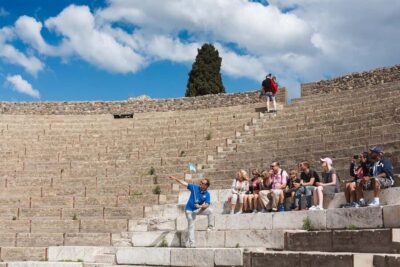
From Rome: Pompeii, Amalfi Coast, and Sorrento Day Trip
Read our review →
From Rome: Pompeii, Amalfi Coast and Positano Day Trip
Read our review →
Pompeii Small Group Tour with an Archaeologist
Read our review →
Pompeii, Amalfi Coast and Positano Day Trip from Rome
Read our review →
Pompeii and Mount Vesuvius Day Trip from Rome with Pizza Lunch
Read our review →Browse the lists this tour appears in