
Reviewed · POMPEII TOURS
Pompeii and Mount Vesuvius excursion from Naples
Mount Vesuvius and Pompeii make a natural pair: one shows the volcano that shaped the region, the other preserves the Roman city it buried. This seven-hour excursion takes you from Naples to the crater first, then through Pompeii’s streets, homes, temples, theaters, and food shops with a live guide.
I like the small group size of up to 16 and the way transport, site tickets, and timing are handled for you. I also like the Pompeii guiding, which has included archaeologists such as Nicoletta and Antonieta, plus engaging guides such as Julia and Ilaria. The main trade-off is time: Pompeii is enormous, and two hours gives you the highlights rather than a full visit.
Key points at a glance
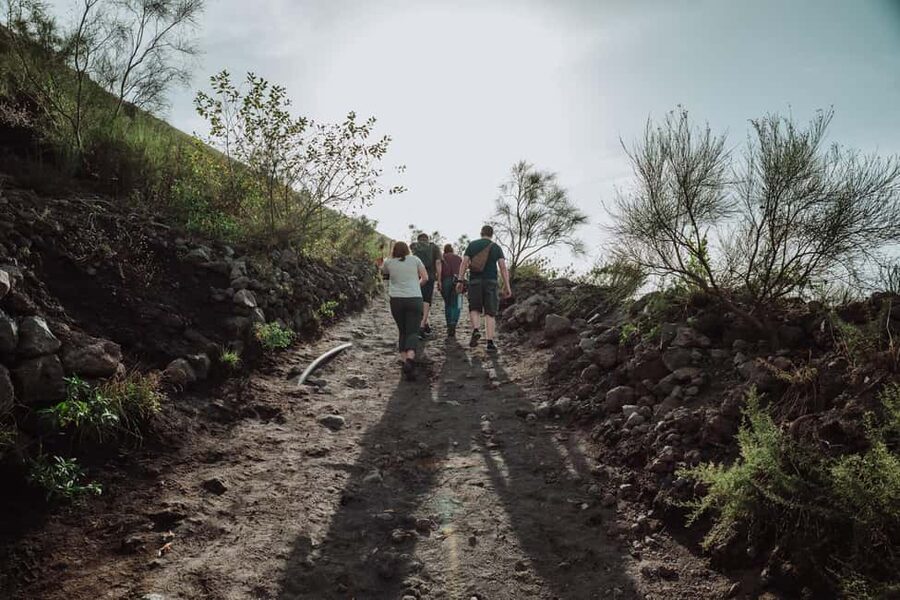
- Start with Mount Vesuvius: Walk to the crater and use an audioguide while your tour leader helps with timing and directions.
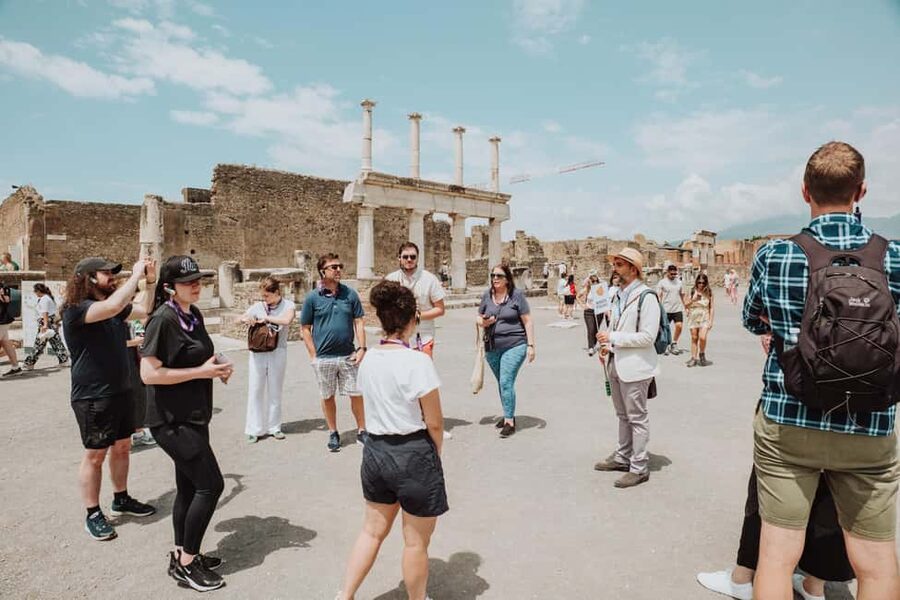
- See Pompeii with a live guide: The two-hour walk covers major buildings and gives Roman daily life useful context.
- Travel from Naples by minibus: Meet outside Starhotels Terminus, opposite Naples Central Station.
- Expect a compact day: You get about seven hours in all, with transport between Naples, Vesuvius, and Pompeii.
- Lunch may be practical rather than atmospheric: Some departures stop at a modern shopping center, while other arrangements have included a local restaurant.
- Pack for uneven walking: Closed-toe shoes, comfortable clothes, and a warm layer for the windy summit are sensible.
Why combine Pompeii with Mount Vesuvius?
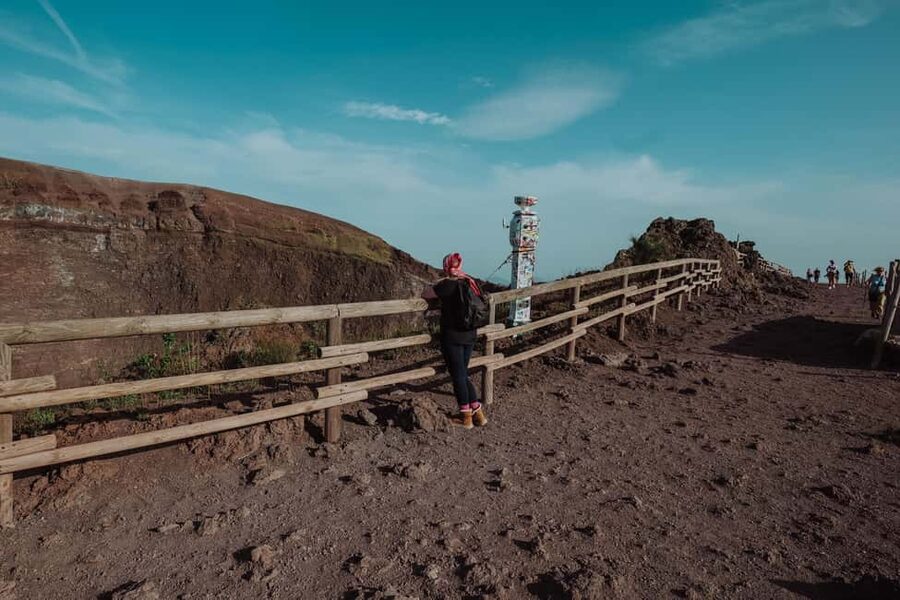
You can visit Pompeii and Vesuvius separately, but putting them together gives the day a clear story. First, you climb the volcano. Then you walk through the city destroyed by its eruption. The pairing turns two major sights into one connected experience rather than two unrelated stops.
The morning drive from Starhotels Terminus takes about 20 minutes to reach Vesuvius, depending on traffic and road conditions. After the mountain, you ride for roughly another 20 minutes to Pompeii. The return trip to Naples takes about 30 minutes.
That transport matters in Campania. The roads around Vesuvius are steep and winding, and the excursion removes the need to coordinate trains, buses, entrance times, and local connections. You can simply follow the day’s schedule while the tour leader keeps the group together.
The group is limited to 16 people, which is small enough for instructions to be clear without feeling like a large coach tour. The exact vehicle can vary, so do not assume every minibus has room for suitcases. If you are leaving Naples with luggage, store it at the station or another luggage facility before you go.
A few more Pompeii half-days worth a look
- Pompeii: Entry Ticket and Guided Tour with an Archaeologist
★ 4.8 · 19,459 reviews - Pompeii: Entry Ticket with Optional Audio Guide
★ 4.2 · 12,360 reviews - Pompeii: Small Group Tour with an Archaeologist
★ 4.8 · 12,264 reviews
Meeting outside Starhotels Terminus
The meeting point is outside Starhotels Terminus, directly opposite Naples Central Station. Look for the tour leader holding an ASKOS TOURS sign. This is a useful location if you are staying near the station or arriving by train, though Naples station is busy, so give yourself time to get to the correct side of the road.
The tour is in English. A tour leader handles the practical side of the day, including meeting times, transport, and transitions. The guides used at Pompeii may vary, but past departures have included Davide, Mario, Vincentto, Diego, and other staff who helped groups stay on schedule.
The organization is one of the strongest reasons to choose this trip. You are not left to figure out which entrance to use or where to meet after the crater walk. That can be worth paying for in Naples, where a small delay or missed connection can quickly eat into your sightseeing time.
Walking to the crater of Mount Vesuvius
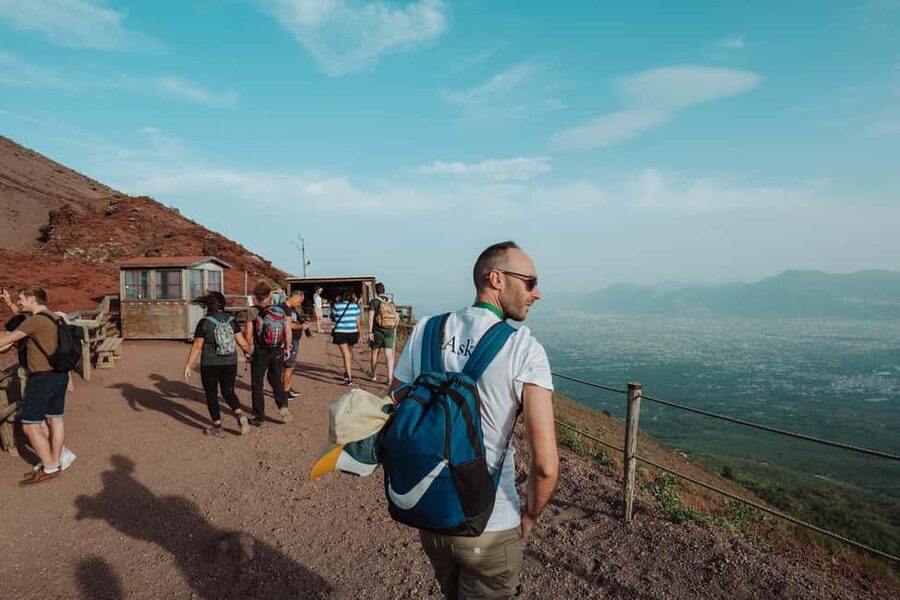
The Vesuvius section includes about 1.5 hours of hiking, although the total time at the volcano can approach two hours depending on the day’s schedule. You walk uphill to the crater edge, then return along the same general route. The path is not described as a technical hike, but it is uphill, exposed, and uneven enough that proper shoes matter.
The tour provides an audioguide for Vesuvius rather than a live volcano guide. Your tour leader assists you, helps the group stay on track, and can answer practical questions, but the spoken information comes mainly through the app. Some visitors find the audio useful and easy to operate; others find it less lively than the personal guiding at Pompeii.
That difference is important. If you want a guide beside you explaining each volcanic feature, this is not quite that format. If you are happy to walk at your own pace with recorded information and sweeping views, the arrangement gives you some freedom.
At the top, you can look across the Bay of Naples and the surrounding countryside. Clear weather makes the view the reward for the climb, but conditions can change quickly. The summit may be cold and windy even when Naples feels warm, so bring a warm layer. Clouds can hide the panorama, and you should not book this part only for a guaranteed view.
The walk is manageable for reasonably mobile visitors, but the excursion is not suitable for children under six, wheelchair users, or people with mobility impairments. The practical advice is simple: wear closed-toe shoes, avoid anything slippery, and do not rush the descent just to take one more photograph.
A short break before Pompeii
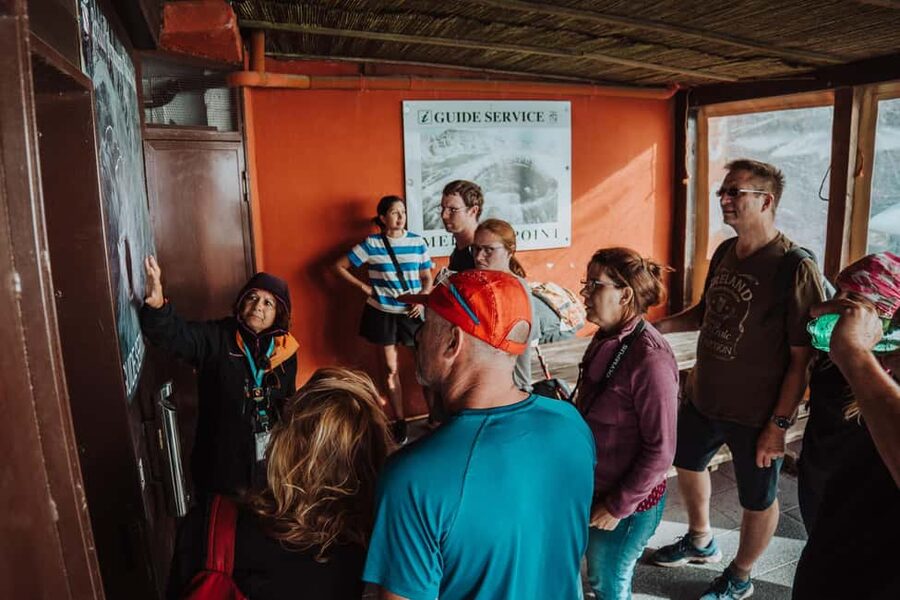
After Vesuvius, the day includes a break before the archaeological visit. The exact lunch stop can shape how much you like this part of the schedule.
Some departures have used a new shopping center near Pompeii, with plenty of restaurants and quick food options. That gives you choice and makes the meal efficient, but it is not the most atmospheric setting for an Italian day out. If you are hoping for a quiet meal in an old Pompeian neighborhood, this stop may feel too modern.
Other arrangements have included a local restaurant, Italian small plates, wine, and a limoncello tasting. Treat that as something that can vary, not as a guaranteed inclusion. If lunch is important to you, ask the tour leader when and where you should eat as soon as the group arrives. One departure had a very short lunch break after a late start, and another person chose takeaway food near Pompeii instead.
The break is generally around 30 minutes in the stated schedule, though some departures have allowed about 90 minutes. That variation may reflect traffic, group timing, or the day’s arrangements. Bring a little patience and do not wait until the last minute to order food.
Same city, a completely different sort of day:
- From Naples: Pompeii Ruins & Mount Vesuvius Day Tour
★ 4.3 · 11,459 reviews - From Rome: Pompeii, Amalfi Coast, and Sorrento Day Trip
★ 4.6 · 7,031 reviews - From Rome: Pompeii, Amalfi Coast and Positano Day Trip
★ 4.6 · 6,620 reviews - Pompeii Small Group Tour with an Archaeologist
★ 5.0 · 6,593 reviews
Entering Pompeii through Porta Marina
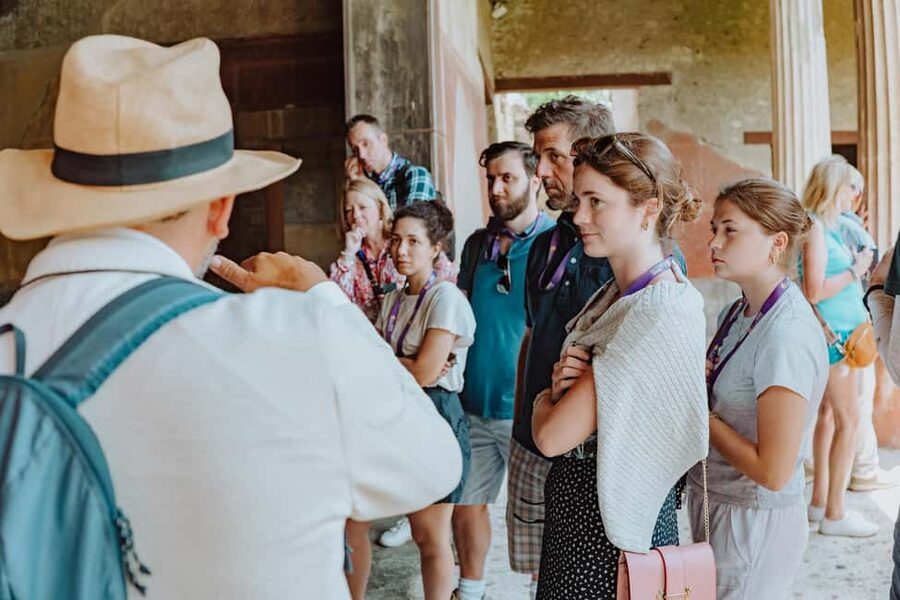
The Pompeii visit begins around Porta Marina, one of the site’s main entrances. This is where the tour shifts from a self-guided volcano walk to a live, in-person historical tour.
You then follow a planned route through the most important parts of the site. The guide’s job is not to show you every street. That would take far longer than this excursion allows. Instead, you get a concentrated route that connects public life, religion, business, entertainment, and private homes.
The tour includes tickets and skip-the-line access, which keeps the entrance process from taking over your limited Pompeii time. Your guide may be an archaeologist or another specialist in the site. Nicoletta, for example, has been praised for adding small details and stories beyond the basic textbook account, while Julia and Antonieta have been noted for clear, lively explanations.
From the Basilica to the Civil Forum
The Basilica is one of the first major stops. It helps you picture Pompeii as a working city, not just a collection of ruined walls. The guide explains how public buildings functioned and points out details that are easy to miss when you walk alone.
From there, the route continues to the Temple of Apollo and the Foro Civile di Pompei, or Civil Forum. This central public space brought together civic, religious, and commercial activity. A good guide helps you read the open space, surrounding buildings, columns, and raised structures as parts of a city system.
The Macellum, Pompeii’s market building, gives you another angle on ordinary life. Here the focus moves from government and religion to food, trade, and shopping. These changes in subject keep the walk from becoming a long procession of stones and names.
Homes, food, and the Lupanare
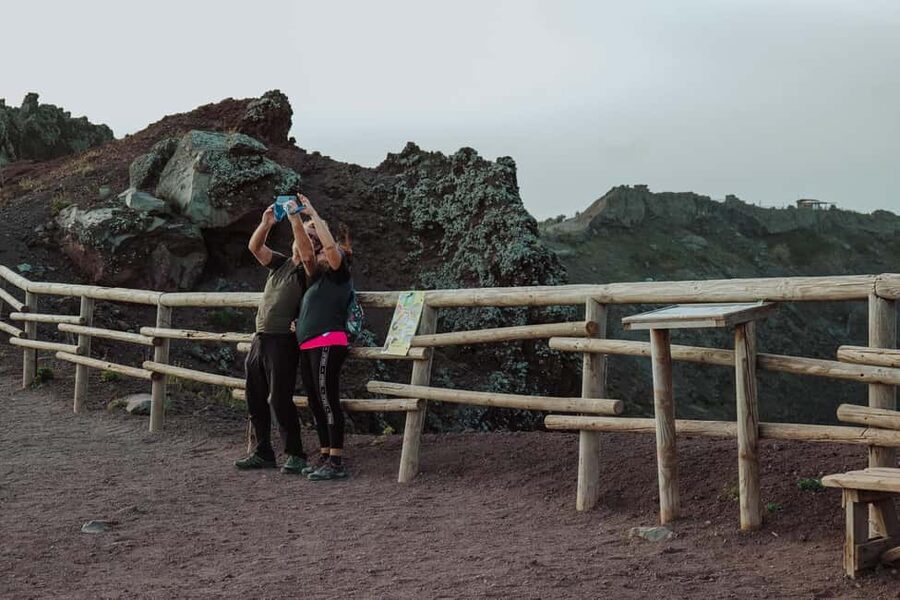
The Lupanare is one of Pompeii’s best-known stops. Its small rooms and painted material offer a frank look at sex work in the Roman city. It can be a crowded point on the route, and the space is tight, so listen closely while you have the chance.
The House of Menander and House of the Vettii show how wealthy households used rooms, courtyards, wall paintings, and decorative details to express status. The House of the Faun is another major private residence, with a scale and layout that make it easier to understand the gap between an ordinary home and an elite one.
The Thermopolium is especially useful for connecting archaeology with daily routine. This ancient food counter helps you imagine how residents bought prepared food and drink. It is one of those small stops that makes Pompeii feel like a lived-in town rather than a silent monument.
A guide adds real value here. Without context, you might see a painted wall or stone counter and move on. With clear explanations, you begin to understand what the feature meant and who used it.
Baths and theaters complete the route
The Terme Stabiane, or Stabian Baths, show the Roman taste for public bathing and social life. The complex also gives you a sense of how engineering, leisure, and status overlapped in Pompeii.
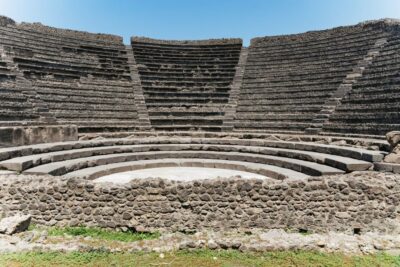
The final stops include the Teatro Piccolo and the Large Theatre. These spaces bring performance and public entertainment into the picture. The smaller theater and larger venue help show that Pompeii was not simply a town of private homes and temples. It had civic rituals, performances, business, and a full calendar of public activity.
The Pompeii portion is scheduled as a two-hour guided tour. That is enough to see a wide range of buildings at a steady pace, but not enough to linger everywhere. One guide may stop longer at a house, another may spend more time on public spaces. The route is chosen to give you variety.
I would not book this excursion expecting free time to wander after the guided walk. The schedule sends you back to Naples after the Pompeii route. If you want a full day inside the site, you need a separate Pompeii visit.
How the transport and timing affect the day
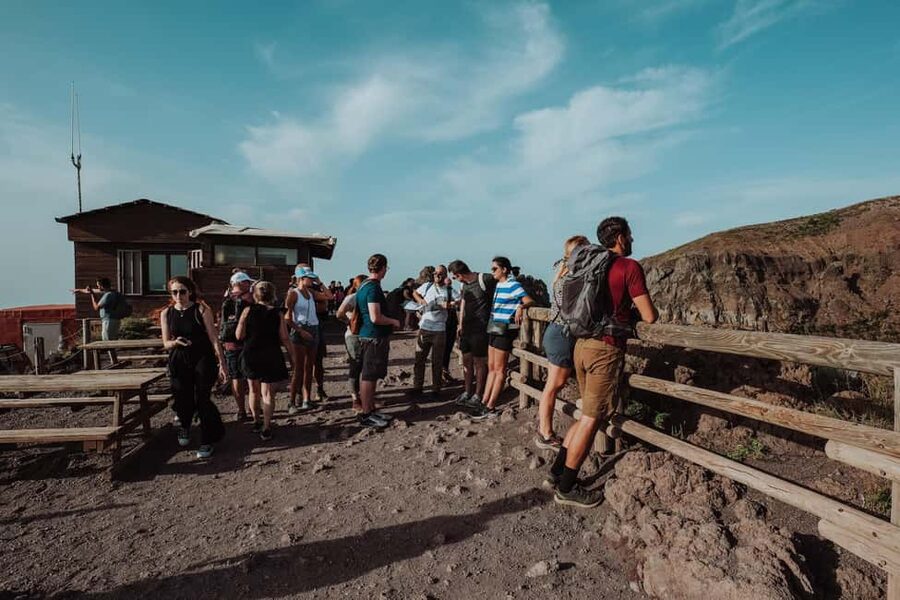
The seven-hour format is efficient, but it is also tightly planned. The stated sequence includes a 20-minute ride to Vesuvius, the crater walk, another 20-minute ride, a lunch break, the Pompeii tour, and the return to Naples.
That structure works well if you want to cover both major sights in one day. It works less well if you dislike fixed schedules or want long pauses for photography. At Vesuvius, some people would prefer another 30 minutes because the climb, views, and photographs can make the descent feel rushed. At Pompeii, nearly everyone could use more time simply because the site is so large.
The tour leader is an important part of the experience. Davide has been praised for explaining options and keeping everyone informed, while other leaders have handled delays and vehicle problems calmly. A few departures have experienced a technical issue or late start, so leave a little flexibility in your Naples plans after the tour.
The vehicle is intended to make the day easier, not luxurious. Past departures have been described as comfortable and air-conditioned, with drivers handling the narrow, curving roads toward Vesuvius well. The small-group setup is a better fit than a large bus if you prefer quicker loading and more direct help.
What the tour costs you in time and money
The listed information does not give a tour price, so I cannot judge a specific fare. You should compare the price with the separate costs of transport, Pompeii entry, Vesuvius entry, and professional guiding.
Mount Vesuvius entry is listed at 11 euros. Pompeii entry is included with the tour, as is the transportation and the guided visit. The value is strongest if you want both sites in one day and would otherwise spend time arranging connections and tickets yourself.
The value is weaker if you mainly want to explore Pompeii at your own pace. In that case, the two-hour guided route may feel too short, and a separate Pompeii visit would give you more freedom. The Vesuvius audioguide is also less personal than a live guide, so compare this trip with tours that specifically include a volcano guide if that matters to you.
You can cancel up to 24 hours ahead for a full refund, and the reserve-now, pay-later option keeps your plans flexible. Those policies are useful if your Naples schedule depends on weather or changing transport plans.
Who should book this excursion?
I would choose this tour if you have one free day in Naples and want the simplest way to see both Pompeii and Vesuvius. It suits first-time visitors, people who prefer a guide at major archaeological sites, and anyone who would rather not manage regional transport.
It is also a good match for families with older children who can handle a steady uphill walk. One 11-year-old completed the Vesuvius walk, but the trip is not suitable for children under six.
I would think twice if you have limited mobility, want wheelchair access, dislike walking on uneven ground, or need a slow and flexible schedule. I would also choose a longer Pompeii-only visit if the ancient city is your main reason for coming to Campania.
Should you book the Pompeii and Vesuvius day trip?
Yes, if you want a well-organized introduction to two major sights and value expert guidance more than free time. The strongest part is Pompeii, where an archaeologist or specialist guide can make the homes, markets, baths, and theaters understandable in a short visit.
The main compromise is that both stops are compressed. Vesuvius uses an audioguide rather than a live guide, lunch may be at a modern shopping center, and Pompeii deserves far more than two hours. Still, the transport, small group, included tickets, and clear route make this a practical choice from Naples.
Wear good shoes, carry a warm layer, store your suitcase before meeting the group, and ask early about the lunch plan. With those expectations, you get a memorable day that links the volcano to the city it buried.
FAQ
Where does the tour meet in Naples?
Meet outside Starhotels Terminus, opposite Naples Central Station. The tour leader will hold an ASKOS TOURS sign. The meeting point coordinates are 40.85170364379883, 14.27153491973877.
How long does the excursion last?
The full excursion lasts about seven hours, including transport, the Vesuvius walk, the Pompeii visit, a break, and the return to Starhotels Terminus.
Is Mount Vesuvius guided by a live guide?
The Vesuvius section uses an audioguide, with an expert tour leader assisting the group. Pompeii includes a live, in-person English-speaking guide.
How much walking is involved at Mount Vesuvius?
The Vesuvius portion includes about 1.5 hours of hiking to and around the crater area. You should bring comfortable closed-toe shoes and clothing suitable for changing conditions.
Is lunch included?
The provided information does not confirm a single fixed lunch arrangement. Some departures have used a shopping center with restaurants and quick food, while other arrangements have included a local restaurant. Ask the tour leader about the day’s lunch plan.
Can I bring a suitcase on the minibus?
Suitcase storage is not guaranteed because not all vehicles have a luggage compartment. Store luggage at Naples Central Station or another luggage facility before the excursion.
Is the tour suitable for wheelchair users or people with mobility impairments?
No. The activity is not suitable for wheelchair users or people with mobility impairments. It is also not suitable for children under six.
Just added around Pompeii
- Vesuvius National Park Skip-the-Line Ticket★ 3.8 · 221 reviews
- From Rome: Sorrento & Pompeii Day Tour with Hotel Pickup★ 4.2 · 257 reviews
- From Rome: Day Trip to Pompeii with Tickets★ 4.4 · 1,161 reviews
- Pompeii Ruins Private Tour with Optional Skip-the-Line Entry★ 4.9 · 732 reviews
- From Rome: Pompeii All-Inclusive Tour with Live Guide★ 4.3 · 261 reviews
- Pompeii: Exclusive Tour with Archaeologist and Entry Tickets★ 4.9 · 634 reviews
- Pompeii 3hours Villa of Mysteries tour with an Archaeologist★ 4.8 · 486 reviews
- Pompeii and Vesuvius Full-Day Tour from Amalfi Coast★ 4.4 · 319 reviews
Pompeii Tours, compared.

Entry Ticket and Guided Tour with an Archaeologist
Read our review →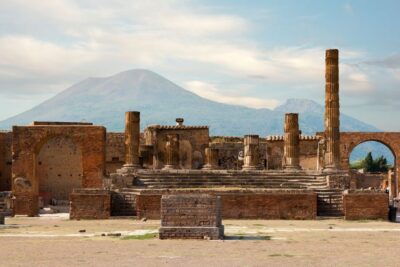

From Naples: Pompeii Ruins & Mount Vesuvius Day Tour
Read our review →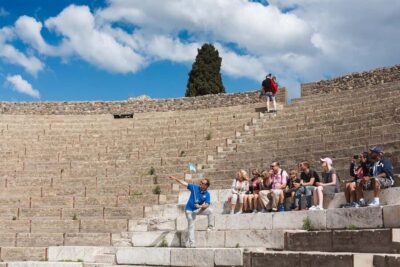
From Rome: Pompeii, Amalfi Coast, and Sorrento Day Trip
Read our review →
From Rome: Pompeii, Amalfi Coast and Positano Day Trip
Read our review →Pompeii Small Group Tour with an Archaeologist
Read our review →
Pompeii, Amalfi Coast and Positano Day Trip from Rome
Read our review →Browse the lists this tour appears in