
Reviewed · MUSEUMS
Leonardo Da Vinci Museum Entrance Ticket
Leonardo’s notebooks come alive here through more than 50 full-size and detailed models, many built to move or demonstrate the idea behind his drawings. Instead of focusing on paintings such as the Mona Lisa, this small central Florence museum puts his engineering, anatomy, architecture, military designs, and flying machines first.
I like the way the museum lets you see the same idea from several angles: read about a design, examine the model, then test a related mechanism. I also like the modest time commitment. One hour fits easily into a busy Florence day, especially if you want an indoor break. The main caution is that these are replicas and teaching models, not original Leonardo artifacts, so visitors seeking rare manuscripts or major works of art may find the experience too light.
Key points to know before you go
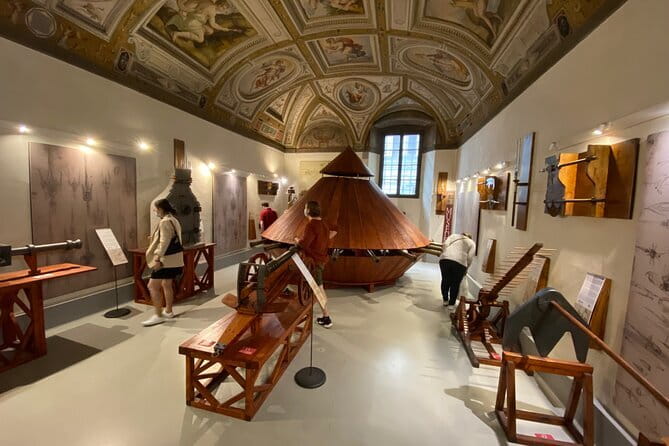
- Four rooms cover four sides of Leonardo’s mind: civil machines, flying machines, war machines, and anatomical models.
- Many models are designed to work: selected displays let you turn, pull, test, or examine the mechanics behind the drawings.
- The museum suits families especially well: a children’s activity area and hands-on displays add a playful note.
- Allow one to one and a half hours: you can move quickly in about an hour or stay longer to read the explanations.
- The location is central: the museum occupies the Galleria Michelangelo in one of Florence’s well-known city-center streets.
- Check the city carefully when booking: this ticket is for Florence, not a Leonardo museum in Rome, Milan, or Venice.
What you are really seeing in Florence
This is not an art museum devoted to Leonardo’s paintings. It is a museum of ideas, built around physical replicas of machines shown in his sketches and notebooks.
That distinction matters. Leonardo is often presented through the Mona Lisa, The Last Supper, and his studies of the human body. Here, you get a different portrait: the restless inventor who studied movement, water, flight, warfare, buildings, anatomy, and practical tools.
The museum displays more than 50 models in four rooms at the Galleria Michelangelo. The building itself is part of the setting. The gallery was once a meeting place for the Macchiaioli, the nineteenth-century Italian painters, and its painted ceilings help give the space more character than a plain modern exhibition hall.
You will also find large-screen documentary material about Leonardo’s life and work. It gives useful background, though the main appeal remains the machines themselves. The museum is self-guided, so you can set your own pace rather than follow a fixed talk or group route.
More Entry Tickets in Tuscany
- Venice: Leonardo Da Vinci Museum Entrance Ticket
★ 4.5 · 3,560 reviews - Siena: Siena Cathedral and Piccolomini Library Entry Ticket
★ 4.5 · 3,462 reviews - Rome: Leonardo da Vinci Exhibition Entrance Ticket
★ 4.4 · 2,885 reviews
Room one: civil machines and useful engineering
The first room focuses on civil machines, probably the best place to begin because it introduces Leonardo as a practical engineer. You might find designs connected with construction, water, lifting, transport, and mechanical power.
This section helps explain why Leonardo’s drawings still feel modern. He was not simply sketching strange contraptions. He was asking how force could be transferred, how weight could be moved, and how a machine could make difficult work easier.
The working replicas are the real attraction. A drawing on a page can be hard to understand, but a model with gears, levers, or moving parts gives you a clearer sense of the original thought process. You can see how a small change in shape or balance might alter the whole machine.
I would spend extra time here if you enjoy engineering or architecture. It is also a good section for children because the mechanics are easy to grasp visually. You do not need specialist knowledge to understand that one gear drives another or that a lever changes the amount of effort needed.
The limitation is scale and depth. The displays offer a clear introduction, but they do not replace a serious study of Leonardo’s original notebooks. If you want detailed information about dates, construction methods, or the scholars who recreated each model, you may wish for longer explanations.
Room two: flying machines and the dream of flight
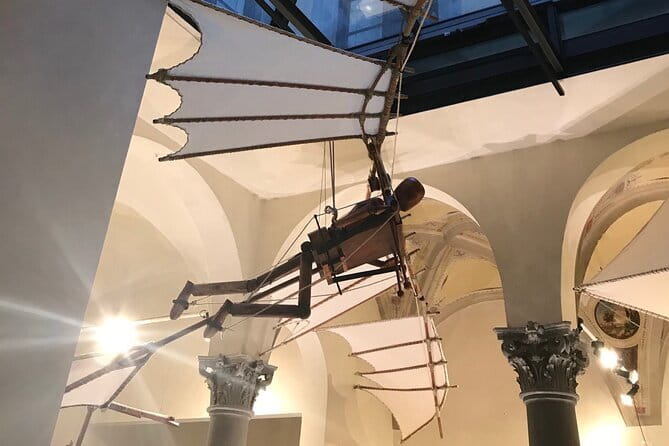
The second room turns upward, with models of Leonardo’s flying machines. These designs show his habit of watching nature closely and trying to translate it into mechanics.
The flying machines are among the most visually appealing exhibits because their shapes are instantly recognizable. You can compare human-powered concepts with designs inspired by birds and other forms of movement. Even when an invention could not have flown as planned, the model makes the problem easier to see.
This room also reveals the limits of Leonardo’s time. He had imagination and sharp observation, but no engine capable of providing enough power for sustained human flight. That tension between bold vision and practical limits is part of the fun.
For younger visitors, this section can feel like a workshop of ideas. For adults, it offers a chance to think about the difference between copying nature and understanding the forces that make flight possible.
Do not come expecting aircraft from a modern aviation museum. These are interpretations of Leonardo’s sketches, not proven flying machines. The value is in seeing how he approached a problem centuries before powered flight became possible.
Room three: war machines and the darker side of invention
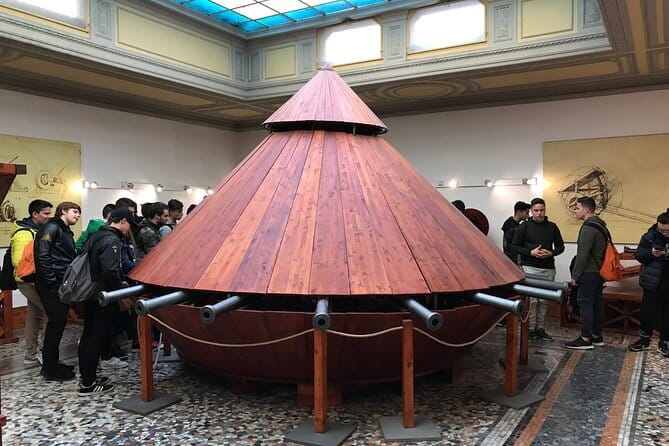
The third room presents Leonardo’s military designs. Here you may see models connected with defense, weapons, fortifications, and battlefield strategy.
This room adds balance to the familiar image of Leonardo as a peaceful artist and scientific thinker. Renaissance rulers wanted artists and engineers who could also design defenses and weapons, and Leonardo was willing to present himself as someone who could solve military problems.
The models make the designs easier to understand than a flat sketch. You can examine the shape, consider how it might have moved, and see why certain arrangements would have been useful. Some displays are especially interesting because the design looks advanced at first glance but raises practical questions when you study it closely.
This is a good section for anyone interested in military history, architecture, or engineering. It may be less appealing if you are hoping for a gentle, art-centered museum. The displays focus on machines and concepts, not on original weapons from Leonardo’s period.
The museum’s strength here is its range. By placing civil, flying, military, and anatomical models under one roof, it shows how broad Leonardo’s interests were. You can move from construction to flight to warfare without leaving the same compact exhibition.
More Museum Tours in Tuscany
- Milan: Science and Technology Leonardo da Vinci Museum Entry
★ 4.5 · 7,169 reviews - Golf Cart Tour to Fiesole Roman Theatre and Museum
★ 4.5 · 2,039 reviews - Milan: Pinacoteca Ambrosiana & da Vinci Codex Exhibition
★ 4.6 · 1,816 reviews - Siena Walking Tour with Cathedral and Crypt & Museum Option
★ 4.9 · 380 reviews
Room four: anatomy and the human body
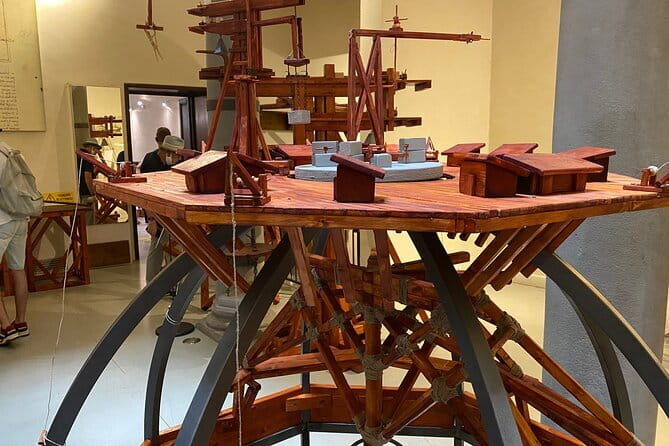
The fourth room contains the newer collection of anatomical models. This section connects Leonardo’s artistic eye with his scientific curiosity.
Leonardo studied the human body because he wanted to draw it accurately, but his investigations also became studies of structure, movement, and function. Anatomical models help make that link visible. You can see how his interest in art and science fed each other.
This room may appeal most to adults and older children who enjoy biology. It also gives the museum a useful change of pace. After machines built from wood and gears, the focus turns to the body as a complex system.
The displays are models, not original anatomical material. That makes them easier to approach, but it also means the experience remains educational rather than archival. If you are looking for original drawings or historic scientific documents, this will not provide that.
Hands-on displays make the visit more active
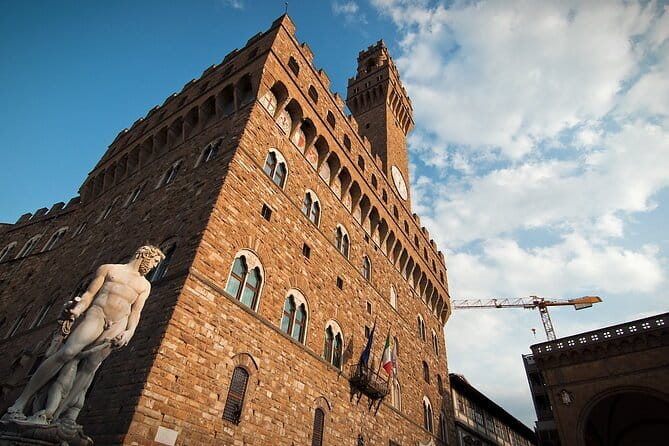
The museum is not entirely hands-on, and that is worth knowing before you arrive. Some exhibits are intended for looking and reading, while selected machines can be handled or tested.
The interactive pieces are a major reason I would recommend this museum to families. Turning a mechanism or trying a simple construction idea gives a child a reason to stop and think. It also helps adults understand designs that might otherwise seem like a tangle of lines in a notebook.
There is a children’s area in the basement, and some displays invite building or experimentation. The quality of individual interactive elements can vary, and not every mechanism may be operating perfectly at every moment. Still, the museum offers more active participation than a traditional gallery.
If you are visiting without children, you can still enjoy the models. Just set your expectations correctly. This is not an elaborate multimedia attraction with every exhibit animated. It is a compact museum where physical replicas carry most of the story.
The documentary, bookshop, and café
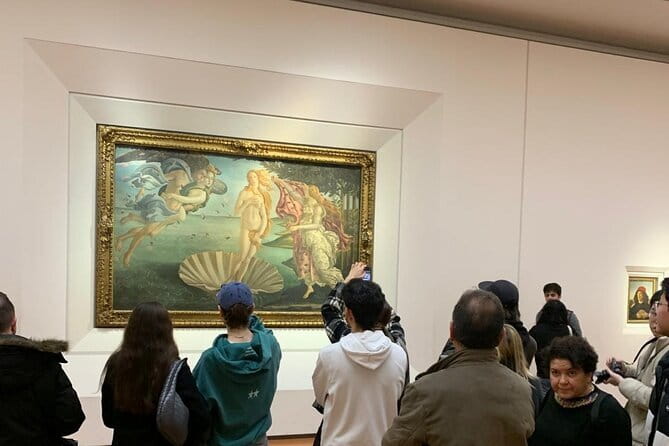
Large-screen monitors show a documentary about Leonardo’s life and work. I would treat this as useful supporting material rather than the main event. It can help you place the inventions in context, especially if you arrive with only a basic understanding of Leonardo.
The bookshop sells publications and souvenirs related to the museum and Leonardo. It is a practical stop if you want a book explaining the inventions or a small educational gift. The selection includes gadgets as well as reading material.
The exhibition area also has an arrangement with Caffé Michelangiolo. Food and drinks are not included with admission, but the café gives you an option for a pause around your visit. Since the museum itself is small, combining it with a coffee break can make the stop feel less rushed.
How long to allow, and how to fit it into Florence
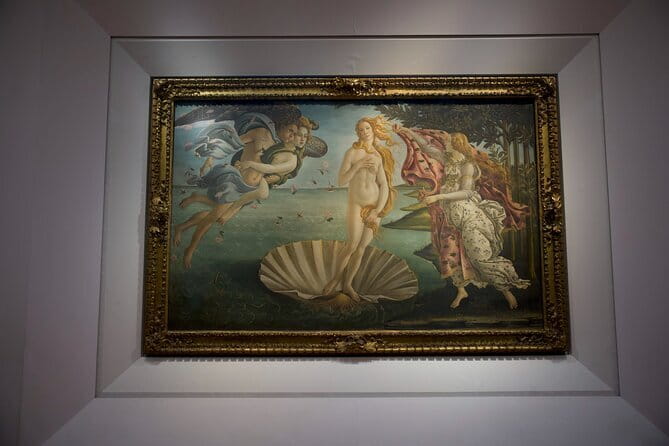
The stated visit time is about one hour to one and a half hours. I think that is realistic.
You can see the main models in roughly an hour if you read selectively. Allow closer to 90 minutes if you want to study the explanations, watch some of the documentary, and let children use the interactive displays.
That compact length is one of the museum’s strongest points. Florence can fill a day with major churches, galleries, markets, and historic streets. A small museum lets you add a focused subject without giving up half a day.
The museum is open daily from 10:00 a.m. to 6:00 p.m. The ticket information describes flexible entry times during the day, while the visit itself is self-guided. Since details about timed entry can vary, check the instructions on your confirmation and the current opening information before setting out.
The museum is near public transportation and sits in central Florence, making it easy to pair with other sightseeing. Its city-center position also means you should take care when comparing it with other Leonardo museums. Florence, Rome, Milan, and Venice each have different attractions, and a booking for this experience is specifically for Florence.
Is $12.55 good value?
At $12.55 per person, the museum offers fair value if you enjoy inventions, science, or family activities. The visit is affordable compared with many major European attractions, and the one-hour format makes it easy to fit into a crowded schedule.
The value is strongest for families. You get a subject that works across ages, a few hands-on elements, a children’s area, and enough visual material to keep the visit moving. Adults interested in engineering or Leonardo’s working methods may also find the price reasonable.
The value is less clear if your main goal is Leonardo’s art or original historical objects. The exhibits are replicas and models. Some displays are basic, and the museum does not offer the same kind of original-art experience you would find at a major painting collection.
I would think of the ticket as paying for interpretation and access to working demonstrations, not for rare artifacts. If that matches your interest, the price is sensible. If you want depth, original documents, or a large museum collection, you may prefer to spend your admission money elsewhere.
Who will enjoy this museum most?
I would recommend it most strongly to:
- Families with children who enjoy building, testing, and touching selected displays
- Adults curious about engineering, science, anatomy, or military design
- Visitors who want a short indoor attraction in central Florence
- Anyone who wants to understand Leonardo beyond his paintings
- People looking for a self-guided visit with no fixed tour commentary
I would be more cautious if you want an art museum, original Renaissance objects, or a long scholarly presentation. The museum is small, and some visitors may finish in less than an hour.
It can also work well as a starting point for a wider Florence day. After seeing Leonardo’s inventions, you can approach the city’s art and architecture with a better sense of the period’s mix of artistic skill, scientific study, and practical design.
Booking, entry, and cancellation details
Confirmation is provided at booking. The activity is offered in English, and the maximum group size is listed as 20 people, though the museum visit itself is self-guided rather than a guided group tour.
Admission includes entry to the Leonardo da Vinci Museum. Food, drinks, and hotel pickup or drop-off are not included.
You can cancel for a full refund if you do so at least 24 hours before the scheduled start time. Changes or cancellations made inside that 24-hour window are not accepted for a refund, and the cut-off follows Florence local time.
Before paying, read the city name carefully. Several Leonardo museums operate in Italy, and confusion between Florence and another city can ruin an otherwise simple visit.
Should you book the Leonardo da Vinci Museum?
Book it if you want a short, visual, family-friendly look at Leonardo’s inventions, especially if working models and hands-on learning appeal to you. The four-room layout gives you a clear tour through civil engineering, flight, military design, and anatomy, and the central location makes the museum easy to add to a Florence itinerary.
Skip it if you are expecting original Leonardo art, rare manuscripts, or a large museum with extensive historical artifacts. You will be looking at replicas, and some displays may feel too basic for serious adult study.
For most curious visitors, the ticket makes sense as a one-hour stop. Go for the machines, not the paintings, and you will know exactly what you are buying.
FAQ
Where is the Leonardo da Vinci Museum located?
The museum is located at the Galleria Michelangelo in central Florence, on one of the city’s well-known streets.
What are the museum’s opening hours?
The stated opening hours are Monday through Sunday, 10:00 a.m. to 6:00 p.m.
How long does a visit take?
Plan on approximately one hour to one and a half hours, depending on how closely you read the displays and use the interactive areas.
What does the admission ticket include?
The ticket includes admission to the Leonardo da Vinci Museum.
Are food and drinks included?
No. Food and drinks are not included, though the exhibition area has an arrangement with Caffé Michelangiolo.
Is this a guided tour?
No. The museum visit is self-guided, allowing you to enter during the available opening period and explore at your own pace.
Can I cancel for a refund?
Yes. You can cancel at least 24 hours before the experience start time for a full refund. Cancellations or changes made less than 24 hours before the start time are not accepted for a refund.
Just added around Tuscany
- Florence Sunset Food Tour with Wine & Dine at a Tuscan farmhouse★ 5.0 · 194 reviews
- Wine Tasting Experience in Ponte Vecchio: Best Tuscany selection!★ 5.0 · 197 reviews
- Val d’Orcia Brunello Wine Tour with Montalcino and Montepulciano★ 4.5 · 359 reviews
- Wine Experience In Chianti Hills from Florence★ 4.5 · 195 reviews
- Tuscany Vespa Tour: Lunch & Wine Tasting, Countryside Roads★ 5.0 · 614 reviews
- Tuscany Vespa Tours Through the Hills of Chianti★ 5.0 · 515 reviews
- Tuscany Vespa Tour from Florence with Wine Tasting★ 5.0 · 425 reviews
- Tuscany Bike Tours Through the Chianti Hills with Wine Tasting★ 5.0 · 1,300 reviews
Museums, compared.
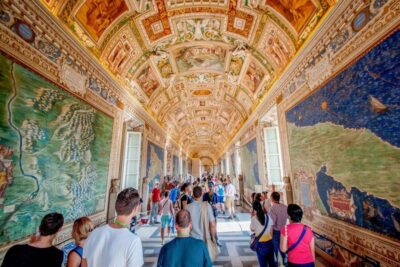
Vatican: Museums & Sistine Chapel Entrance Ticket
Read our review →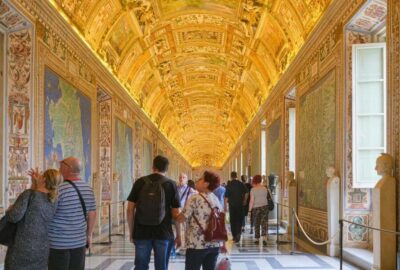
Vatican Museums & Sistine Chapel Tour with Optional Basilica
Read our review →
Vatican Museums, Sistine Chapel & St Peter’s Basilica Guided Tour
Read our review →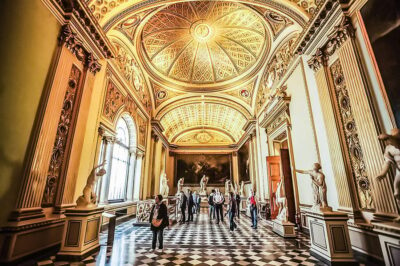
Skip-The-Line Uffizi Gallery Timed Entry Ticket
Read our review →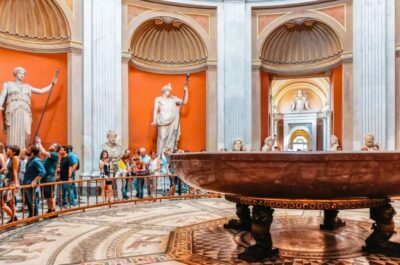
Vatican Museums, Sistine Chapel & Basilica Tour
Read our review →
Vatican Museums & Sistine Chapel Skip-the-Line Entry Ticket
Read our review →Vatican Museums, Sistine Chapel & Basilica Tour
Read our review →
Vatican Museums & Sistine Chapel Guided Tour
Read our review →Browse the lists this tour appears in