
Reviewed · MUSEUMS
Rome: Leonardo da Vinci Exhibition Entrance Ticket
Leonardo da Vinci’s sketches can look like tidy museum pages, but this exhibition gives them weight, gears, wings, pulleys, and moving parts. At Rome’s Palazzo della Cancelleria, you can examine more than 65 full-scale models, touch many of them, and see how his ideas about flight, water, warfare, and machines worked in practice. I especially like the hands-on design and the chance to build a version of his bridge. The underground setting also makes this a welcome cool stop in Rome.
I like the nine holograms, which show Leonardo’s paintings and inventions in three dimensions, and I like the way the exhibition reaches beyond the famous artist. You see the engineer, theorist, architect, scientist, and inventor. The main drawback is size: this is a small exhibition, not a grand art museum, and the route through the rooms can be confusing. Plan on about 45 to 60 minutes unless you read everything or use the audio guide.
Key points at a glance
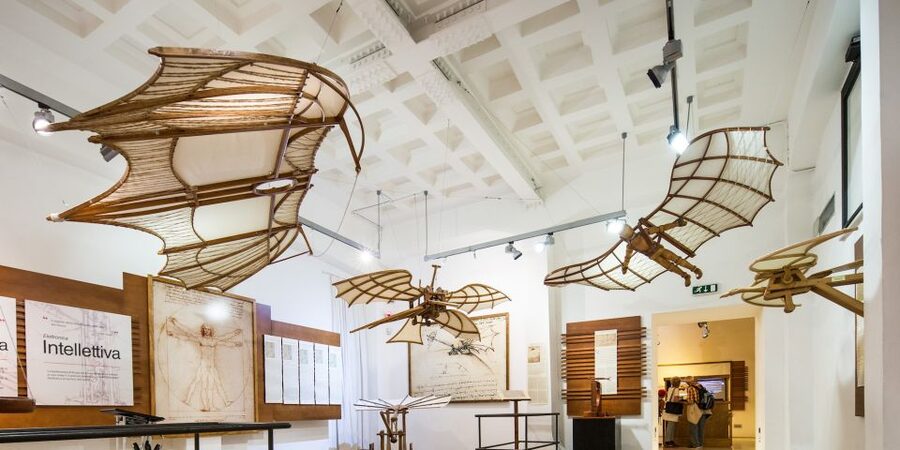
- More than 65 working-style models: See full-scale reproductions of Leonardo’s machines for flight, transport, water study, military use, and more.
- Hands-on learning: You can touch and operate many exhibits, and build your own version of one of Leonardo’s bridge designs.
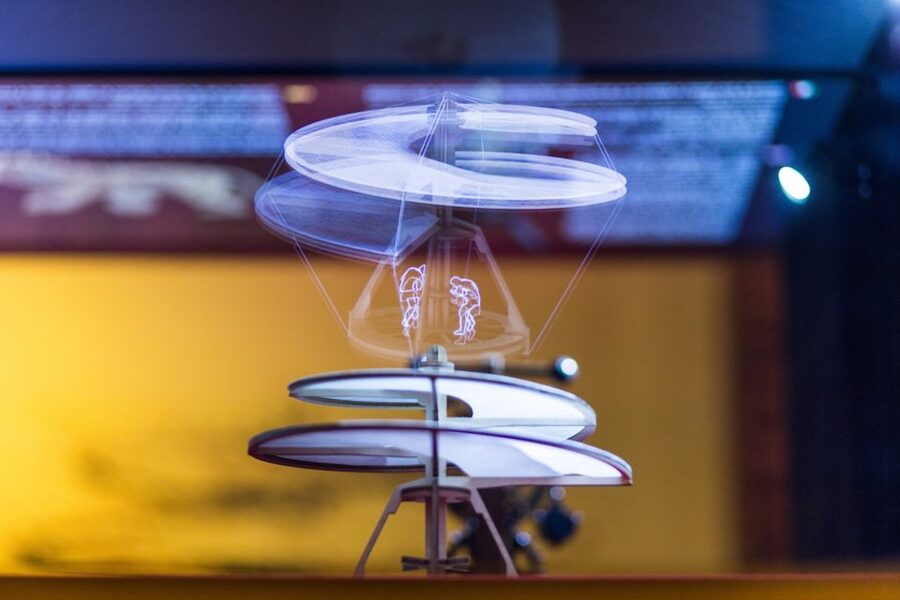
- Nine 3D holograms: Holographic displays present Leonardo’s art and inventions in an unusual, theatrical format.
- Four themed sections: The exhibition follows ideas linked to Water, Air, Fire, and Earth.
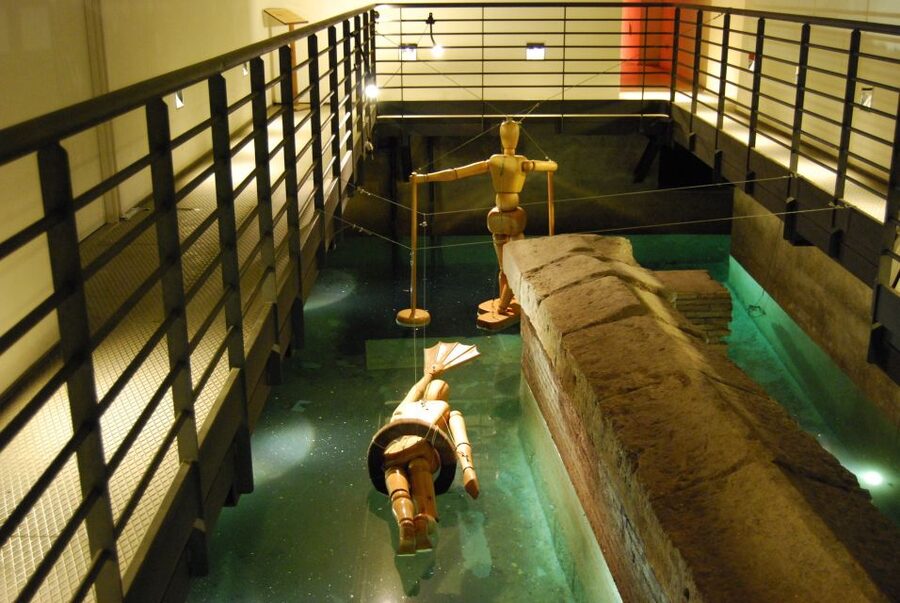
- A Roman archaeological surprise: See the tomb of the architect Auro Irzio, dating from 43 BC, beside an underground natural pond.
- Useful on hot afternoons: The exhibition is downstairs and offers a quiet break from Rome’s heat and crowded streets.
Leonardo’s paper designs become full-size machines
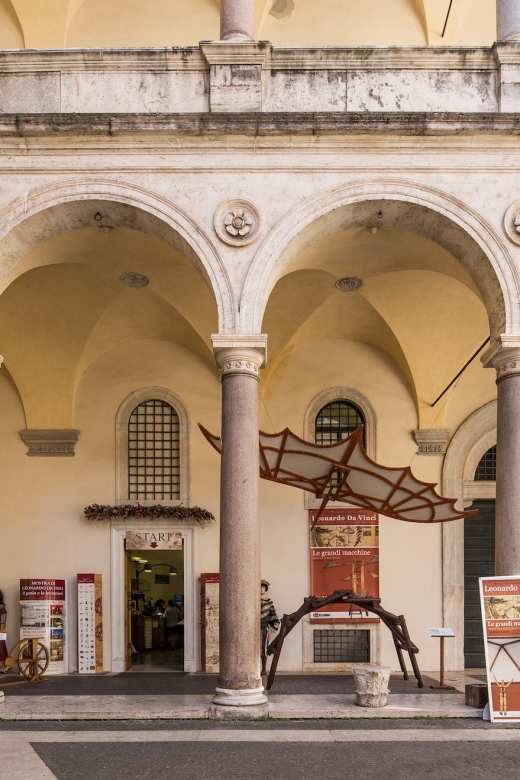
The main reason to come is simple: you do not just look at drawings. You see physical reproductions based on Leonardo’s studies, often at a scale that lets you understand how the parts might work together.
Leonardo was interested in motion, force, balance, and materials. Those ideas appear in machines for transportation, aviation, construction, military use, and water management. A sketch can be hard to read, especially when it mixes notes and mirrored writing. A large model makes the idea easier to grasp.
I find this particularly useful for families and anyone who likes to learn by doing. You can turn components, examine mechanisms, and test selected machines. The models help explain why Leonardo remains important, but they also show that his work was not magic. His ideas depended on gears, leverage, air, water, and careful observation.
The models are reproductions, not original Leonardo objects. That matters if you are expecting original paintings, manuscripts, or rare Renaissance artifacts. This is an interpretation of his engineering work, presented through models, digital displays, and explanatory material.
Some machines may show signs of wear, and a few displays can make it unclear where touching is encouraged. Take a little care around the equipment, particularly with young children. The exhibition works best when you move slowly and follow the instructions rather than treating every object as a toy.
More Entry Tickets in Tuscany
- Venice: Leonardo Da Vinci Museum Entrance Ticket
★ 4.5 · 3,560 reviews - Siena: Siena Cathedral and Piccolomini Library Entry Ticket
★ 4.5 · 3,462 reviews - Pisa: Leaning Tower & Cathedral Tickets with Timed Entry
★ 4.3 · 2,365 reviews
Four sections built around Water, Air, Fire, and Earth
The exhibition is arranged in four sections linked to Leonardo’s studies of Water, Air, Fire, and Earth. This gives the visit a broad shape. You are not simply moving from one famous invention to another. You are seeing how Leonardo studied the forces around him and applied them to design.
The Water section helps explain his interest in currents, flow, canals, and machines that could move or control water. His water studies were not separate from his engineering. They were part of a larger effort to understand nature through observation and experiment.
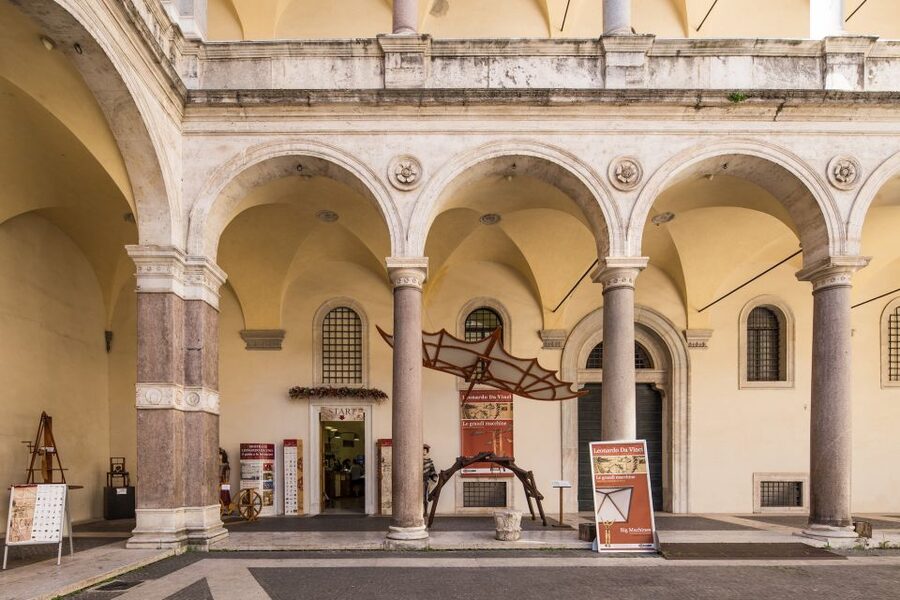
Air connects naturally with his flying-machine designs. Leonardo studied birds and the mechanics of flight, then tried to apply those observations to human invention. The full-size models let you compare the elegance of his sketches with the practical problems any flying machine would face.
Fire and Earth broaden the picture again. The exhibition connects these themes with machines, materials, tools, construction, and military ideas. You see that Leonardo was not working in neat modern subjects. Art, science, architecture, and engineering overlapped constantly in his notebooks.
The room numbering and route are not always obvious. The sequence may not flow in the order you expect, and the audio guide does not always match the room order perfectly. I would spend a minute at the entrance getting your bearings before starting the detailed explanations.
The inventions worth slowing down for
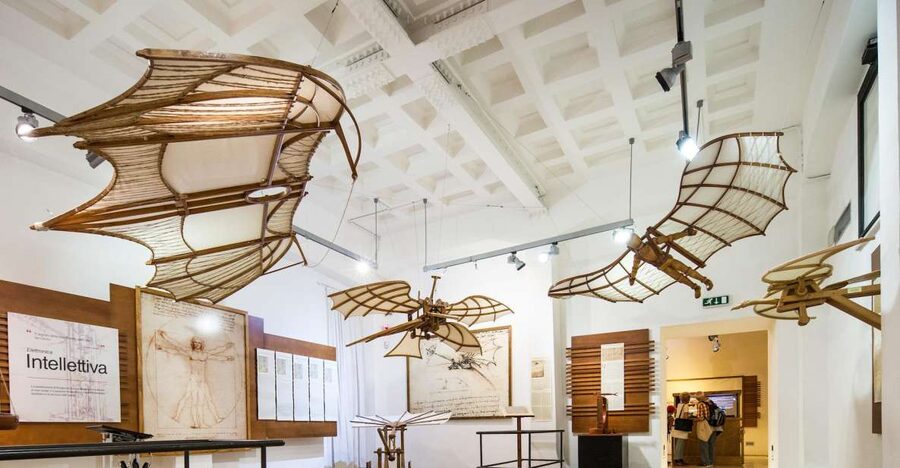
The exhibition includes models of a tank, scientific and engineering instruments, musical instruments, and flying machines. These displays show the range of Leonardo’s curiosity better than a single famous painting could.
The tank is an easy crowd-pleaser because its shape is familiar, yet the engineering behind it invites closer inspection. The transportation models are also useful for seeing how Leonardo thought about movement and human power. His designs may look futuristic at first, but the models reveal the practical details that support them.
The musical instruments offer a change of pace from gears and military machines. They remind you that Leonardo’s technical skill was tied to his artistic work. He was interested in sound, proportion, materials, and performance, not just in machines meant for war or travel.
The flying machines are among the most memorable displays because they turn his study of birds into a physical object. You can better understand the ambition of his ideas when you see the amount of structure required to support them.
There is also a copy of The Last Supper. It is not the main reason to visit, and this is not a substitute for seeing Leonardo’s original works elsewhere. Still, it helps place the engineering displays beside the better-known artistic side of his career.
Interactive exhibits make this more than a display case visit
The strongest feature here is the chance to interact with many of the machines. You can test mechanisms, handle parts, and build a version of a bridge linked to Leonardo’s designs. That turns a history lesson into a small engineering challenge.
This approach is especially good for children old enough to follow instructions and for adults who would normally skim museum labels. I have found that a moving model often answers a question faster than a paragraph of text. You see where force travels, how a structure balances, or why a design needs a certain shape.
The interactive elements also create conversation. You can compare your own solution with Leonardo’s design and ask what problem he was trying to solve. That makes the visit useful even if you are not already interested in Renaissance art.
There are some practical limits. The museum is compact, and not every object is equally clear about touch rules. A few trip hazards have been noted around the displays, so small children need close attention. For that reason, I would call this a good family stop, but not a place where children should roam unattended.
Seven interactive installations add more context through Leonardo’s drawings. These help connect the finished models to the original ideas on paper. If you want the clearest link between sketch and machine, make time for these installations rather than rushing straight to the largest objects.
More Museum Tours in Tuscany
- Milan: Science and Technology Leonardo da Vinci Museum Entry
★ 4.5 · 7,169 reviews - Golf Cart Tour to Fiesole Roman Theatre and Museum
★ 4.5 · 2,039 reviews - Milan: Pinacoteca Ambrosiana & da Vinci Codex Exhibition
★ 4.6 · 1,816 reviews - Leonardo Da Vinci Museum Entrance Ticket
★ 4.5 · 1,458 reviews
Holograms and the audio guide add context
Nine holograms show Leonardo’s paintings and inventions in 3D. They provide a visual change from the wooden and mechanical models, and they help bring his ideas into a modern presentation.
The holograms are best treated as interpretation, not as original artwork. Their value is in showing how an invention or painting can be understood from another angle. They also give the exhibition a multimedia feel without requiring a long film or formal presentation.
The audio guide is not included in the basic admission, but it is worth considering if you want more than the labels provide. It adds background and detailed explanations, and it is available in a way that lets you explore at your own speed. The audio content does not always follow the room order exactly, so check the number or location of each item before pressing ahead.
English explanations are available throughout the exhibition, which makes the self-guided format workable for English-speaking visitors. Staff at the entrance are described as friendly and helpful, but there is no regular guide included with the ticket. If you want personal commentary, ask about the additional guide option.
Palazzo della Cancelleria adds an ancient Roman surprise
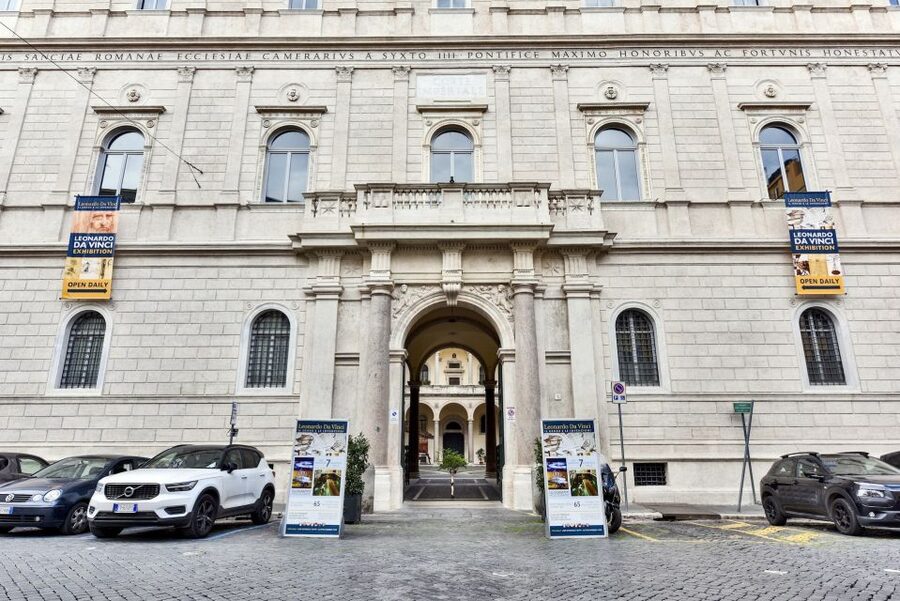
The exhibition is inside Palazzo della Cancelleria, at Piazza della Cancelleria 1, close to Campo de’ Fiori and Piazza Navona. The building itself is worth noticing. It belongs to the Vatican, and its architecture gives the visit a setting with more character than a plain modern gallery.
The unusual extra is underground. You can see the tomb of the architect Auro Irzio, dating from 43 BC, beside an underground natural pond. This is a small archaeological feature, but it changes the mood of the visit. One moment you are testing a Renaissance machine, and the next you are looking at evidence from ancient Rome.
The upper floor houses the Sacra Rota, the church court involved in dissolving marriages. That area is part of the building’s current use and is not the focus of the exhibition. Treat the palazzo as a working historic building, not only as a museum venue.
How much time should you allow?
The exhibition is compact. If you move briskly, 45 minutes may be enough. I would allow 60 to 90 minutes if you want to try the machines, watch the holograms, read the explanations, and use the audio guide.
Some people stay closer to two hours because the interactive displays invite you to stop and discuss what you are seeing. Your timing will depend on your interest and on how busy the rooms are. The exhibition is often a useful alternative when Rome’s major sights feel crowded, and its underground location can offer relief from summer heat.
Entrance is available until one hour before closing, so do not arrive at the last possible moment. The ticket is valid for one day, and skip-the-line entry is included. You can also cancel up to 24 hours ahead for a full refund and reserve without paying immediately, which is helpful when you are still arranging a Rome schedule.
The venue is wheelchair accessible. Still, the displays can be close together, and some areas have objects or equipment near the walking route. If mobility is a concern, allow extra time and ask the entrance staff for help.
Is the $10 ticket good value?
At about $10 per person, this is a reasonably priced Rome activity. The value does not come from spending an entire day inside. It comes from the quality of the learning experience in a short visit, the hands-on models, the unusual holograms, and the central location near two major walking areas.
I would not choose it instead of a major museum if your main goal is original Renaissance art. You will see reproductions and a copy of The Last Supper, not a collection of Leonardo originals. But if you want to understand how his ideas worked, the models do something a standard painting gallery cannot.
The ticket makes particular sense for a family, an engineering enthusiast, or someone looking for an indoor stop between sights. The gift shop is also more interesting than a standard postcard counter, with Leonardo-themed items linked to the machines and inventions.
Who should book this Leonardo exhibition?
I would book it if you like science, design, architecture, transport, or practical history. It is also a strong choice with school-age children who enjoy touching, testing, and building. Adults who know Leonardo mainly as the painter of the Mona Lisa may leave with a much wider picture of his work.
I would be more cautious if you want a large, quiet fine-art museum or original Renaissance objects. The exhibition is small, the route can be unclear, and some displays show normal wear. Bring patience, use the audio guide if you want extra explanation, and treat the visit as an interactive introduction to Leonardo’s mind rather than a major art collection.
For most Rome itineraries, this is an easy stop to fit near Campo de’ Fiori or Piazza Navona. At $10, it offers enough substance to justify the time, especially on a hot afternoon or during a break from Rome’s larger monuments.
FAQ
Where is the Leonardo da Vinci exhibition in Rome?
It is at La Mostra Leonardo da Vinci, Piazza della Cancelleria 1, near Campo de’ Fiori and Piazza Navona.
How long does the exhibition take?
A typical visit can take about 45 to 60 minutes. You may spend up to two hours if you use the audio guide, read the displays closely, and try the interactive machines.
What does the admission ticket include?
The ticket includes entrance to the exhibition and a gadget. A guide or audio guide is not included in the basic admission.
Can I touch the machines?
You can touch and play with almost all the machines on display. Follow the instructions at each exhibit, since not every object has the same handling rules.
Is the exhibition suitable for children?
Yes. The hands-on displays are suitable for children, and the models can make Leonardo’s ideas easier to understand. Young children need close supervision because some areas have trip hazards and unclear touch designations.
Is the exhibition wheelchair accessible?
Yes, the exhibition is wheelchair accessible.
Can I cancel my booking?
You can cancel up to 24 hours in advance for a full refund. The booking also offers a reserve-now, pay-later option.
Just added around Tuscany
- Florence Sunset Food Tour with Wine & Dine at a Tuscan farmhouse★ 5.0 · 194 reviews
- Wine Tasting Experience in Ponte Vecchio: Best Tuscany selection!★ 5.0 · 197 reviews
- Val d’Orcia Brunello Wine Tour with Montalcino and Montepulciano★ 4.5 · 359 reviews
- Wine Experience In Chianti Hills from Florence★ 4.5 · 195 reviews
- Tuscany Vespa Tour: Lunch & Wine Tasting, Countryside Roads★ 5.0 · 614 reviews
- Tuscany Vespa Tours Through the Hills of Chianti★ 5.0 · 515 reviews
- Tuscany Vespa Tour from Florence with Wine Tasting★ 5.0 · 425 reviews
- Tuscany Bike Tours Through the Chianti Hills with Wine Tasting★ 5.0 · 1,300 reviews
Museums, compared.
Vatican: Museums & Sistine Chapel Entrance Ticket
Read our review →
Vatican Museums & Sistine Chapel Tour with Optional Basilica
Read our review →
Vatican Museums, Sistine Chapel & St Peter’s Basilica Guided Tour
Read our review →
Skip-The-Line Uffizi Gallery Timed Entry Ticket
Read our review →
Vatican Museums, Sistine Chapel & Basilica Tour
Read our review →
Vatican Museums & Sistine Chapel Skip-the-Line Entry Ticket
Read our review →Vatican Museums, Sistine Chapel & Basilica Tour
Read our review →
Vatican Museums & Sistine Chapel Guided Tour
Read our review →Browse the lists this tour appears in