
Reviewed · ENTRY TICKETS IN TUSCANY
Siena: Palazzo Pubblico Entry Ticket
The great prize here is Simone Martini’s Maestà, a Gothic masterpiece painted for Siena’s civic palace. Around it, room after room carries wall-to-wall frescoes, painted ceilings, carved wood, and reminders that this was once the working center of a powerful medieval city.
I like the low $7 price, which makes the Civic Museum an easy addition to a day in Siena. I also like the Loggia dei Nove, where you can step outside the formal rooms for a broad view of the Sienese countryside. The main caution is that the famous Allegory and Effects of Good and Bad Government frescoes may be closed for restoration, so check what is open before you arrive.
Key points to know before you go
- Simone Martini’s Maestà is the artistic centerpiece, found in the Sala del Mappamondo.
- The museum is inside the Palazzo Pubblico, so you are touring both an important building and its art collection.
- The Loggia dei Nove adds a fine outdoor view to an otherwise indoor visit.
- The ticket costs $7 per person, a good value for an hour of major Sienese art.
- You exchange your voucher at the ticket office inside the Cortile del Podestà, not at the outer street entrance.
- Torre del Mangia is separate, so buy that ticket at the desk if you want the tower too.
Why the Palazzo Pubblico matters in Siena
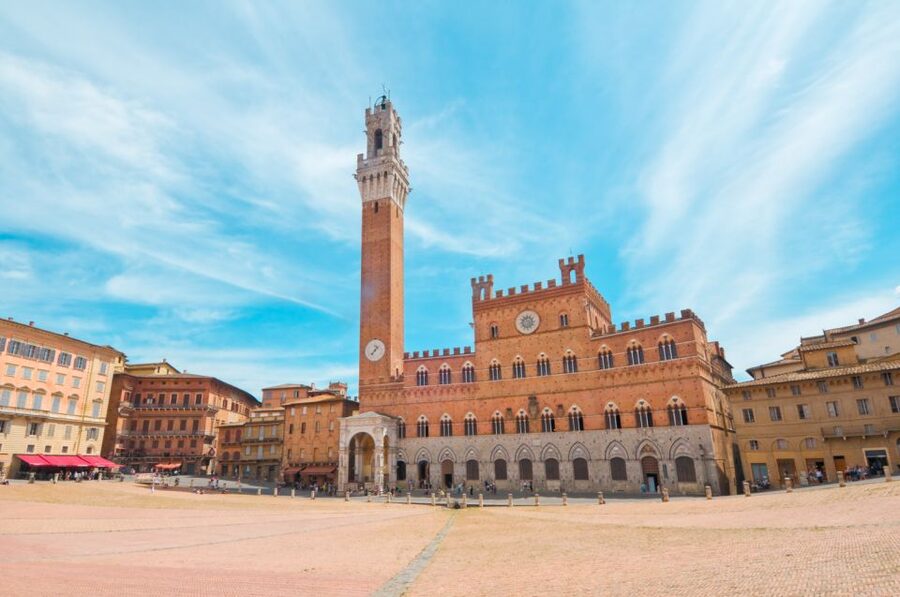
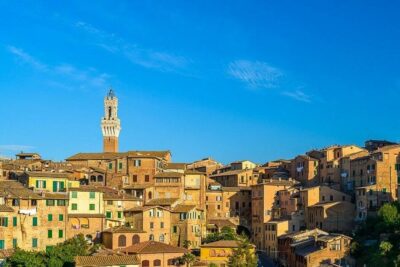
Siena’s Palazzo Pubblico is not simply a museum placed inside an old building. The palace was built in the 13th century as the seat of civic government, and its rooms were designed to show the city’s power, ideals, faith, and political order.
That setting gives the art extra weight. You are not looking at paintings in a neutral gallery. You are seeing them where officials met, councils debated, and Siena presented its idea of good government.
The visit is self-guided. No guide or audio commentary is included, so I recommend taking a few minutes to read the room descriptions and looking carefully at the painted details instead of rushing from one doorway to the next. The listed visit takes about an hour, though you can spend longer if the art matters to you.
The museum is a good fit if you want a focused cultural stop in the center of Siena. It is not a huge collection, and only a limited number of rooms may be open at any given time. Still, the rooms that are available contain an impressive amount of art.
More Entry Tickets in Tuscany
- Venice: Leonardo Da Vinci Museum Entrance Ticket
★ 4.5 · 3,560 reviews - Siena: Siena Cathedral and Piccolomini Library Entry Ticket
★ 4.5 · 3,462 reviews - Rome: Leonardo da Vinci Exhibition Entrance Ticket
★ 4.4 · 2,885 reviews
Finding the ticket office in the Cortile del Podestà
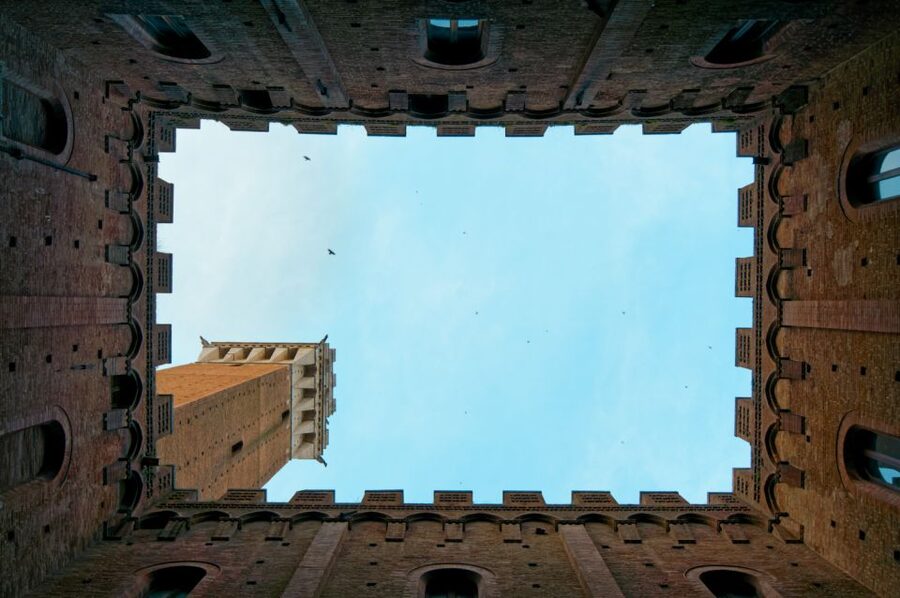
The practical challenge comes before the art. Enter the Palazzo Pubblico and go into the Cortile del Podestà, the inner courtyard. The ticket office is there, where you exchange your voucher for the admission ticket.
Do not rely only on a street map pin. A map may lead you to the exterior of the building on Via di Salicotto, while the ticket office is inside the courtyard. If you are unsure, continue into the palace rather than waiting outside on the street.
Arrive about 10 minutes before your booked time. The voucher exchange is normally straightforward, but this small buffer keeps you from starting in a rush. You need a passport or ID card, and large bags or luggage are not allowed inside.
The experience is described as a small group, limited to 10 participants, but this is still an entry visit rather than a guided tour. You will make your own way through the rooms. Flash photography is not allowed, so set your camera or phone accordingly.
Sala del Risorgimento and the story of Italian unity
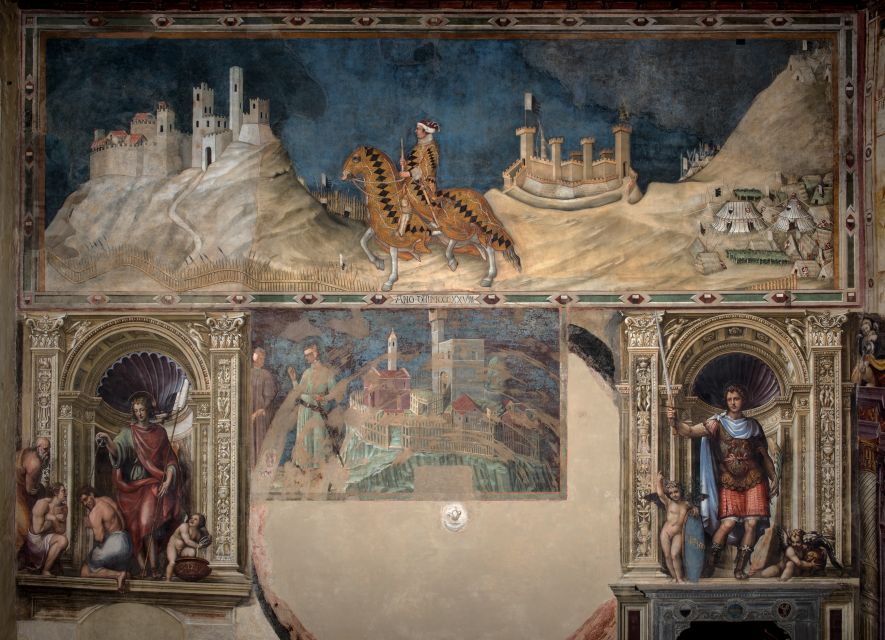
The visit begins in the Sala del Risorgimento, a room devoted to Vittorio Emanuele II, the first king of Italy. Its frescoes show episodes from his life and from the creation of a unified Italian state.
This is a useful opening because it shifts the palace story beyond medieval Siena. The building may have begun as a center of a medieval republic, but its rooms also reflect later chapters of Italian politics and national identity.
The room is different in subject from the medieval religious and civic paintings that follow. I find that contrast helpful. It reminds you that the Palazzo Pubblico continued to serve public purposes long after the original government structures changed.
Do not expect a full museum devoted to the Risorgimento. This is one room within a larger sequence, and the main reason to visit remains the combination of architecture, fresco painting, and civic history.
Sala di Balìa and the painted walls
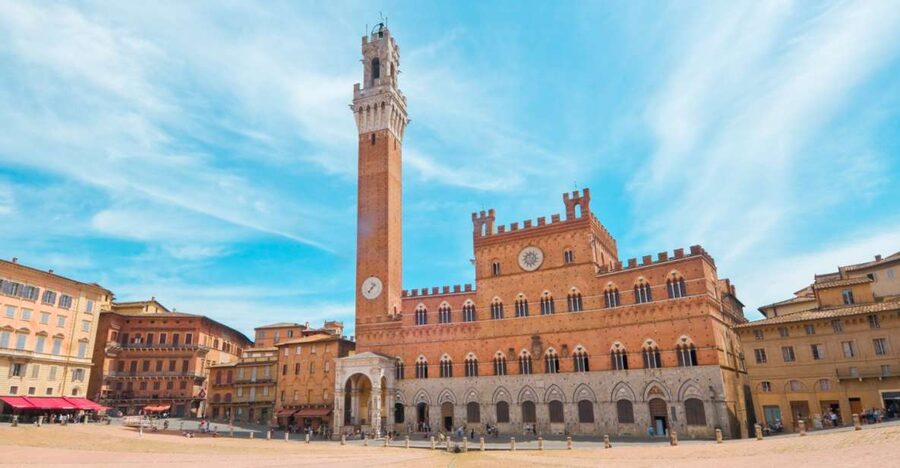
Next comes the Sala di Balìa, with 15th-century wall paintings by Spinello Aretino and Martino di Bartolomeo. These works are part of the pleasure of the visit: the art is not isolated in frames, but fitted into the room itself.
Look up and across the walls. In a building like this, the painted program works as a whole. Figures, architectural details, borders, and scenes all contribute to the room’s appearance. You may find yourself noticing small details only after standing still for a few minutes.
The paintings also show how Siena’s artistic identity developed across generations. The museum brings together works from different periods, so you can see changes in style without needing to visit several separate churches or galleries.
Because the museum does not provide an audio guide, visitors who want detailed explanations should do a little reading beforehand. For a casual visit, the visual impact is enough. For art lovers, a short guidebook or phone notes can make the names and dates easier to follow.
A few more Tuscany half-days worth a look
- Tuscany Day Trip from Florence: Siena, San Gimignano, Pisa and Lunch at a Winery
★ 5.0 · 21,634 reviews - Reserved Entrance to Leaning Tower of Pisa & Cathedral
★ 4.5 · 10,391 reviews - Milan: Da Vinci’s Last Supper Guided Tour
★ 4.7 · 10,143 reviews - Florence: Pisa, Siena and San Gimignano Day Trip with Lunch
★ 4.6 · 9,771 reviews
Sala dei Cardinali and its carved coffers
The Sala dei Cardinali offers a change from painted walls. Here, precious carved coffers hold reliquaries, bringing attention to craftsmanship as well as religious objects.
This is one of the rooms where the building itself becomes part of the display. The coffers are not just storage. Their carved surfaces show the care given to objects connected with worship and ceremony.
I like this stop because it breaks up the sequence of frescoes. A visit made entirely of wall paintings can become visually dense, especially when you are moving quickly. The woodwork and reliquaries give your eyes a different surface to study.
The room also helps explain the close link between civic life and religion in historic Siena. The palace was a government center, but its decoration reflects a society in which public authority, Christian devotion, and ceremony were closely connected.
Beccafumi’s vault and the Cappella
In the Sala del Concistoro, look up at the vault by Domenico Beccafumi. The ceiling is one of the museum’s most memorable features, and it rewards the simple act of pausing beneath it.
This room was used for council business, so the decoration had a public purpose. It surrounded political discussion with visual reminders of morality, order, and responsibility. Even without a guide, you can sense that these rooms were designed to shape how officials saw their work.
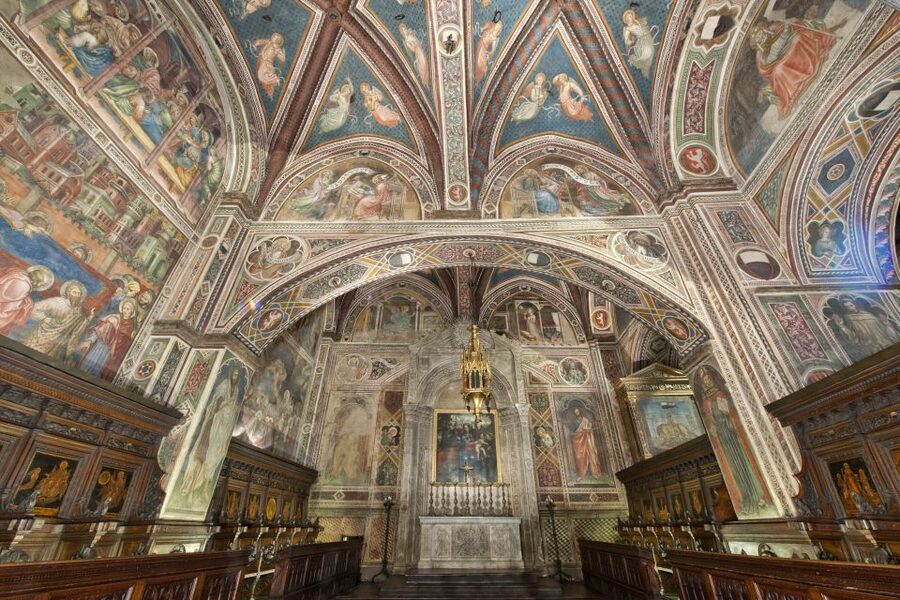
The nearby chapel, or Cappella, contains 15th-century work by Taddeo di Bartolo. Its smaller scale changes the mood again. After the large civic rooms, the chapel feels more intimate and devotional.
I recommend giving the chapel a little time instead of treating it as a passageway. The experience is strongest when you notice the shift from public council chamber to sacred space. The Palazzo Pubblico keeps making that transition, room by room.
Sala del Mappamondo and Simone Martini’s Maestà
The Sala del Mappamondo is the widest room in the palace and was used as the meeting place of the General Council. It is also where you find Simone Martini’s celebrated Maestà.
The painting is a major reason to come. It presents the Virgin Mary in majesty and reflects Siena’s strong devotion to her as the city’s protector. The work is filled with fine Gothic detail, elegant figures, decorative pattern, and careful color.
I love that the Maestà remains in a civic setting rather than being separated from the political room around it. Its location tells you something about Siena’s idea of government. Public authority operated under the protection and moral presence of the Virgin.
Take time to look beyond the central figures. The surrounding saints, angels, inscriptions, and architectural details reward close attention. This is not a painting to glance at on your way to the exit.
The room’s size also matters. You can understand why it was chosen for the General Council. It gives the work breathing space and allows you to imagine public meetings taking place beneath a major religious image.
The missing Allegory of Good and Bad Government
Many people come to the Palazzo Pubblico hoping to see Ambrogio Lorenzetti’s Allegory and Effects of Good and Bad Government, one of the most important civic painting cycles in Italy. At times, the frescoes are closed for restoration or unavailable because of work in the rooms.
That can be a real disappointment, especially if the paintings are the main reason you booked. The absence is not always made clear in advance, so it is sensible to check current conditions before your visit.
Even if Lorenzetti’s cycle is unavailable, the museum still offers Simone Martini’s Maestà, Beccafumi’s vault, works by Spinello Aretino and Martino di Bartolomeo, Taddeo di Bartolo’s chapel, and the carved coffers with reliquaries. I would not cancel a Siena visit solely because of the restoration, but I would adjust expectations.
If the allegories are open, they may become the emotional center of your visit. If they are closed, the museum still works as a compact introduction to Siena’s civic art and medieval palace interiors.
Loggia dei Nove and the view beyond the palace
The ticket also includes access to the Loggia dei Nove, a 14th-century gallery with a view behind the Palazzo Pubblico.
This is more than a pleasant final stop. After looking at enclosed rooms and painted ceilings, the open view gives you a sense of the setting that helped shape Siena. You can see the countryside beyond the city and understand the palace’s position within the wider Tuscan setting.
The Loggia is also useful as a pause. The museum can be visually intense, and stepping outside gives you time to process what you have seen. If you enjoy photography, this is one of the best parts of the visit, though flash photography inside the museum is not allowed.
Do not confuse this view with access to the Torre del Mangia. The tower is separate and not included in the $7 museum ticket. If you want to climb it, ask at the ticket desk about buying a separate ticket.
Is one hour enough for the Civic Museum?
For a brisk visit, yes. An hour gives you time to see the principal rooms, admire the major frescoes, and step onto the Loggia dei Nove.
I would allow more time if you care about medieval and Renaissance art. The walls are crowded with detail, and you will get more from the visit if you stop in each room rather than moving straight through. The museum is not enormous, but its art deserves attention.
The best pace is neither a quick photo stop nor an all-day study session. Plan on about an hour, then add time if you want to read closely, sketch, photograph permitted details, or combine the museum with the tower.
Because the experience is self-guided, you control the pace. That suits independent visitors who prefer to linger at the Maestà or move quickly through the Risorgimento room.
Price, access, and who will value it most
At $7 per person, this is one of Siena’s better-value cultural tickets. You receive access to the Civic Museum, a major historic palace, several decorated rooms, the Maestà, and the Loggia view. Even with some rooms closed, the price remains modest for a central Siena attraction.
I would recommend it most strongly to:
- Anyone interested in medieval or Gothic painting
- First-time visitors who want context for Siena’s political past
- Art lovers who value original frescoes in their historic setting
- Visitors looking for a one-hour indoor activity
- People who want a view from the palace without automatically buying the tower ticket
The visit is wheelchair accessible. The elevator door is 69 centimeters wide and the elevator is 83 centimeters deep, so check those measurements against your equipment before booking.
Opening hours can change, and access may be suspended during extraordinary events. The museum does not allow pets except assistance dogs, and large bags must be left out of the visit.
Should you book the Palazzo Pubblico ticket?
I would book this ticket if you want Siena’s art and civic story in one compact stop, especially if the Maestà appeals to you. The palace rooms are the real attraction, and the Loggia view adds a welcome outdoor finish.
I would pause only if your main goal is Lorenzetti’s Allegory and Effects of Good and Bad Government. Check restoration status first, since that cycle may not be visible. Also remember that the ticket does not include Torre del Mangia.
For $7, the balance is favorable. You get a serious art experience without committing half a day, and you can add the tower separately if you want a higher view. Enter through the Cortile del Podestà, exchange your voucher at the desk, and give yourself enough time to look up. The ceilings are often as important as the walls.
FAQ
Where do I exchange my voucher for the museum ticket?
Enter the Cortile del Podestà, the inner courtyard of the Palazzo Pubblico. Find the ticket office there and exchange your voucher before entering the museum.
How early should I arrive?
Arrive at the ticket office 10 minutes before your booked time.
How long does the visit last?
The stated duration is about one hour. You may spend longer if you want more time with the frescoes and historic rooms.
Is a guided tour included?
No. The ticket includes entrance to the Civic Museum only. A guided tour and audio guide are not included.
Is Torre del Mangia included?
No. Access to Torre del Mangia is separate. Tickets may be purchased directly at the ticket office.
Is the museum wheelchair accessible?
Yes. The museum is wheelchair accessible. The elevator door is 69 centimeters wide, and the elevator is 83 centimeters deep.
Can I bring luggage or a large bag?
No. Luggage and large bags are not allowed inside.
Can I take photographs?
Flash photography is not allowed. Access and opening hours may also change during extraordinary events.
Just added around Tuscany
- Florence Sunset Food Tour with Wine & Dine at a Tuscan farmhouse★ 5.0 · 194 reviews
- Wine Tasting Experience in Ponte Vecchio: Best Tuscany selection!★ 5.0 · 197 reviews
- Val d’Orcia Brunello Wine Tour with Montalcino and Montepulciano★ 4.5 · 359 reviews
- Wine Experience In Chianti Hills from Florence★ 4.5 · 195 reviews
- Tuscany Vespa Tour: Lunch & Wine Tasting, Countryside Roads★ 5.0 · 614 reviews
- Tuscany Vespa Tours Through the Hills of Chianti★ 5.0 · 515 reviews
- Tuscany Vespa Tour from Florence with Wine Tasting★ 5.0 · 425 reviews
- Tuscany Bike Tours Through the Chianti Hills with Wine Tasting★ 5.0 · 1,300 reviews
Entry Tickets in Tuscany, compared.
Siena Cathedral and Piccolomini Library Entry Ticket
Read our review →
Leaning Tower & Cathedral Tickets with Timed Entry
Read our review →
Pisa Excursion with optional Leaning Tower Entry Ticket
Read our review →
Browse the lists this tour appears in