
Reviewed · SKIP THE LINE
Palazzo Vecchio: Skip-the-Line Entry and Secret Passage Tour
Palazzo Vecchio’s grand halls are only half the story. This 75-minute small-group tour takes you through narrow stairways, concealed doors, private rooms, and passageways that most standard visitors never see. The Medici family used these spaces for work, storage, movement, and privacy, which gives the palace a more personal feel than its formal public rooms alone.
I like the tiny Studiolo of Francesco I, packed with the atmosphere of a private treasure room, and the chance to see Cosimo I’s Tesoretto. I also like the small group, limited to four people, since a guide such as Julia, Marta, Francesca, or Sara can explain details without shouting across a crowd.
The main caution is physical: tight, twisting stairs and narrow spaces are part of the experience. If you dislike enclosed rooms, have limited mobility, or need generous stairways, this may not be the right Palazzo Vecchio visit for you.
Key points to know before booking
- Secret rooms with real access: See spaces closed during a normal palace visit, including Medici rooms and concealed routes.
- A tiny group of four: The format allows easy questions and a clear view of the rooms.
- A strong Medici focus: Guides explain how the family lived, worked, moved, and protected its privacy.
- More than a corridor tour: The route includes Francesco I’s Studiolo, Cosimo I’s Tesoretto, and Vasari’s roof structure above the Salone del Cinquecento.
- The main palace comes afterward: The guided portion ends in the Hall of the Five Hundred, where you can continue exploring independently.
- Watch the stairs: Narrow, winding steps and warm, enclosed rooms can be uncomfortable for some people.
Why Palazzo Vecchio’s secret side is worth seeing
Palazzo Vecchio is easy to underestimate from the outside. From Piazza della Signoria, it looks like a fortress and city hall, which is exactly what it was meant to suggest. Inside, the palace becomes a stage for Florence’s political power and Medici ambition.
The public route gives you the grand effect: decorated rooms, painted ceilings, monumental sculpture, and the Hall of the Five Hundred. The secret passage tour adds something different. Instead of only admiring the palace from its grandest angles, you get to consider how people actually moved through it.
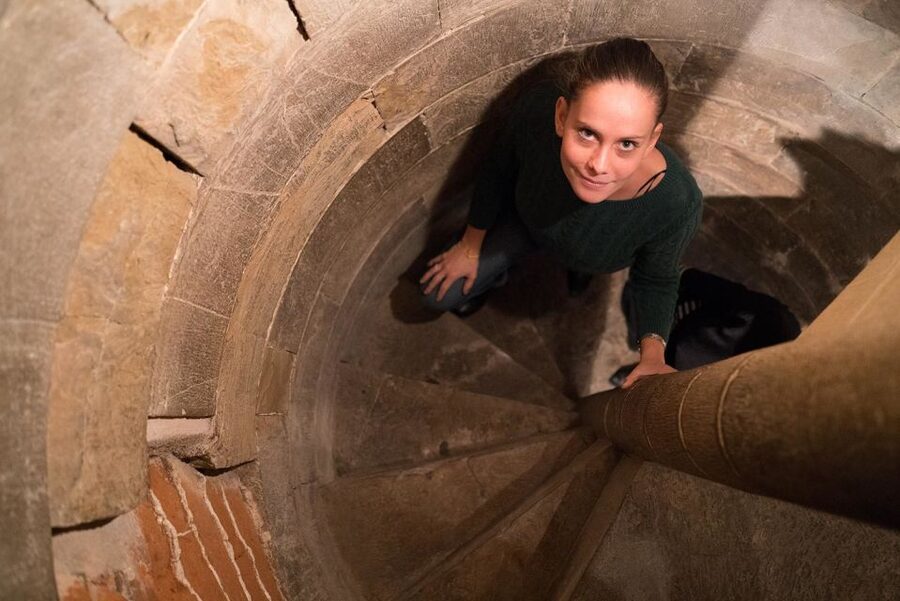
A concealed stairway built into the thick walls is one of the most memorable parts of the route. It was created at the order of Gualtieri di Brienne, and its design shows how much empty or hidden space can exist inside a massive medieval palace.
I find this kind of access valuable because the rooms are not simply smaller versions of the main halls. They show the practical side of power. A ruler needed private workrooms, storage areas, discreet routes, and ways to move around without crossing a public chamber every time.
More Skip-the-Line Tickets in Florence
- Florence: Skip-The-Line Uffizi Gallery Timed Entry Ticket
★ 4.5 · 27,832 reviews - Florence: Michelangelo’s David Skip-the-Line Entry Ticket
★ 4.5 · 12,764 reviews - Florence: Skip-the-Line Uffizi Small Group Tour
★ 4.6 · 5,926 reviews
Meeting your guide inside Piazza della Signoria
The entrance to Palazzo Vecchio is on Piazza della Signoria. Once inside the courtyard, do not wait in the general ticket line. Go to the ticket office and continue to the InfoPoint counter, where you exchange your voucher for the tour ticket.
This detail matters. One visitor had trouble finding the ticketing office because it is inside the building, not an obvious outdoor meeting point. Give yourself enough time to enter the courtyard, locate the counter, and get organized before the start.
The tour is conducted in English, and the group is limited to four participants. That is an excellent size for rooms with narrow doorways and limited standing space. You are more likely to hear the guide clearly, ask about a detail, and stay close enough to see a small object or hidden mechanism.
Guides vary, but the strongest praise has gone to people such as Francesco, Francesca, Julia, Giulia, Marta, Sara, Roberta, Simone, Martina, and Daisy. The consistent theme is clear storytelling and strong knowledge of the palace. Some guides focus more on Medici personalities, while others spend extra time on the building and its structure.
The secret stairway inside the thick walls
The tour begins with a look at the palace’s lesser-seen routes. You may pass through doors that blend into the surrounding architecture and climb stairways that feel more like service routes than elegant palace stairs.
The mysterious stairway built into the wall is a good example. It is not wide, polished, or designed for ceremony. Its appeal comes from the fact that it is hidden in the building itself. You can see how a powerful household could move between areas without using the main public route.
Expect tight turns and uneven-feeling movement through some areas. The passages are narrow, and the stairs twist in places. You should wear comfortable shoes and avoid carrying anything bulky if possible.
The enclosed spaces may also feel warm, particularly in summer. One person left the tour early because of claustrophobia, so be honest with yourself before booking. This is not a tour where you simply look at a hidden door from a wide gallery. You may need to enter the passage and climb through it.
Francesco I de’ Medici’s Studiolo
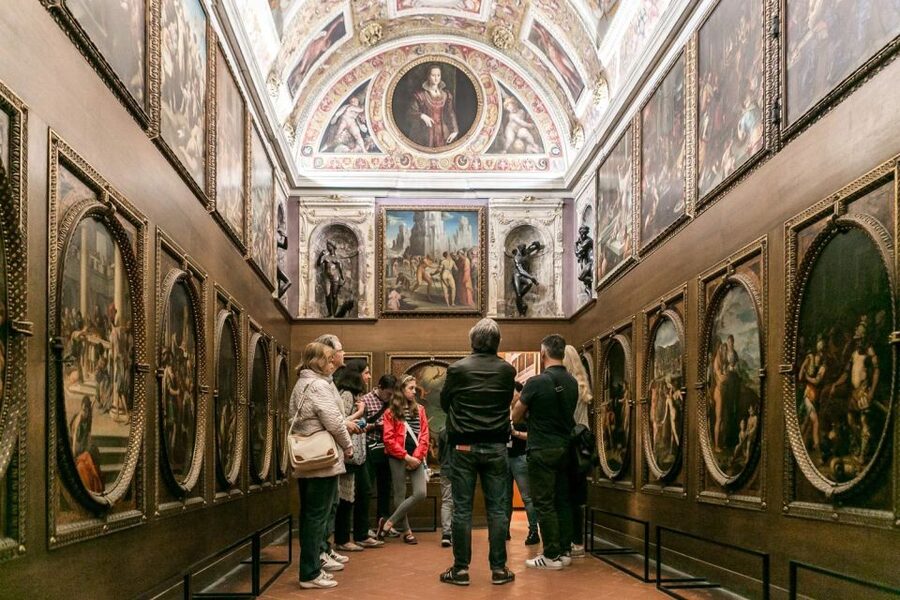
The Studiolo of Francesco I is one of the tour’s best stops. It was a small private study and treasure room, designed for rare and precious objects. Its scale makes it a sharp contrast to the huge state rooms elsewhere in the palace.
The room helps explain Francesco I’s personality and interests. Rather than presenting power through a vast audience hall, the Studiolo suggests a ruler surrounded by unusual objects, symbols, and carefully chosen decoration. Your guide can connect the room’s purpose to the wider Medici habit of collecting, displaying, and controlling valuable things.
This is also where the small group pays off. In a crowded room, it can be hard to see details or hear an explanation. With only four participants, you have a better chance of taking in the room’s decoration and asking why certain features were made private.
The Studiolo is not a giant art gallery, so do not book this tour expecting a long list of famous paintings. Its appeal is intimacy. You are seeing a personal room that reveals how a Medici duke presented himself when he was away from the formal business of government.
Same city, a completely different sort of day:
- Florence: Timed Entrance Ticket to Michelangelo’s David
★ 4.6 · 16,983 reviews - The Best tour in Florence: Renaissance & Medici Tales – guided by a STORYTELLER
★ 5.0 · 12,316 reviews - Florence: Leonardo Interactive Museum Entry Ticket
★ 4.5 · 11,763 reviews - The Best Tour in Florence: Renaissance and Medici Tales
★ 5.0 · 10,810 reviews
Cosimo I’s Tesoretto and the private working world
Another highlight is the desk of Francesco I’s father, Cosimo I, known as the Tesoretto. The name suggests a small treasury or collection of valuable things, and the space gives the tour another private angle on Medici rule.
Cosimo I is closely tied to the expansion and organization of Medici power in Florence. Seeing a place connected with his work makes the palace feel less like a static museum and more like an operating center. Decisions were made here, documents were handled here, and private business had to fit within the grand machinery of government.
Your guide will also help connect objects and rooms to the people who used them. That personal thread is one of the best reasons to choose this tour over a basic palace admission. You are not simply looking at a locked door. You are hearing why the room existed and how it fit into Medici life.
The stop is especially useful if you want to understand Florence through its ruling family. The tour does not treat the Medici as distant names from a textbook. It links rooms, habits, ambitions, and security concerns to real spaces in the building.
Secret doors, cabinets, and routes through the palace
The hidden doors are fun, but the tour works best when the guide explains their purpose. Some routes helped residents move unseen. Others provided access between rooms or offered storage and working space behind the palace’s public face.
You may be asked to guess where a concealed entrance is located, or to notice how a cabinet or panel blends into the room around it. These details reward close attention. Look at the walls, bookcases, paintings, and woodwork rather than focusing only on the floor ahead.
The route can feel theatrical, but it is not just a treasure hunt. The stories connect secret movement with security, privacy, and the complicated workings of a ruling household. Guides such as Julia and Marta have been especially praised for bringing these stories to life with humor and clear explanations.
This is also where the experience works well for families. Teenagers who have lost patience with churches and conventional museums may respond to the physical act of finding a passage or door. The history has a built-in mystery, and the route gives younger visitors something active to follow.
Vasari’s great roof structure above the Hall of the Five Hundred
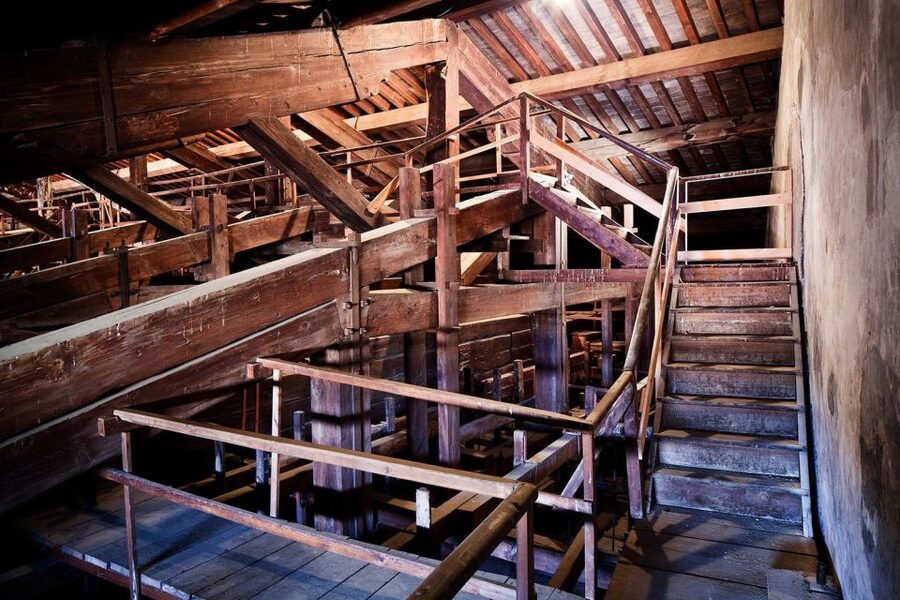
Near the end, the guide explains the huge trussed structure created by Giorgio Vasari. It supports the paneled ceiling of the Salone del Cinquecento, also called the Hall of the Five Hundred.
This is one of the tour’s strongest details for anyone interested in architecture or engineering. The grand ceiling is easy to admire from below, but the structure above shows the practical work needed to support it. One visitor with an engineering background found this part especially fascinating, and I can see why.
The stop also changes the way you look at the main hall afterward. Painted panels and decorative ceilings can seem purely artistic until you consider the beams, trusses, weight, and access needed to create them. The tour makes the palace’s beauty feel more physical and more complicated.
The Hall of the Five Hundred is where the guided portion ends. You can then continue through the rest of Palazzo Vecchio on your own, giving you a useful combination of expert context and free time.
What you can see after the 75-minute tour
The 75 minutes apply to the secret passage experience itself. They do not include a full guided tour of every room in Palazzo Vecchio.
Plan to spend another hour or so exploring the palace independently if you want to see the public rooms at a relaxed pace. The Hall of the Five Hundred is a natural place to continue, especially after hearing how its ceiling is supported.
This arrangement suits me better than a tightly scripted tour of the entire building. The guide handles the parts that are difficult or impossible to visit alone, then leaves you free to set your own pace through the main palace.
Keep in mind that the tower is not included. If climbing the tower is important to you, you will need a different ticket. The secret passage admission covers the palace entry and the guided route, not every possible Palazzo Vecchio attraction.
Is $37 a fair price?
At $37 per person, this is not the cheapest way to enter Palazzo Vecchio. A standard admission would normally be enough if you only want the public rooms and have no interest in restricted areas.
The price makes better sense when you treat it as a small-group access experience. You are paying for the guided explanation, the English-language tour, the restricted rooms, and a group capped at four. The secret spaces are the main value, since you cannot simply wander into them on your own.
I think it is a fair deal for first-time visitors who care about the Medici, palace politics, architecture, or unusual access. It is less useful for someone who prefers to move quickly through museums or who mainly wants the famous public rooms.
The tour also offers free cancellation up to 24 hours before the start and allows you to reserve without paying immediately. Those policies help if your Florence schedule is still shifting, but the main decision should be based on your interest in narrow, private spaces.
Who should book this tour?
I would choose this for:
- First-time visitors who want more than the standard palace route
- People interested in the Medici family and private court life
- Families whose children respond to mystery, doors, and secret routes
- Architecture fans who want to understand Vasari’s ceiling structure
- Visitors who prefer small groups and direct access to a guide
- Anyone who has already seen major Florence museums and wants a different angle
I would think twice if you have limited mobility, dislike enclosed spaces, or feel uneasy on narrow, twisting stairs. The tour is not recommended for people with limited mobility, and the route can be warm and cramped.
My verdict on Palazzo Vecchio’s secret passages
Book this tour if you want Palazzo Vecchio to feel like a working Medici residence rather than only a grand public museum. The Studiolo, Tesoretto, concealed doors, wall stairway, and Vasari’s roof structure give you a side of the palace that a normal visit will miss.
The small group and strong English-speaking guides add real value. Just remember that the experience is short, physical, and focused on restricted areas. If you can manage the stairs and enjoy a little closeness, the $37 price is justified. If you want only the main halls or need an easy, open route, choose a standard palace visit instead.
FAQ
How long does the secret passage tour last?
The guided tour lasts 75 minutes.
What does the ticket include?
It includes skip-the-line admission to Palazzo Vecchio and a guided tour of the secret passages and lesser-visited areas.
Is the tour conducted in English?
Yes. The tour includes a live English-speaking guide.
How many people are in the group?
The group is limited to four participants.
Where do I meet the guide?
Enter Palazzo Vecchio from Piazza della Signoria. Once inside the courtyard, go to the ticket office and then to the InfoPoint counter to exchange your voucher for the tour ticket.
Can I explore the rest of Palazzo Vecchio afterward?
Yes. The guided portion ends in the Hall of the Five Hundred, and you can continue exploring the rest of the palace independently.
Is the tower included?
No. The tower requires a different ticket.
Is the tour suitable for people with limited mobility?
No. The tour is not recommended for people with limited mobility because the route includes narrow and twisting stairs.
Can I cancel the booking?
Yes. You can cancel up to 24 hours in advance for a full refund. You can also reserve now and pay later.
Just added around Florence
- Walking Food Tour of Florence with Tastings and Wine★ 5.0 · 518 reviews
- Uffizi Gallery Timed Entry Admission Tickets★ 4.0 · 392 reviews
- Uffizi Gallery Small Group Tour with Guide★ 4.5 · 879 reviews
- Florence Accademia Guided Tour – Shared, Private & Combo Options★ 4.5 · 370 reviews
- Early Access Guided Uffizi Gallery Tour Skip-the-Line Small Group★ 4.5 · 707 reviews
- Uffizi and Accademia Small Group Guided Tour★ 4.5 · 449 reviews
- Florence Central Market Food Tour with Eating Europe★ 5.0 · 224 reviews
- Truffle Hunting Experience with Lunch in San Miniato★ 5.0 · 383 reviews
Skip the Line, compared.
Skip-The-Line Uffizi Gallery Timed Entry Ticket
Read our review →
Vatican Museums & Sistine Chapel Skip-the-Line Entry Ticket
Read our review →
Skip-the-Line Group Tour of the Vatican, Sistine Chapel & St. Peter’s Basilica
Read our review →
Michelangelo’s David Skip-the-Line Entry Ticket
Read our review →
Vatican Museums & Sistine Chapel Skip-The-Line Ticket
Read our review →
Vatican, Sistine Chapel & St. Peter’s Skip-the-Line Tour
Read our review →
Skip-the-Line Vatican, Sistine Chapel & St. Peter’s | Small Group
Read our review →
Vatican: Vatican Museums Sistine Chapel Skip-the-Line Ticket
Read our review →Browse the lists this tour appears in