
Reviewed · GUIDED TOURS IN SICILY
Benedictine Monastery of Catania – English Guided Tour
The most surprising part of Catania’s Benedictine Monastery is how many different worlds sit inside one complex. You move from Roman houses to a medieval religious foundation, grand late baroque rooms, lava-built cellars, and a modern university library. I like the way the 75-minute tour connects ancient remains with student life today, rather than treating the monastery as a frozen monument.
I also like the access to rooms you might otherwise miss, including the kitchens, cellar, novices’ garden, and library areas. Guides such as Carmen, Giovanni, Nicola, and others are praised for clear English, good humor, and thoughtful answers. The main drawback is that the route and access to certain areas can vary, and one tour time may not include the viewing platform.
Key points to know before you go
- Roman remains beneath a university library: See an ancient Roman house directly below a modern student mezzanine.
- Two cloisters and a lava-built cellar: The tour moves through some of the monastery’s most memorable spaces.
- A 75-minute history lesson: You cover roughly 2,000 years without giving up a whole morning.
- Guides make the difference: Carmen, Giovanni, Nicola, and other guides are praised for lively English presentations and humor.
- A working university, not just a museum: Students now use parts of the former monastery, including the library.
- Strong value at $11: The price is modest for a guided visit that includes areas not normally open to everyone.
Why this monastery is more than a pretty baroque building
Catania’s Benedictine Monastery of San Nicolò l’Arena is one of Europe’s largest monastic complexes. Its scale is the first thing to grasp. This is not a small cloister with a chapel and a few quiet rooms. It is a sprawling set of courtyards, corridors, libraries, gardens, kitchens, cellars, and monumental stairways.
The building also tells Catania’s story in layers. Roman remains lie below later construction. The Benedictine order brought wealth and ambition to the site. Late baroque architects reshaped the complex. Earthquakes, volcanic activity, changing religious life, and modern restoration all left their mark.
What makes the visit especially useful is the way the complex is still connected to everyday life. The University of Catania uses the monastery today, including the former cellar as the Library of the Department of Humanities. Students study beneath old stone vaults and beside archaeological remains. That contrast gives the visit more bite than a standard grand-palace tour.
You are not simply looking at old rooms. You are seeing how a historic building can keep changing its purpose.
More Guided Tours in Sicily
- Catania: Heart of the City Guided Walking Tour
★ 4.6 · 708 reviews - Catania: Underground Catania Tickets and Guided Tour
★ 4.6 · 536 reviews - ETNA SUNSET: GUIDED TOUR OF ETNA WITH PICKUP FROM CATANIA
★ 5.0 · 371 reviews
Meeting the guide at Piazza Dante
Enter through the main gate on Piazza Dante. Once inside the courtyard, look for the information point on the right. That is the meeting point, and baggage storage is available there, which is handy if you are carrying more than a small day bag.
The tour lasts 75 minutes and returns to the monastery entrance. An English-speaking guide leads the group, and written translations in French or Spanish can be provided if English is not your first language.
The route includes areas that are not normally accessible on a casual visit. That is important here. The monastery is large and still functions as part of a university, so wandering in without context would not give you the same access or understanding. A guide helps you know which architectural details matter and explains why a modern staircase, mezzanine, or library sits where it does.
The tour is wheelchair accessible. Since the complex is substantial and the route includes multiple parts of the building, you may still want to confirm the exact route when booking if you have specific mobility needs.
The two cloisters and Vaccarini’s grand design
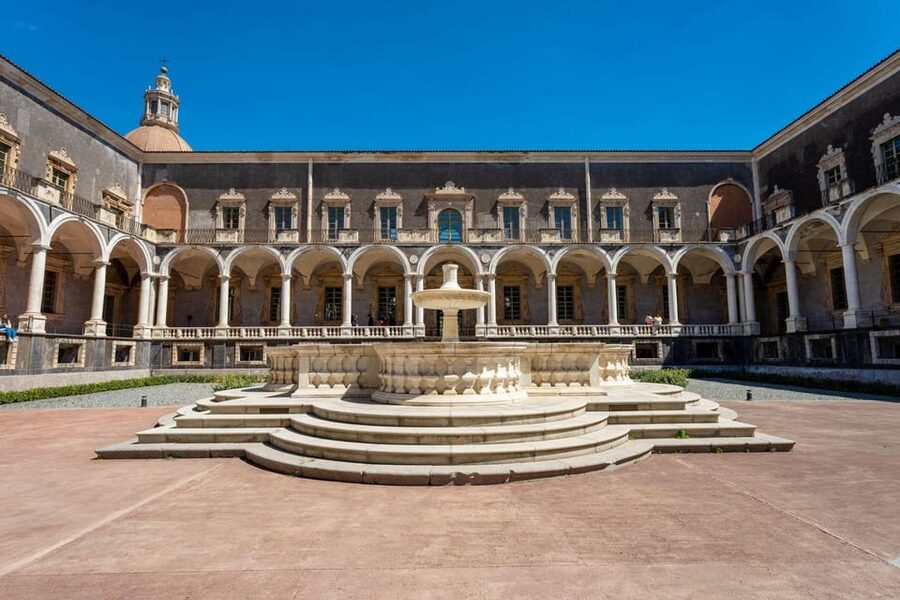
The cloisters provide the first clear sense of the monastery’s size and ambition. They are not simply peaceful courtyards for taking photographs. They help you understand how the monks’ daily life was organized around shared circulation, light, gardens, and work areas.
The tour also discusses the work of Giovanni Battista Vaccarini, one of the leading architects associated with Catania’s late baroque rebuilding. Look for the balance between practical monastic planning and theatrical architectural gestures. The monastery needed kitchens, storage, study rooms, and working spaces, yet it was also designed to express the standing and wealth of the Benedictine order.
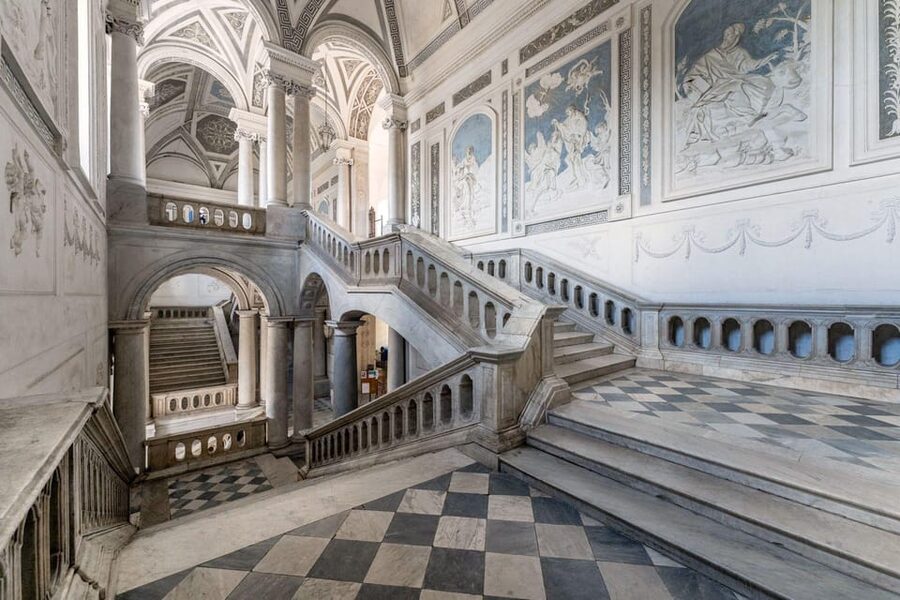
The monumental staircase is one of the most memorable architectural features. It gives the complex a sense of ceremony and scale. You can expect your guide to explain how the stairs fit into the wider design rather than simply pointing out their decoration.
I find this part most useful for visitors who have already seen Catania’s baroque center. The monastery shows the same taste for grand stonework and dramatic forms, but on a much larger and more complicated scale.
The Roman house under the modern library
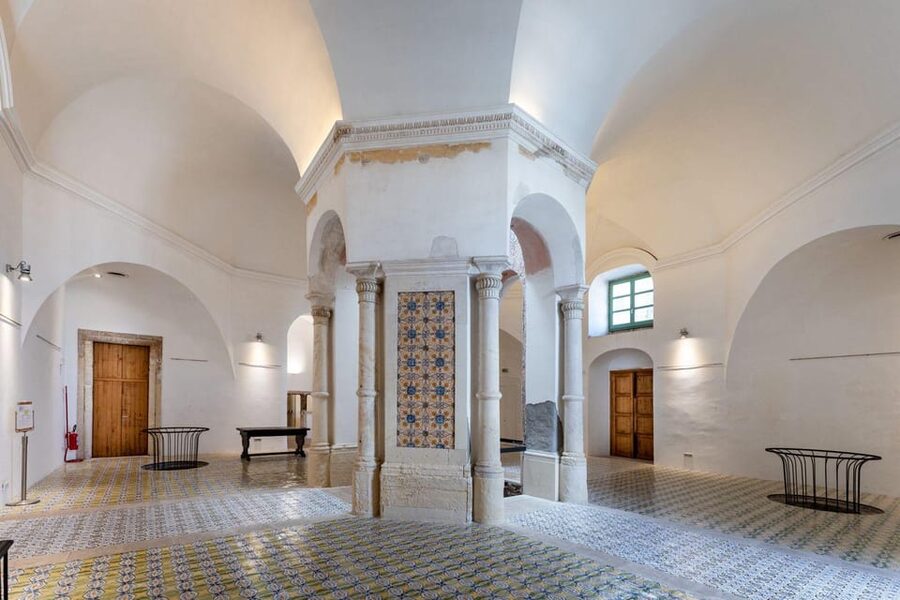
One of the tour’s sharpest changes of mood comes when you see a Roman house beneath a modern mezzanine used by university students. Ancient walls and archaeological remains sit directly below a contemporary academic space.
This is the kind of detail that is easy to miss if you only admire the monastery’s exterior. The Roman house shows that the site had an important life long before the Benedictines. The modern library shows that the location has not stopped being useful.
The contrast also explains why restoration here lasted more than 30 years. The goal was not to polish everything into one neat period. Instead, the restoration had to respect different layers of the site while allowing the building to function as a university. The contemporary refurbishment project led by architect Giancarlo De Carlo is central to that story.
You will see old masonry, modern interventions, and student facilities sharing the same complex. Some visitors may prefer a building restored in a single style. I think the mixture is one of the monastery’s strongest features because it makes the history visible rather than smoothing it away.
A few more Catania half-days worth a look
- Catania: Mount Etna Morning or Sunset Day Trip with Tasting
★ 4.8 · 4,028 reviews - Catania: Sunset Jeep Tour of Mount Etna and Lava Flow Caves
★ 4.8 · 2,113 reviews - Sicily: Etna and Alcantara Gorges Full-Day Tour with Lunch
★ 4.8 · 1,766 reviews - Catania: Etna Sunset Tour with Pickup and Drop-off
★ 4.8 · 1,348 reviews
The novices’ garden and the working side of monastic life
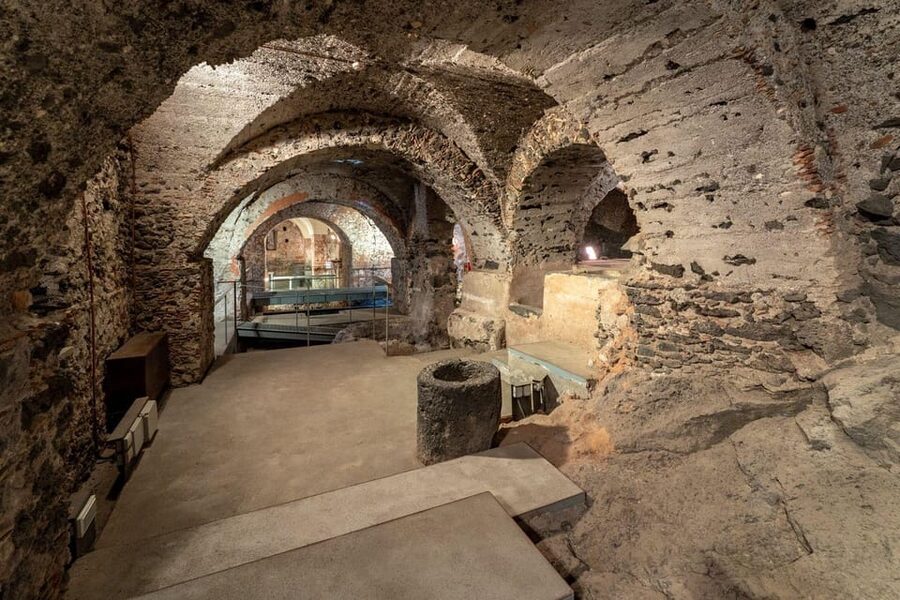
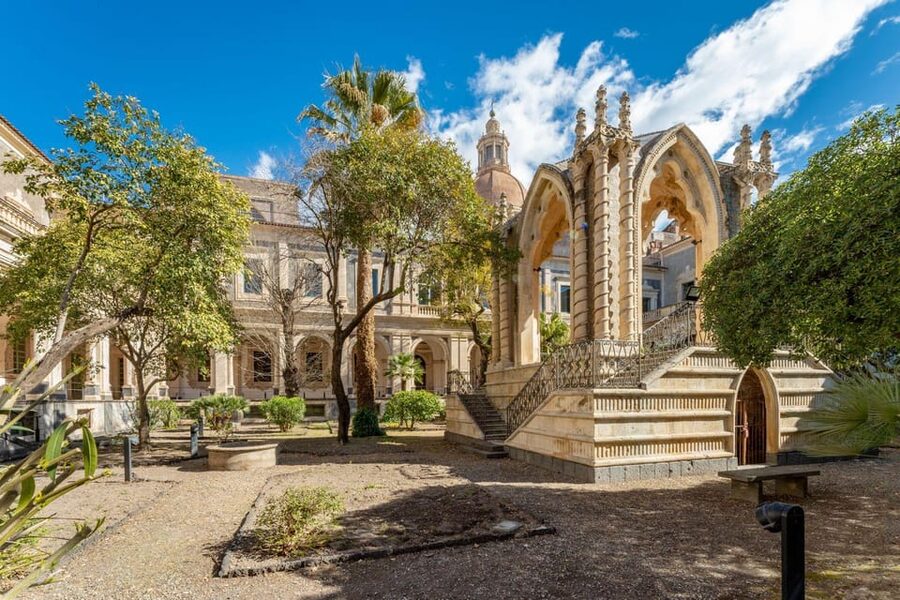
The Garden of the Novices gives the tour a more human scale. Grand corridors and public rooms can make a monastery seem like a place built only for ceremony. A garden connected with novices brings you closer to the routine and discipline of religious life.
This is also a useful stop for understanding the monastery as a self-contained community. The monks needed places for prayer, study, food preparation, storage, and training. The tour does not focus only on wealthy patrons and impressive architecture. It also shows how the residents moved through the building and used its quieter corners.
The garden may not be the single most dramatic sight, but it helps the rest of the tour make sense. Without spaces like this, it would be easy to view the monastery as a collection of grand rooms with no daily purpose.
The 18th-century kitchens and dining rooms
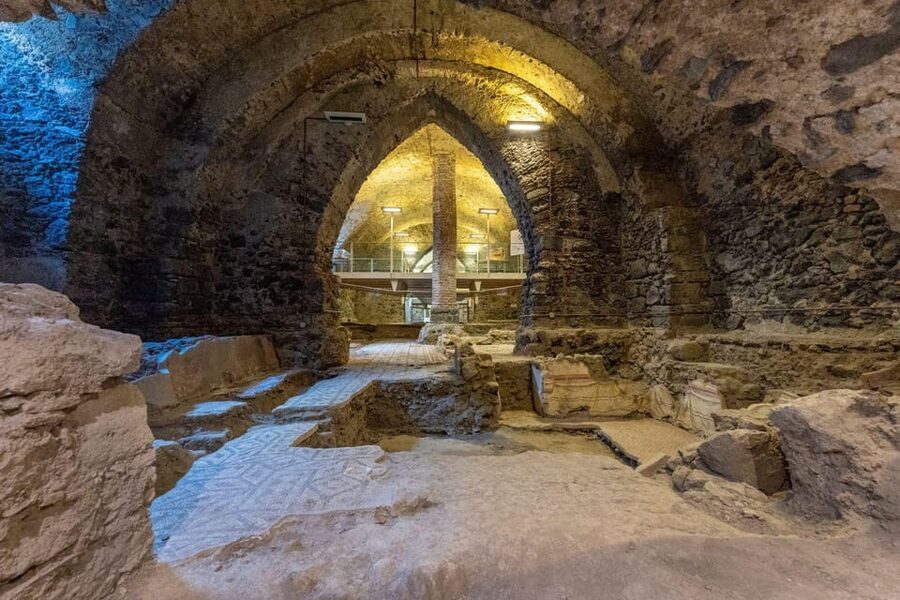
The famous kitchens are among the most practical and memorable parts of the visit. Large religious houses needed to feed many people, and the scale of the cooking areas reflects that fact.
Here, the monastery’s wealth becomes easier to understand. A powerful order could support extensive food preparation, large dining rooms, storage areas, and a staff of workers. These spaces tell you more about the institution’s resources than a decorative façade alone.
The dining rooms add another piece to the picture. They were built for communal life, with the monks eating together according to a set routine. Your guide can explain how these rooms fitted into the monastery’s social order and why the kitchens needed to be so substantial.
I like this section because it cuts through the idea that historic monasteries were only places of quiet prayer. They were also busy institutions with supplies to manage, meals to prepare, buildings to maintain, and people to organize.
The lava-built cellar and the cooler underground rooms
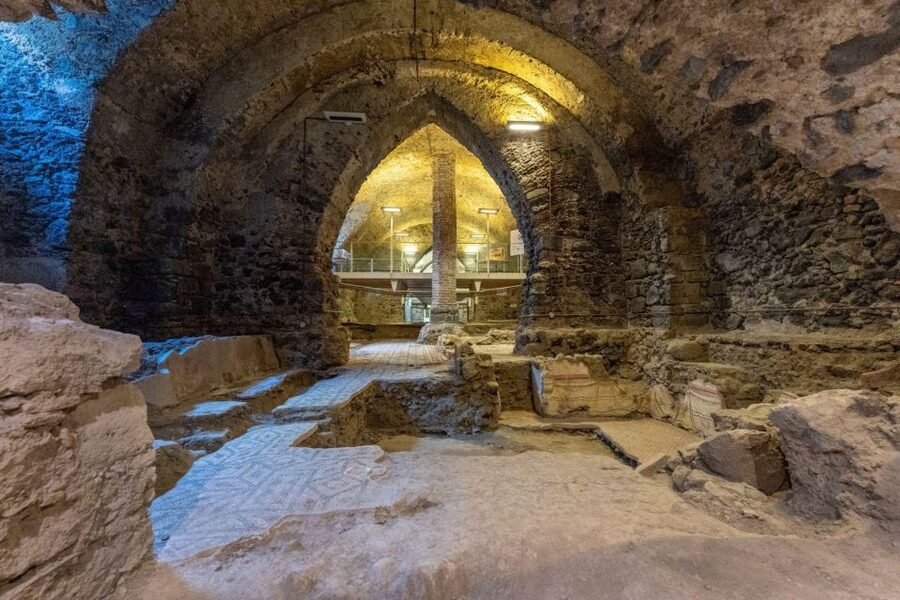
The cellar is one of the most unusual stops. It was built on lava, linking the monastery directly to Catania’s volcanic setting. The underground spaces also offer a welcome change from the bright courtyards and grand upper rooms, especially during hot weather.
The cellar is now used as the Library of the Department of Humanities. That reuse is practical and visually striking. Students work in a place originally connected with monastic storage and service, while the volcanic foundation remains part of the building’s physical story.
This is a good example of why the tour works best with a guide. A cellar may look like a dark stone room if you visit without explanation. With context, it becomes a meeting point between geology, architecture, religious life, and modern education.
The monastery’s lava foundations also help explain the character of Catania. The city has repeatedly had to build, rebuild, and adapt around volcanic ground and natural disasters. Here, those forces are not distant background facts. They are under your feet.
Corridors, libraries, and the long restoration
The monastery’s corridors can feel labyrinthine. That is part of the experience, but it also means the route benefits from a steady guide who keeps the group moving and explains how the sections relate to one another.
You will pass through library areas and see how the former monastic rooms now support university study. The library is one of Sicily’s most important, and its presence gives the building an active purpose. It is not a decorative shell waiting for special events.
The restoration took more than 30 years, a reminder of how difficult it is to preserve a complex of this size. The work had to accommodate archaeology, historic architecture, university use, and modern safety needs. Giancarlo De Carlo’s contemporary refurbishment did not try to hide every modern element. Instead, it allowed new construction to sit beside older fabric.
For me, this is the intellectual heart of the tour. You learn not only what the monastery was, but also how people decided what it should become.
What the guides add to the visit
The guides are a major reason to choose this experience instead of simply seeing the building on your own. Carmen is repeatedly praised for clear explanations, good pacing, and a light touch. Giovanni is noted for turning the history into an entertaining story, while Nicola is also praised for an engaging presentation.
The strongest guides do more than recite dates. They explain how the monastery’s architecture reflects power, how the monks lived, why the Roman remains matter, and how the building became part of the university. They also answer questions without making the tour feel like a formal lecture.
Several guides are described as funny and lively, but the humor does not replace substance. You still get a useful account of Catania’s history, the monastery’s inhabitants, its restoration, and its current role.
English is the main tour language. The available information also notes that written French or Spanish translations can be supplied for those who need extra help following the English presentation.
Is $11 good value for 75 minutes?
At $11 per person, this is one of the better-value cultural visits in Catania. The price is low enough to fit easily into a day of sightseeing, yet the tour gives you access to a very large historic complex and areas that are not normally open to casual visitors.
The value comes from the combination of access and interpretation. You see cloisters, Roman remains, the novices’ garden, kitchens, dining rooms, cellars, library spaces, and the monumental staircase. Without a guide, you might notice the beauty but miss the connections.
The 75-minute length is also sensible. The monastery is large enough to fill much longer, but a focused visit gives you a clear introduction without taking over your day. You can pair it with a walk through central Catania, a church visit, or a meal nearby.
One limitation is that not every part of the complex is guaranteed on every departure. The viewing platform, for example, may be available only on a later tour. If that viewpoint matters to you, check the departure details rather than assuming every time slot follows the exact same route.
Who should book this tour?
I recommend it most strongly to first-time visitors who want to understand Catania beyond its main streets and churches. It is also a good choice if you enjoy architecture, archaeology, religious history, or buildings that have been adapted for modern use.
Families and mixed-age groups should find the variety helpful. Roman ruins, underground rooms, gardens, kitchens, and grand stairways create more changes of scene than a tour made up of paintings and dates.
It suits independent travelers too. You do not need a full-day excursion to get value from it, and the relatively short duration makes it easy to fit between other plans.
The tour may be less satisfying if you want to explore every room at your own pace or spend a long time photographing details. A guided visit has a set route and timing. Still, the access to closed or less obvious areas is a fair trade for that structure.
Free cancellation up to 24 hours before the tour and the option to reserve now and pay later make it easier to fit into a changing schedule. The tour is also wheelchair accessible, though anyone with specific access needs should confirm the current route in advance.
My verdict on the Benedictine Monastery tour
You should book this tour if you want a compact but substantial introduction to Catania’s past and present. The monastery offers far more than baroque decoration: Roman remains, lava foundations, monastic kitchens, working libraries, university life, and a restoration story that lasted over three decades.
The best reason to go is the combination of places and explanations. You get the scale of one of Europe’s largest monasteries, but the guides also point out the small details that make the building understandable. At $11, the visit is an easy recommendation for most people with time in Catania.
Check the departure time if the viewing platform is important to you. Otherwise, allow 75 minutes, meet at the information point just inside Piazza Dante, and expect a thoughtful tour through one of the city’s most unusual buildings.
FAQ
How long does the Benedictine Monastery tour last?
The guided tour lasts 75 minutes and begins and ends at the Benedictine Monastery of San Nicolò l’Arena.
What is the price of the tour?
The tour costs $11 per person.
Where is the meeting point?
Enter through the main gate on Piazza Dante. The information point is in the courtyard on the right.
Is the tour conducted in English?
Yes. The live guided tour is in English. Written translations in French or Spanish can be provided if English is not your main language.
What can I see inside the monastery?
The route includes two cloisters, a Roman house, the Garden of the Novices, 18th-century kitchens, dining rooms, cellars, the library, the monumental staircase, and work associated with architect Vaccarini. Some areas may vary by departure time.
Is the monastery tour wheelchair accessible?
Yes, the activity is listed as wheelchair accessible. If you have particular mobility requirements, confirm the route before booking.
Can I cancel the booking?
Yes. You can cancel up to 24 hours in advance for a full refund. A reserve-now-and-pay-later option is also available.
Just added around Catania
- Syracuse, Ortigia and Noto walking tour from Catania★ 5.0 · 273 reviews
- The Godfather Movie Tour★ 5.0 · 275 reviews
- Tour Etna & Wine Tasting★ 5.0 · 317 reviews
- Etna, Wine and Alcantara Tour – From Taormina★ 5.0 · 464 reviews
- The Original Catania Street Food and Market Tour by Streaty★ 5.0 · 345 reviews
- Etna and Alcantara Gorges Excursion★ 4.5 · 256 reviews
- Etna Tour in 4×4★ 5.0 · 583 reviews
- Etna Morning Jeep Tour★ 4.5 · 241 reviews
Guided Tours in Sicily, compared.
Street Food Walking Tour with Local Guide & Tasting
Read our review →
UNESCO World Heritage Sites Guided Walking Tour
Read our review →

Guided tour of the Trapani Salt Pans and Salt Museum
Read our review →
ETNA SUNSET: GUIDED TOUR OF ETNA WITH PICKUP FROM CATANIA
Read our review →Browse the lists this tour appears in