
Reviewed · SKIP THE LINE
Rome: Castel Sant’Angelo Skip-the-Line Ticket & Audio Guide
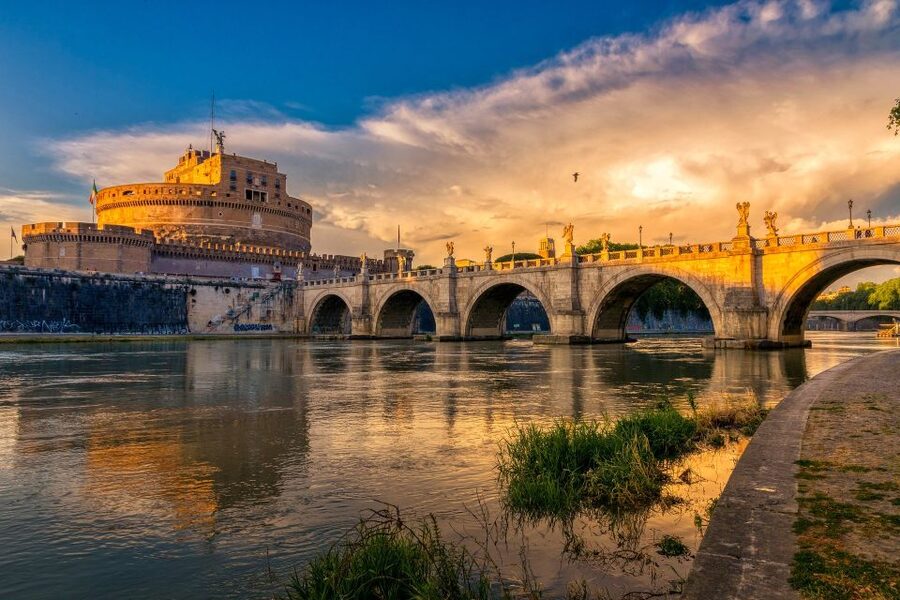
Castel Sant’Angelo is one of Rome’s best surprises: a Roman emperor’s tomb turned fortress, prison, papal refuge, and grand viewpoint. You’ll walk through layers of the city’s past, then climb to a terrace with broad views of the Tiber, St. Peter’s area, and Ponte Sant’Angelo. I especially like the freedom to set your own pace and the chance to see Hadrian’s tomb alongside papal corridors and military spaces. The skip-the-line entry can also save real time when the ticket queue stretches down the passage.
The main drawback is that this is not a fully guided tour. The audio guide is an optional phone app, and you must download it before arriving. The castle also requires stair climbing, so it is not suitable for wheelchair users or people with significant mobility limits. Your entry time is strict, too: arriving late can mean losing admission without a refund.
Key points to know before booking
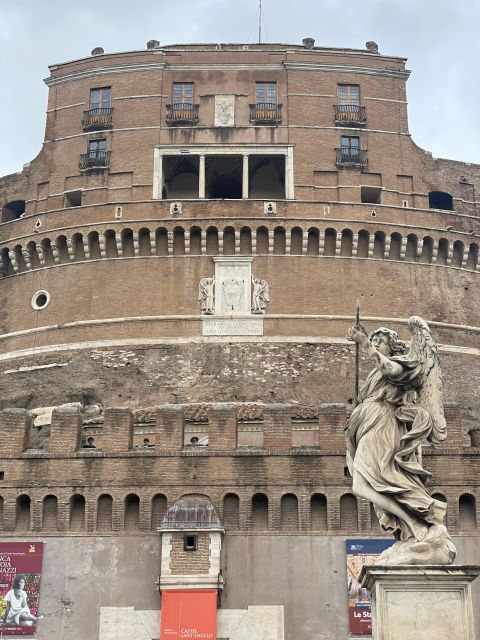
- A Roman mausoleum with many later lives: Hadrian’s tomb became a fortress, papal stronghold, and museum-like monument.
- The terrace is the payoff: Climb upward for sweeping views over Rome, the Tiber, and Ponte Sant’Angelo.
- Skip-the-line has real value at busy times: You enter with a reserved ticket instead of waiting to buy one on site.
- The audio guide is self-guided: Use your own phone, your own headphones, and your own timing.
- The Archangel Michael legend explains the name: The castle is tied to the story of the plague of 590.
- Plan for stairs and a timed arrival: This is a poor fit for limited mobility or a rushed schedule.
Why Castel Sant’Angelo is worth your time
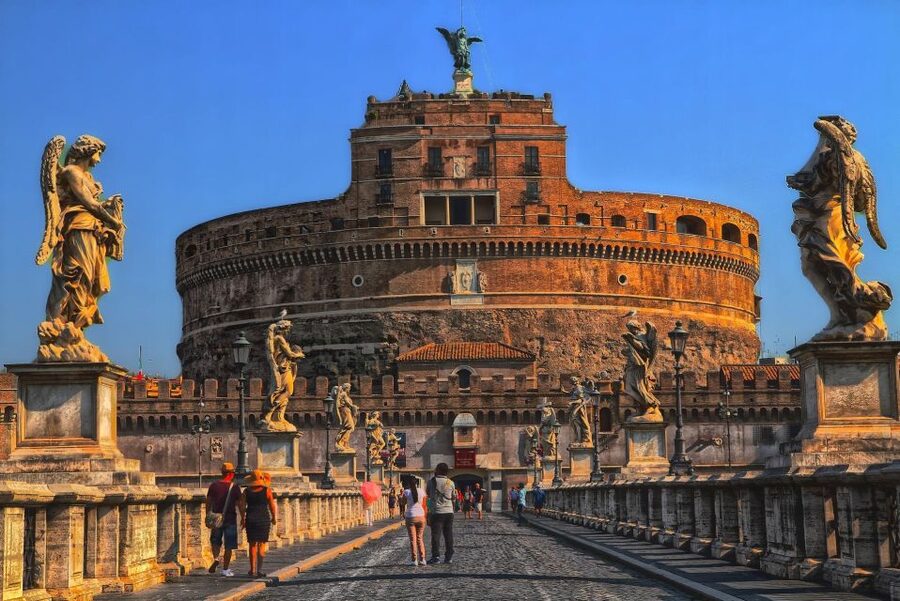
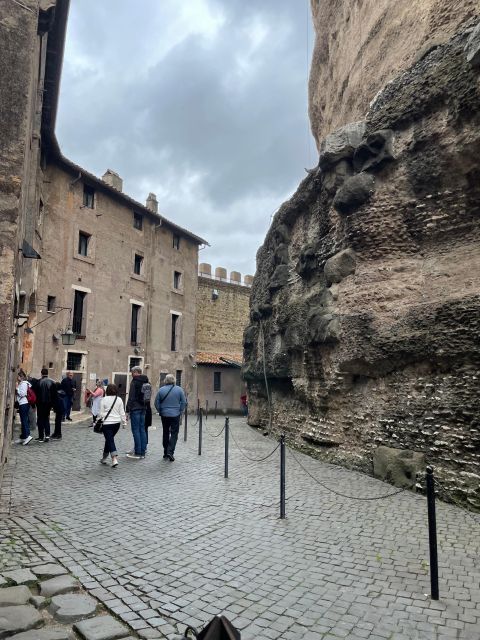
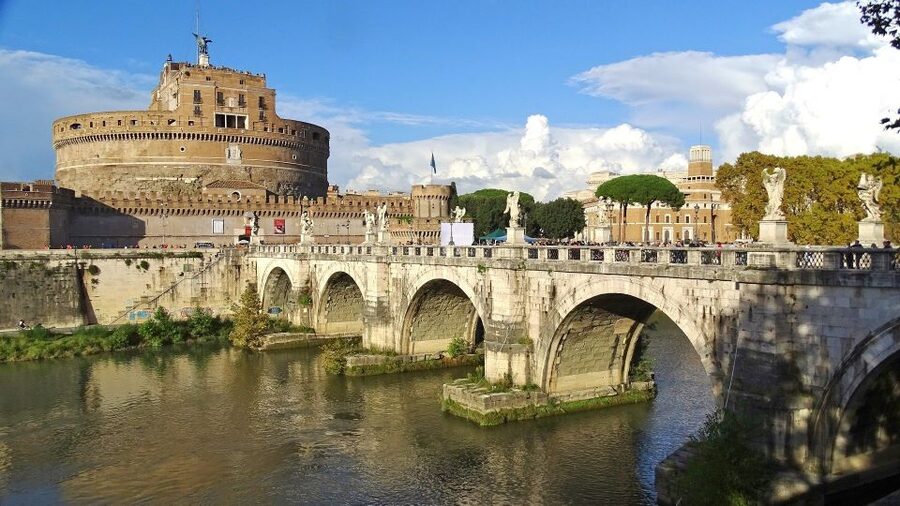
Many people first notice Castel Sant’Angelo from the outside, a round, heavy fortress near the Vatican. From the street, it can look stern and closed off. Inside, the building opens into a long story that reaches from imperial Rome to the papacy and the modern city.
The original structure was built as the mausoleum of Emperor Hadrian. It was also known as Hadrian’s Mole, a name that hints at its massive size and rounded form. Over time, the building changed purpose. Its thick walls and commanding position beside the Tiber made it useful as a defensive fortress. The papacy later connected it to the Vatican through fortified corridors.
That mixture is what makes the visit rewarding. You are not simply touring a palace or looking at one ancient monument. You are moving through a building that was repeatedly adapted for power, defense, religion, and display.
I like sites that make Rome’s long timeline easy to see. Castel Sant’Angelo does that without requiring you to visit several separate locations. A room, passage, or wall can belong to a different period from the space next to it, and the building’s shape helps you feel that change.
More Audio Guide Tours in Rome
- Rome: Colosseum & Forum with Audio Guide App -Optional Arena
★ 4.2 · 24,770 reviews - Rome: Pantheon Fast-Track Ticket and Official Audio Guide
★ 4.3 · 21,008 reviews - Rome: St. Peter’s Basilica & Dome Entry Ticket & Audio Tour
★ 4.2 · 7,537 reviews
Entering with a reserved ticket
This experience does not require a traditional meeting point. Your entry ticket is sent by email, generally in the late afternoon of the day before your visit, with delivery also noted for WhatsApp or email around 24 hours before entry. You show the ticket at the castle at your scheduled time.
That arrangement is handy, but it puts the responsibility on you. Check your inbox and messages before leaving for the site. Download the audio-guide application before you arrive if you selected that option. Do not wait until you are standing at the entrance and trying to solve a phone problem.
The ticket is described as valid for one day, but this does not mean you can arrive at any time. Entry is tied to the scheduled time, and punctuality matters. Last admission is at 6:30 PM. If you arrive late, admission may be refused without a refund, so allow time to reach the castle and find the entrance.
The skip-the-line benefit is most useful when the ticket-buying queue is long. One morning, the line was reported to snake around the corridor, while reserved-ticket holders could go directly inside. At a quiet time in February, the same feature may matter less because there may be little or no line. That is the honest value calculation: you are paying for convenience and timing, not simply for admission.
The listed price is $20 per person, while the official ticket price is €16. The difference pays for the reservation service and the convenience of arranging your visit in advance. If you are visiting during a busy period, that can be a sensible trade. If you are visiting in a quiet month and are happy to wait, the premium may feel less worthwhile.
Hadrian’s tomb and the Roman beginning

Once inside, look past the fortress image and keep the original purpose in mind. This began as the tomb of Hadrian, one of Rome’s emperors. The building’s circular mass was designed to make a strong impression, and its later military role did not erase that earlier identity.
The visit gives you a chance to connect the architecture with the emperor’s burial monument. You might find some of the interiors more atmospheric than visually polished, especially compared with Rome’s churches and art-filled palaces. That is part of the appeal. Castel Sant’Angelo feels substantial and defensive, with thick masonry, enclosed routes, and changes in level.
Follow the signs as you go. There is information posted throughout the castle, and you can explore independently without choosing the audio guide. Several people found the written material enough to understand the route and avoid missing major sections.
I would still choose the audio option if you enjoy context. The building can be confusing at first, and an audio explanation helps connect Hadrian’s tomb with the later fortress and papal uses. The app also lets you stop, look around, and continue when ready. You are not tied to the pace of a group.
Papal corridors and the castle’s later life
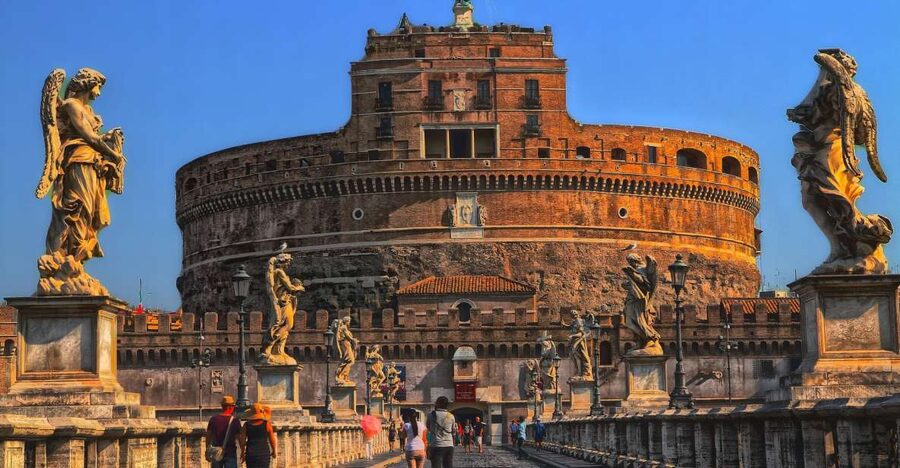
The papal connections give Castel Sant’Angelo its most dramatic medieval and Renaissance chapter. The castle’s corridors linked it with the Vatican area and provided a protected route during danger. Seeing these routes helps explain why the monument mattered long after Hadrian’s burial.
The Papal corridors are one of the key features included in the visit, but you should not expect a single polished narrative from every room. This is a large, layered site. Some areas reward close attention to the signs, while others are more about atmosphere, stonework, and the feeling of moving through a fortified complex.
The optional guide is available in English, Italian, French, Spanish, German, and Chinese. It is app-based rather than a set of rental headphones. That saves you from collecting and returning equipment, but it also means your phone must be ready.
The application needs roughly 100 to 150 MB of free space. It works with Android version 5.0 and later and with supported iPhones, but it is not compatible with Windows Phones, iPhone 5, iPhone 5C, older iPhones, older iPod Touch models, iPad 4th generation or older, or the first iPad Mini. Bring your own headphones because none are provided.
One useful detail is that the audio option includes text as well as sound, according to the experience information. That can help if you prefer reading, need to keep the volume low, or find it easier to absorb details at your own speed.
More Entry Tickets in Rome
- Vatican: Museums & Sistine Chapel Entrance Ticket
★ 4.5 · 144,003 reviews - Rome:Hop-On Hop-Off Panoramic Open Bus Ticket 3 Circuits x 1
★ 4.0 · 15,405 reviews - Vatican Museums & Sistine Chapel Skip-the-Line Entry Ticket
★ 4.4 · 13,838 reviews - Rome: Vatican Museums & Sistine Chapel Skip-The-Line Ticket
★ 4.2 · 11,708 reviews
The Archangel Michael legend
The name Castel Sant’Angelo comes from a story connected to the plague of 590. According to the legend, the Archangel Michael appeared above the mausoleum and sheathed his sword, signaling that the plague was ending.
You will find this story tied to the monument’s identity and its statue-topped silhouette. It is a good example of how Rome layers religious meaning onto older Roman structures. The ancient mausoleum did not disappear when the building became a fortress. Instead, new stories and uses gathered around it.
This is where an audio guide can be especially helpful. A room-by-room explanation can give shape to details that might otherwise feel disconnected. Still, do not feel obliged to listen to every section. You can use the app selectively, read the posted information, or simply walk and look. The experience works best when you treat the guide as a tool, not as homework.
Climbing to the panoramic terrace

The upper terrace is the clearest reward for making the climb. You will need to use stairs, and the route is not suitable for wheelchair users or people with mobility impairments. Comfortable shoes are a must, especially if you plan to take your time inside.
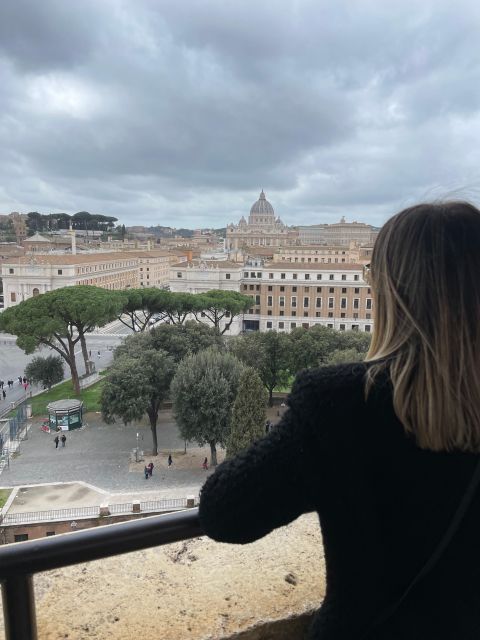
From above, Rome opens in several directions. You can look across the River Tiber, toward the Vatican area, and down to Ponte Sant’Angelo, also called the Bridge of Angels. The bridge is especially photogenic from the castle, with its line of statues and its approach toward the monument.
The views are not a quick add-on. They change how you understand Castel Sant’Angelo’s position. From ground level, the fortress can feel sealed off. From the top, you see why the location mattered, with the river, bridge, and nearby Vatican district laid out around it.
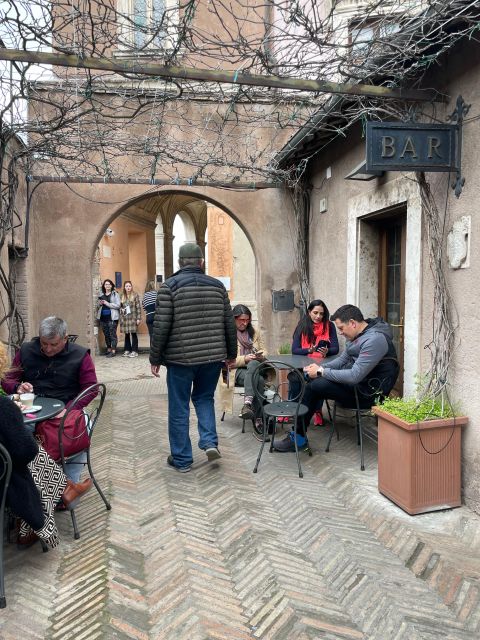
There is also a café partway up, with views toward the Vatican City. Availability and crowd levels can vary, but it can be a pleasant pause if you want a drink or something to eat. Do not build your schedule around the café, though. The castle itself is the main event, and the rooftop seating can be busy.
Allow more time than you might expect. A quick visit could cover the main route and terrace, but people who read the displays and use the full audio guide have spent several hours inside. I would allow at least two hours if you want to explore without rushing, and more if you plan to stop often for photos, the café, and the views.
Using the audio guide well
The self-guided format suits you if you prefer independence. You can pause at a doorway, skip a section, replay an explanation, or leave the phone in your pocket while looking closely at the architecture.
It also avoids the limits of a large group. You do not have to keep up with a guide or wait while someone else takes photos. That freedom was one of the strongest reasons to choose the audio option.
There are tradeoffs. A phone screen can distract you from the rooms, and you must manage battery power, storage, and headphones. If your phone is old or incompatible, the app may not work. Download everything in advance and bring a charged device.
If you prefer to look rather than listen, the castle can still be visited without the audio guide. Clear signs and information panels support an independent visit. The ticket-only option is also cheaper in spirit, since you are not paying for a feature you will not use.
Timing, access, and practical limits
The experience is best for someone who can arrive at a fixed time and climb stairs comfortably. It is less suitable if you need flexible admission, have heavy luggage, or want a fully guided tour with a person leading the way.
Large bags and luggage are not allowed, along with pets, weapons, and sharp objects. Carry only what you need for the visit. Bring your passport or ID card, comfortable shoes, a charged smartphone, and headphones if you selected the audio guide.
The visit takes place near the Vatican, making it easy to pair with other central Rome sights, but do not squeeze it into a tiny gap between appointments. The strict entry time and the size of the castle make a rushed plan frustrating.
Due to the Jubilee, some monuments may be under restoration and access routes may change. Check your messages before you go for current instructions. That is particularly important if your route depends on seeing a specific corridor or entering through a particular access point.
Cancellation is flexible up to 24 hours before the visit for a full refund. After that point, the strict entry rule becomes more important. Save your ticket offline if possible, but still keep the original email or WhatsApp message available.
Who should book this Castel Sant’Angelo visit?
I would recommend it to first-time Rome visitors who want a major historic site with strong views but do not need a full live tour. It also suits independent visitors who like to read, stop, and take photos without being hurried.
Families with older children may enjoy the fortress setting and the legend of the Archangel Michael. The building has enough variety to keep the visit moving, though younger children may tire from the stairs and long interior route.
History fans should choose the audio guide if their phone supports it. The app adds useful context to Hadrian’s tomb, the papal corridors, the plague legend, and the castle’s changing role.
I would hesitate if you have limited mobility, dislike stairs, or are uncomfortable with timed entry. I would also think twice about the audio option if you do not want to use your phone during sightseeing. In that case, the ticket-only visit and the posted information may be a better match.
Should you book it?
Book this experience if you want an easy entry plan, a self-paced visit, and one of Rome’s best high viewpoints. The $20 price is reasonable when queues are long and your schedule is tight, though the €16 official ticket price means the convenience fee is worth weighing during quiet periods.
Choose the audio guide if you want the building’s many chapters explained as you go. Skip it if you prefer to read signs and explore freely. Either way, the real reward is the combination of Hadrian’s mausoleum, papal history, fortress rooms, and the terrace above Ponte Sant’Angelo.
FAQ
How much does the Castel Sant’Angelo ticket cost?
The listed price is $20 per person. The official ticket price is €16, so the higher price covers the reserved entry arrangement and booking convenience.
Is the audio guide included?
The smartphone audio guide is optional. It is available in English, Italian, French, Spanish, German, and Chinese.
Do I need to meet a guide?
No. There is no required meeting with a guide. Your ticket is sent by email, with delivery also noted through WhatsApp or email before the visit.
When will I receive my ticket?
Tickets are sent by email in the late afternoon of the day before the entry date. The information also states that tickets are sent by WhatsApp or email around 24 hours before the activity.
Can I arrive at any time during the day?
No. You must arrive at your scheduled entry time. Late arrival can lead to denied access without a refund. Last entry is at 6:30 PM.
Do I need headphones for the audio guide?
Yes. Headphones are not included, so bring your own if you select the audio-guide option.
Is Castel Sant’Angelo accessible to wheelchair users?
No. The activity is not suitable for wheelchair users or people with mobility impairments, and you must climb stairs to reach the panoramic terrace.
Can I cancel for a refund?
You can cancel up to 24 hours before the activity for a full refund.
More Skip-the-Line Tickets in Rome
- Skip-the-Line Group Tour of the Vatican, Sistine Chapel & St. Peter’s Basilica
★ 4.5 · 12,779 reviews - Vatican, Sistine Chapel & St. Peter’s Skip-the-Line Tour
★ 4.5 · 7,770 reviews - Skip-the-Line Vatican, Sistine Chapel & St. Peter’s | Small Group
★ 5.0 · 7,060 reviews - Vatican: Vatican Museums Sistine Chapel Skip-the-Line Ticket
★ 4.2 · 6,682 reviews
Just added around Rome
- Boat excursion to Gaeta with a stop for swimming and snorkeling 2 HOURS★ 5.0 · 240 reviews
- Palatine Hill and Roman Forum Tour with Fast-Track Entrance★ 4.2 · 417 reviews
- Tivoli: Villa D’Este & Villa Adriana Pass & App Audioguide★ 4.4 · 364 reviews
- Tivoli: Villa D’Este Entry Ticket and App Audio Guide★ 4.3 · 191 reviews
- From Rome: Villa D’Este & Villa Adriana Day Trip with Lunch★ 4.4 · 289 reviews
- Vatican Museums & Sistine Chapel Skip-the-Line Guided Tour★ 4.6 · 254 reviews
- Rome: Capitoline Museums and Centrale Montemartini Tickets★ 4.4 · 328 reviews
- Rome: The Three Tenors at St. Paul’s Church Concert Ticket★ 4.7 · 699 reviews
Skip the Line, compared.
Skip-The-Line Uffizi Gallery Timed Entry Ticket
Read our review →
Vatican Museums & Sistine Chapel Skip-the-Line Entry Ticket
Read our review →
Skip-the-Line Group Tour of the Vatican, Sistine Chapel & St. Peter’s Basilica
Read our review →
Michelangelo’s David Skip-the-Line Entry Ticket
Read our review →
Vatican Museums & Sistine Chapel Skip-The-Line Ticket
Read our review →
Vatican, Sistine Chapel & St. Peter’s Skip-the-Line Tour
Read our review →
Skip-the-Line Vatican, Sistine Chapel & St. Peter’s | Small Group
Read our review →
Vatican: Vatican Museums Sistine Chapel Skip-the-Line Ticket
Read our review →Browse the lists this tour appears in