
Reviewed · ENTRY TICKETS IN BOLOGNA
Ravenna: UNESCO Mosaics Entry Tickets
Ravenna’s mosaics are the main event here: tiny glass and stone tiles turn churches, chapels, and baptisteries into glowing picture books from the Roman and Byzantine eras. The seven-day ticket lets you spread the visits out instead of racing through them in one afternoon.
I like the freedom to visit each monument at your own pace, and I like the value of the five-monument option, especially since the main sites are within walking distance. The tradeoff is simple: no guided tour is included, so you will get more from the buildings if you read the displays or arrange your own guide.
Key points to know before you go
- San Vitale’s Justinian and Theodora mosaics: See Ravenna’s most famous imperial portraits inside a remarkable sixth-century church.
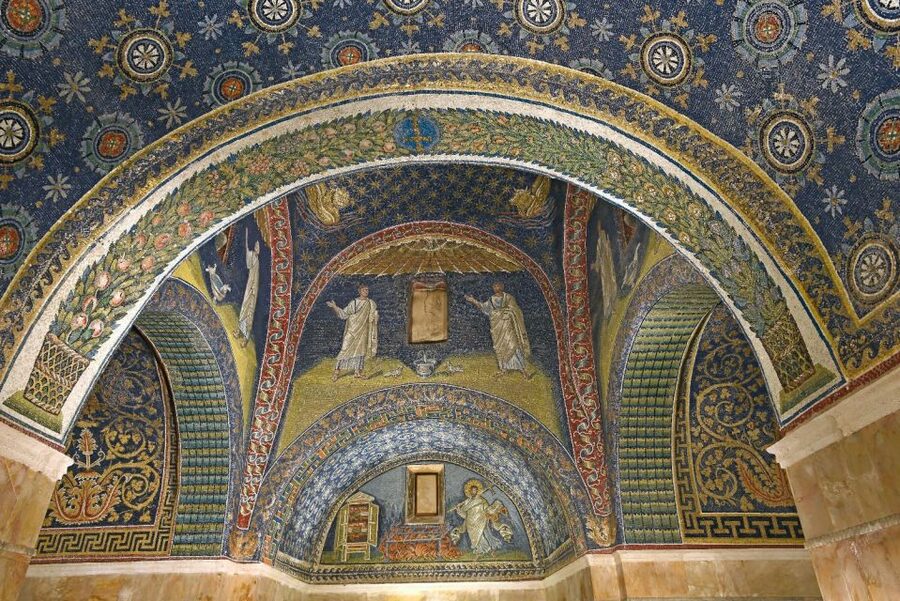
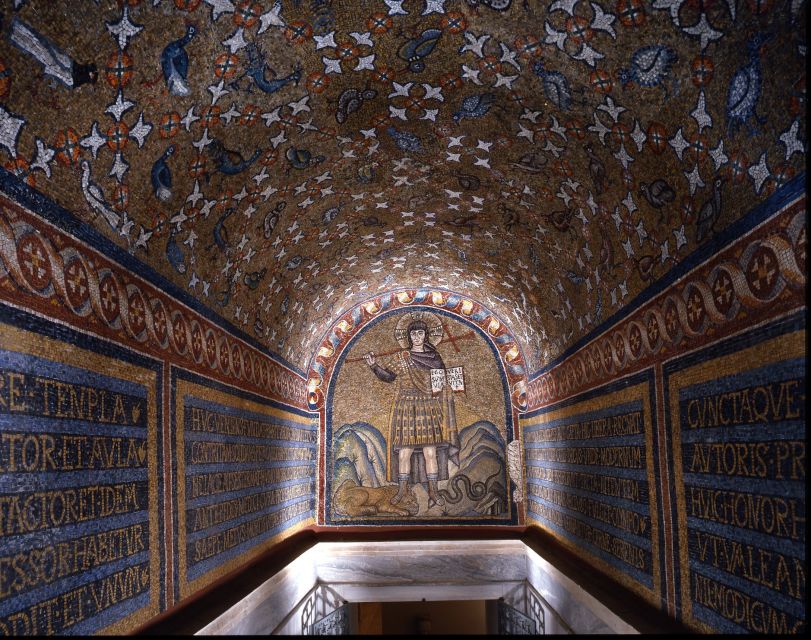
- Galla Placidia option: Add one of Ravenna’s most atmospheric interiors, with a ceiling of starry mosaics.
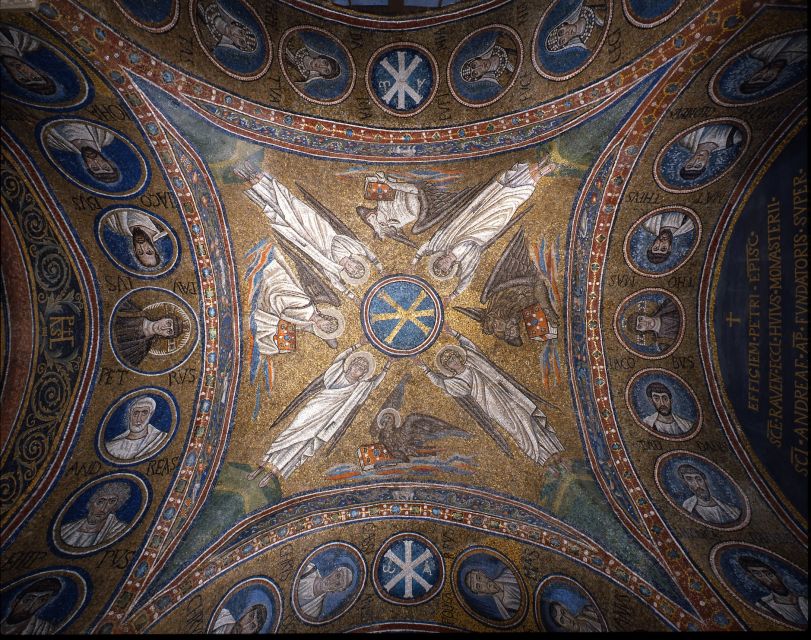
- St. Andrew’s Chapel: Visit the private chapel of Ravenna’s bishops inside the Archiepiscopal Museum.
- Seven days of access: Use the ticket once at each included monument, with no need to see everything on the same day.
- Five sites within walking distance: The larger ticket adds the Mausoleum of Galla Placidia and Neonian Baptistery.
- Self-guided format: You receive entry, not a tour, so comfortable shoes and a little preparation help.
Why Ravenna’s mosaics deserve your time
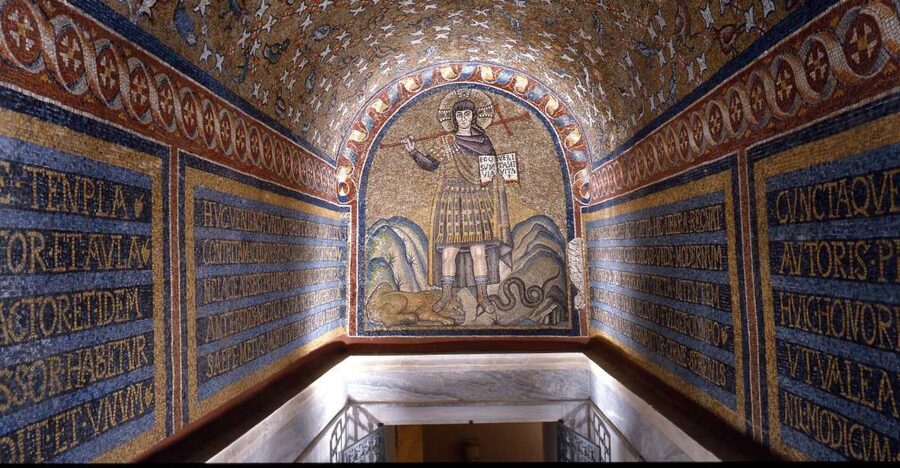
Ravenna can look fairly ordinary at street level. Its greatest treasures are indoors, behind plain brick walls and modest church façades. Step inside, though, and the mood changes quickly. Gold backgrounds catch the light, faces look out from centuries ago, and every surface seems more carefully planned than the exterior suggests.
The ticket covers some of the city’s most important early Christian and Byzantine monuments. Together, they show Ravenna at several turning points: Roman power, Ostrogothic rule, Byzantine influence, and the religious life of the bishops who governed the city.
I would allow at least one full day for the main sites, though the seven-day validity gives you room to take breaks. The buildings are close enough to visit on foot, but the art rewards slow looking. If you hurry from doorway to doorway, you will see the colors but miss much of the meaning.
This is an entry ticket rather than a guided experience. That keeps the cost low and gives you control, but you should know what you are looking at before entering. A simple guidebook or the information panels at each site will make the difference. If you happen to arrange a separate guide, the experience can become much more layered. Cinzia has been praised for bringing a different point of view to the works, but no guide is part of this ticket.
More Entry Tickets in Bologna
- Maranello: Ferrari Museum Entrance Ticket
★ 4.6 · 1,505 reviews - Maranello and Modena: Ferrari Museums Combo Tickets
★ 4.7 · 994 reviews - Modena: Enzo Ferrari Museum Entrance Ticket
★ 4.5 · 422 reviews
San Vitale and the imperial world of the sixth century
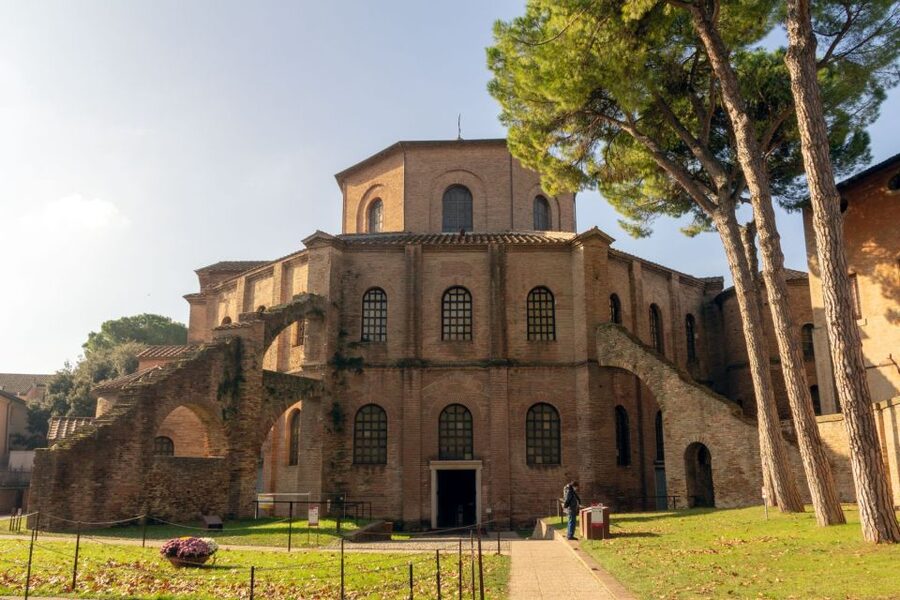
Start with the Basilica of San Vitale if you want the strongest first impression. The church is an octagonal building from the sixth century, and its design brings together Roman structure and Byzantine decoration in a way that feels unusual even before you study the mosaics.
Inside, look upward and around the curved walls. Biblical scenes from the Old Testament are built from thousands of small tiles. The figures are formal, colorful, and full of symbolic detail. This is not a room where you simply glance at a picture and move on. Give yourself time to notice the gestures, clothing, animals, and architectural details.
The most famous panels show Emperor Justinian I and Empress Theodora with their attendants. These are not casual portraits. The rulers appear as part of a carefully arranged religious and political scene, linking imperial power with the church. Even if you know little about sixth-century politics, the message is clear: Ravenna was a place where religion and government shared the same stage.
San Vitale can feel almost too full at first. The architecture, marble, colored stone, and mosaics compete for your attention. I suggest taking one slow circuit of the interior before studying individual panels. Look at the whole room, then return to the faces and clothing.
The basilica is also one reason this ticket offers good value. A single entry gives you access to a major work of early Christian architecture, not just a small museum room. It is the stop most likely to stay with you after you leave.
The Mausoleum of Galla Placidia, if you choose five monuments
The Mausoleum of Galla Placidia is included only with the five-monument option. It is close to San Vitale, so adding it is practical and saves you from needing a separate return visit.
The building dates from the first half of the fifth century. Its exterior is restrained, but the inside is famously atmospheric. The mosaics create a darker, more intimate effect than the broad decorative program at San Vitale. Look for the starry ceiling and the way the gold and blue tiles change the feel of the small space.
This is a good example of why the five-site ticket is worth considering. You are not simply adding another church to a checklist. You are moving from the grand public message of San Vitale into a smaller, more private setting.
Space inside the mausoleum is limited, and the visit may feel brief compared with the basilicas. That is not a reason to skip it. It is a reason to arrive ready to look carefully rather than expecting a long indoor visit.
Sant Apollinare Nuovo and its long mosaic walls
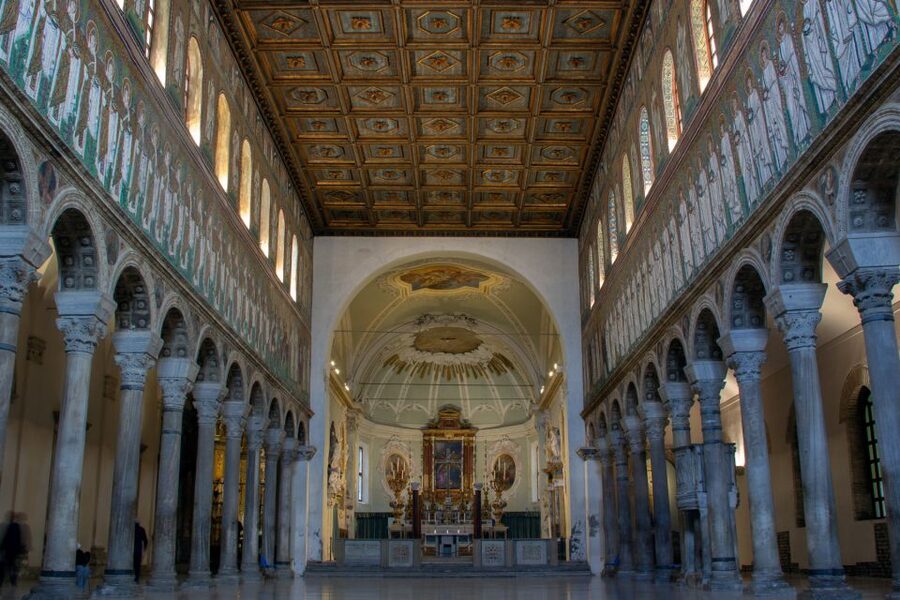
Sant Apollinare Nuovo was built in the sixth century by Ostrogothic king Theodoric the Great. From outside, it is relatively discreet. Inside, the long nave opens into one of Ravenna’s most impressive mosaic programs.
The walls carry floor-to-ceiling scenes from the Byzantine era. You will see processions of saints and figures connected with the life of Christ. The cycle is especially valuable for anyone interested in early Christian art, since it offers one of the oldest surviving mosaic programs linked to Christ’s life.
The church also carries signs of political and religious change. Some mosaics were altered over time, and parts were once painted black under Pope Gregory the Great, reportedly to keep worshippers focused on prayer. Later damage from World War I required reconstruction. The result is not a perfectly untouched picture of the past, but a building that shows how art can be changed, covered, repaired, and still survive.
I find Sant Apollinare Nuovo easier to read than San Vitale because the mosaics run along the nave in clear horizontal bands. Start at one end and move slowly. You can follow the scenes and processions without feeling overwhelmed by a central dome and several competing surfaces.
The church is also a useful reminder that Ravenna’s treasures are not limited to one period or one ruler. The building began under Ostrogothic authority and later reflected Byzantine and Catholic changes. Those layers give the mosaics more interest than color alone.
A few more Bologna half-days worth a look
- Bologna: City Center Walking Tour
★ 4.5 · 3,478 reviews - Ravenna: UNESCO Monuments and Mosaics Guided Tour
★ 4.8 · 3,108 reviews - Guided Tour of Mosaic Tiles in Ravenna
★ 5.0 · 1,693 reviews - Bologna Food & Market Tour with 6 Tastings, Pasta, Wines & More
★ 5.0 · 1,328 reviews
St. Andrew’s Chapel and the Archiepiscopal Museum
The Archiepiscopal Museum offers a different experience from the large basilicas. Here, the focus is smaller and more connected to the bishops of Ravenna. Its most important room is St. Andrew’s Chapel, the private chapel used by the city’s bishops.
The chapel is sometimes called the hidden pearl of the museum, but the important point is what you see inside: mosaics connected with people and places of Ravenna, along with evidence of religious divisions during the early Byzantine period. The setting is more intimate than San Vitale or Sant Apollinare Nuovo, so details that might disappear in a large church are easier to study.
The museum also contains epigraphs, the cathedral treasure, and an ivory throne linked with Bishop Maximian. These objects give the mosaics a wider setting. You are not only looking at decoration. You are seeing the working religious world around the churches, including inscriptions, ceremonial objects, and the authority of the bishop.
This stop requires a little more patience. If you only want the biggest and brightest mosaics, you may spend less time here. If you like church history, objects, and political clues, it can be one of the most rewarding parts of the ticket.
The Neonian Baptistery on the five-monument ticket
The Neonian Baptistery is also included only with the five-monument option. It takes its name from Bishop Neon, who continued construction after his predecessor, Ursus.
The main feature is the mosaic decoration of the dome, dating from the time of Bishop Neon. Baptisteries were built for an important Christian ritual, so the dome’s imagery is not random ornament. The entire space was designed to give meaning to the ceremony taking place below.
The baptistery is a smaller stop, and you may find that the visit does not last as long as the basilicas. Still, it helps complete the picture of Ravenna’s religious architecture. San Vitale shows imperial ceremony, Sant Apollinare Nuovo shows long narrative walls, the chapel shows episcopal life, and the baptistery shows the setting for baptism.
If you choose the five-monument ticket, check how much time you have inside. One visitor wished for a longer look at the baptistery, and that is easy to understand. The dome deserves more than a quick upward glance.
Is the $14 ticket good value?
At $14 per person, the ticket is priced well for anyone planning to visit several monuments. The strongest value comes from the five-monument version, since it includes San Vitale, Sant Apollinare Nuovo, the Archiepiscopal Museum with St. Andrew’s Chapel, the Mausoleum of Galla Placidia, and the Neonian Baptistery.
You get one visit to each included monument, and the ticket remains valid for seven days. That flexibility matters. Ravenna’s mosaics are visually intense, and seeing every site in one stretch can leave you tired and less attentive. You can visit two or three places, stop for lunch, and return the next day if your schedule allows.
The ticket also provides a 20 percent discount in the bookshops at the sites. That is useful if you want a booklet explaining the mosaics or a small art book to help you remember what you saw. I would not buy the ticket solely for the shop discount, but it adds a little value if you plan to take home reading material.
The price does not include a guide. You will need to make your own arrangements if you want someone to explain the biblical scenes, rulers, and changes to the mosaics in person. That is the main difference between this ticket and a traditional tour.
Practical details that can save you trouble
You must show the official ticket at the entrance of each attraction. The booking ticket is sent in a separate email, so check your messages before you set out. There has been at least one case where the ticket was not recognized immediately at the door and the person had to return to the ticket office. Keep the official version easy to find, and do not rely only on a screenshot if the booking instructions specify another format.
The ticket is valid for seven days, but you get one visit per monument. Plan your sequence before entering the first site, especially if you have chosen the five-monument option.
Wear comfortable shoes. All five sites are within walking distance, and the best way to connect them is on foot. You will also want time to pause, look upward, and move between buildings without rushing.
Dress respectfully. Knees and shoulders must be covered, and clothing with rips, holes, or transparent material is not permitted. Flash photography is prohibited, so use the available light and keep your camera settings discreet.
The experience is wheelchair accessible. Since this is a self-guided ticket, you can take the time you need at each monument rather than keeping up with a group.
Who should buy this ticket?
I recommend it most strongly for art lovers, church architecture fans, and anyone who wants to see Ravenna at a thoughtful pace. It also works well for independent visitors who dislike fixed tour schedules. The seven-day period gives you room to fit the monuments around other plans.
Families can use the flexibility to avoid asking children to sit through every site in one morning. Choose one major basilica, add a smaller stop, and save the rest for another day.
You may prefer a guided tour if the difference between Arian, Byzantine, Roman, and Catholic imagery is unfamiliar to you. The buildings are beautiful without context, but the political story explains why the mosaics changed and why certain figures appear where they do.
Should you book it?
Book the five-monument ticket if you want the fullest look at Ravenna’s mosaic tradition. San Vitale and Sant Apollinare Nuovo are the essential stops, while Galla Placidia and the Neonian Baptistery add smaller spaces with a different mood. The Archiepiscopal Museum and St. Andrew’s Chapel reward anyone who wants more than the headline monuments.
Choose this experience if you value time, flexibility, and a low price more than a live explanation. Skip it only if you know you will need a guide to make sense of the art. Ravenna’s mosaics are worth the effort, and this ticket gives you the freedom to see them without racing the clock.
FAQ
How much does the Ravenna mosaics ticket cost?
The listed price is $14 per person.
How long is the ticket valid?
The ticket is valid for seven days.
Can I visit each monument more than once?
No. The ticket allows one visit per included monument.
Which sites are included in the basic ticket?
The basic ticket includes San Vitale Basilica, Sant Apollinare Nuovo Basilica, the Archiepiscopal Museum, and St. Andrew’s Chapel.
What does the five-monument option add?
The five-monument option adds the Mausoleum of Galla Placidia and the Neonian Baptistery.
Is a guided tour included?
No. This is an entry ticket and does not include a guided visit.
Are the sites close to one another?
The five monuments are within walking distance of one another.
Is the ticket wheelchair accessible?
Yes, the activity is listed as wheelchair accessible.
What clothing is required?
Your knees and shoulders must be covered. Clothing with rips, holes, or transparent material is not permitted.
Can I use flash photography?
No. Flash photography is prohibited at the monuments.
Is cancellation allowed?
Yes. You can cancel up to 24 hours in advance for a full refund.
Is there any discount included?
Yes. The ticket includes a 20 percent discount on purchases in the bookshops at the sites.
Just added around Bologna
- Bologna Private Highlights & Hidden Gems Tour with a Local★ 5.0 · 359 reviews
- Bologna on the plate, Cooking Class with Alessia★ 5.0 · 260 reviews
- Bologna: Full meal Food Tour with Local Delights by Do Eat Better★ 5.0 · 541 reviews
- Bologna Local Pasta Cooking Class, Ragu, Spritz, Wine & Gelato★ 5.0 · 527 reviews
- Pastamama, Home Cooking Classes at Grace’s Home★ 5.0 · 521 reviews
- Bologna Private Food Tour with 6 or 10 Tastings★ 4.5 · 344 reviews
- Bologna Food Tour by Taste Bologna: Intimate Group (Max 10)★ 5.0 · 424 reviews
- Bologna: Pasta and Tiramisu Small Group Cooking Class with Wine★ 5.0 · 409 reviews
Entry Tickets in Bologna, compared.
Maranello and Modena: Ferrari Museums Combo Tickets
Read our review →

Maranello: Ferrari Museum Entry Ticket and Simulator
Read our review →
Mirabilandia Amusement Park: 1-Day Entry Ticket
Read our review →Browse the lists this tour appears in