

Reviewed · UFFIZI GALLERY TOURS
Florence: Uffizi Priority Ticket & Masterpieces Audio App
Florence’s Uffizi is packed with the paintings that define Italian art, but the ticket office can waste a good part of your day. This experience gets you to the meeting point under the Benvenuto Cellini statue, hands over your reserved ticket, and sends you toward the entrance with an audio app ready for the major works.
I like two things here: the simple ticket handoff and the freedom to set your own pace. You can spend ten minutes with Botticelli, skip a crowded room, or stay for four hours without being tied to a group. The tradeoff is clear: this is not a live guided tour, and the audio app works best if you download it before reaching the museum.
Key points to know before booking
- Meet under Cellini’s statue: Find the ACCORD assistant in a yellow vest at the corner of the Uffizi ticket office and Via Lambertesca.
- Skip two ticket lines: Your reserved ticket avoids the ordinary ticket-buying and pickup queues, though everyone still passes museum security.
- Follow the masterpieces: The app focuses on works by Giotto, Botticelli, Leonardo da Vinci, Michelangelo, Caravaggio, and other major artists.
- Plan at least two hours: A brisk visit takes about two hours, while a fuller look can take four hours or more.
- Bring your own headphones: The phone-based audio guide does not include earphones, and large bags are not allowed.
- Expect a flexible, self-guided visit: On-site staff help you enter, but the gallery visit itself is independent rather than led by a live guide.
Why the Uffizi deserves your time

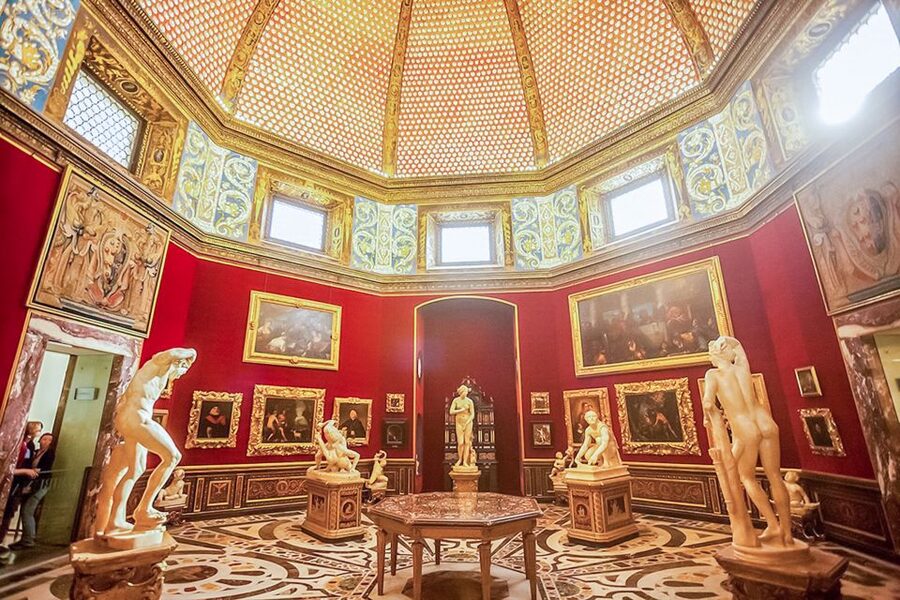
The Uffizi is not simply a room of famous paintings. It is a long visual story, beginning with medieval religious art and moving into the Italian Renaissance and later masterpieces. The collection occupies one of Europe’s oldest museums, and the building itself helps explain Florence’s former power under the Medici family.
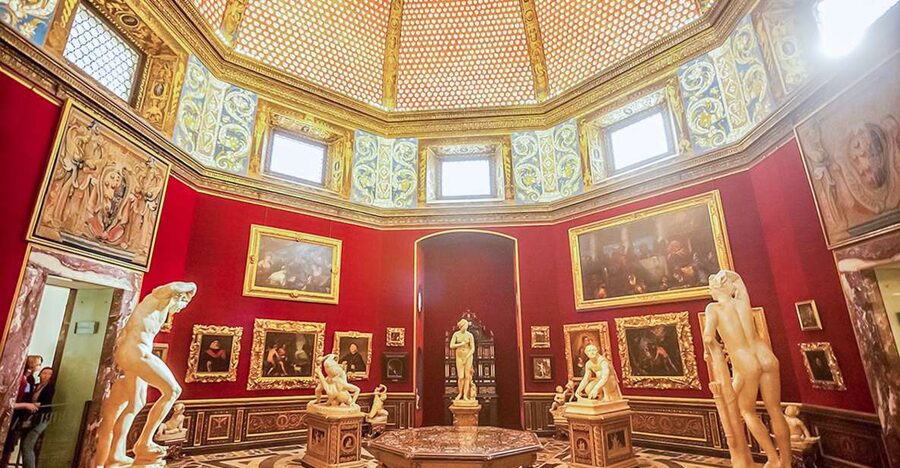
You will see paintings by Giotto, Botticelli, Leonardo da Vinci, Michelangelo, and Caravaggio, along with ancient statues and busts collected by the Medici. The corridor displays are part of the pleasure. As you walk, Roman copies of lost Greek sculptures look down from the walls and line the passageways.
The best-known stops are also the ones most visitors want to see first. Botticelli’s Birth of Venus gives you the famous goddess rising from the sea, while Leonardo’s Annunciation rewards a slower look at the way landscape, gesture, and architectural space work together. Caravaggio’s Medusa brings a darker, more dramatic mood.
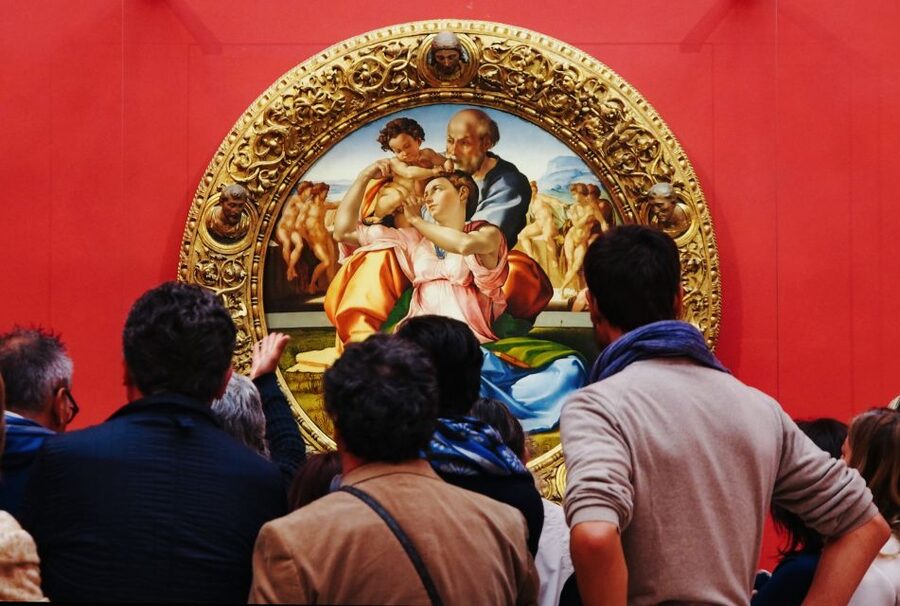
Michelangelo’s wooden painting is another unusual highlight. It is the only work painted on wood by Michelangelo in the collection, making it an easy piece to miss if you wander without a plan. The audio app helps direct your attention to important works instead of leaving you to sort through every room on your own.
More Audio Guide Tours in Florence
- Florence: Cathedral & Brunelleschi’s Dome Ticket & Audio App
★ 4.4 · 6,973 reviews - Florence: Michelangelo’s David Priority Ticket & Audio App
★ 4.4 · 6,812 reviews - Florence: Michelangelo’s David Entrance Ticket and Audio App
★ 4.3 · 1,901 reviews
Meeting the ACCORD host near Cellini’s statue
The meeting point is practical once you know what to look for. Arrive 15 minutes early at the corner of the Uffizi ticket office and Via Lambertesca, close to the statue of Benvenuto Cellini beneath the Loggia. The staff member wears a yellow vest marked ACCORD.
This detail matters. The Uffizi area has several entrances, ticket windows, and lines, and arriving at the wrong door can create needless stress. The host checks your booking, gives you the museum ticket, and directs you to Door No. 1 for entry.
The staff role is brief but useful. You are not joining a full museum tour at this point. You are receiving help with the ticket and the entry procedure, then continuing on your own. Some bookings have included extra explanation from especially helpful staff, including a guide named Leticia, but you should book this experience expecting host assistance rather than a guaranteed live commentary.
If you are delayed, contact with the host may be important, but you should still make every effort to arrive early. The appointment time is reserved, and the museum’s security process is separate from the ticket queue.
How much time the priority ticket saves
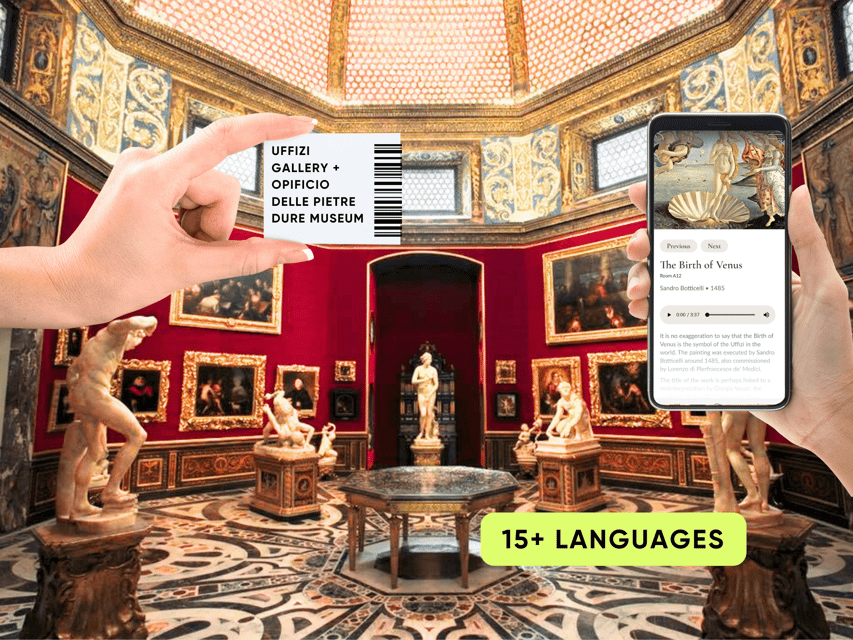
The priority ticket removes the need to buy a ticket at the museum and avoids the separate pickup line. That can make a major difference at busy times, when the ordinary queue outside the Uffizi may stretch along the street.
It does not mean you walk straight through every part of the entrance. All visitors pass the mandatory security check, and this can take about 10 to 15 minutes when the museum is busy. You may also wait briefly for your reserved entry time.
That distinction is worth understanding before you book. Skip-the-line means you skip the ticket-buying process, not security. In busy summer periods, you might still spend some time waiting, but you are avoiding the most troublesome part of the arrival process.
Morning visits tend to be a sensible choice. A 9:30 arrival has worked well for visitors wanting a calmer start, and going early gives you more room to take your time before the gallery fills up.
At $31 per person, the value depends on your priorities. The official adult Uffizi ticket price is €29, so much of the extra cost pays for the reserved arrangement, host assistance, and audio content. If your schedule is tight, that premium can be worthwhile. If you are comfortable handling museum tickets yourself and want only the lowest possible admission cost, it is less attractive.
Using the mobile audio app inside the gallery
The audio app is designed to keep your visit flexible. You listen to selected works in the order suggested by the app, pause whenever you like, and return to information later. You are not forced to keep pace with a group or wait while someone else finishes a room.
The content is written by art historians and available in many languages, including English, Italian, Spanish, French, German, Portuguese, Chinese, Japanese, Korean, Dutch, Greek, Polish, Turkish, Russian, and several others. That broad language choice is useful for mixed-language groups.
The app is strongest as a focused introduction to the headline works. It gives you more context than the short labels beside many paintings and helps explain why certain pieces deserve your attention. It is not a substitute for an expert standing beside you and answering questions.
You should download the application before you reach the museum, using Wi-Fi if possible. The instructions arrive with your voucher and a reminder is sent by WhatsApp the day before. A fully charged phone and your own headphones are essential.
This preparation is not a minor detail. Some people have struggled to download the app near the meeting point, especially when the instructions did not match the browser being used. Install it at your accommodation, open it, and check that the content loads before leaving.
Bring wired or wireless earphones, since none are supplied. Without them, you can still walk through the museum, but you lose the main benefit of the package. The audio content can also be read rather than heard, which helps if your headphones fail, but listening is much easier in crowded rooms.
More Entry Tickets in Florence
- Florence: Skip-The-Line Uffizi Gallery Timed Entry Ticket
★ 4.5 · 27,832 reviews - Florence: Timed Entrance Ticket to Michelangelo’s David
★ 4.6 · 16,983 reviews - Florence: Michelangelo’s David Skip-the-Line Entry Ticket
★ 4.5 · 12,764 reviews - Florence: Leonardo Interactive Museum Entry Ticket
★ 4.5 · 11,763 reviews
A sensible route through the major rooms
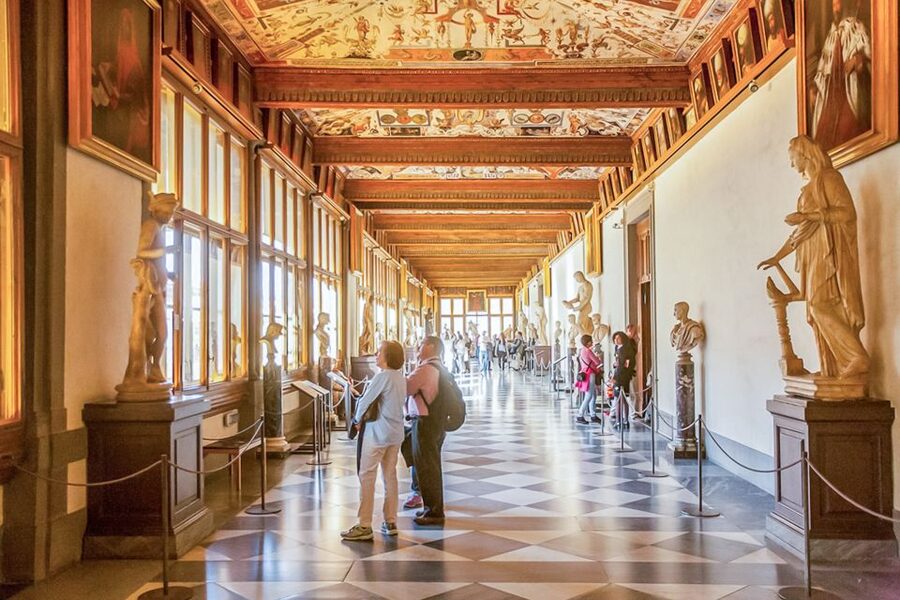
Start with the early medieval and Renaissance works rather than racing straight to Birth of Venus. The gallery’s strength comes from seeing how painting changes over time, from flatter religious scenes to more natural figures, stronger perspective, and the growing interest in the human body.
Giotto is an important early stop. His work helps you see the move toward more solid figures and emotional expression. Even if medieval painting is not your main reason for coming, a few minutes here makes the later Renaissance rooms easier to understand.
Botticelli is the great crowd puller. Birth of Venus and Primavera are among the Uffizi’s most famous paintings, and the rooms can feel crowded around them. Try to step back rather than viewing only from the front row. The overall design, flowing lines, and pale colors become easier to read from a little distance.
Leonardo’s Annunciation is quieter and more subtle. Look at the careful gestures and the way the distant landscape opens behind the figures. The painting rewards patience, which is one reason an independent audio visit works well here. You can pause the narration and study the details without being hurried along.
Michelangelo’s work brings a different force. The wooden painting is a rare chance to see his approach to painting rather than sculpture alone. The app can help you notice the muscular figures and careful structure, details that may be overlooked when you are already tired from the larger rooms.
Caravaggio’s Medusa changes the mood again. Its violent expression and strong light feel far removed from the ideal beauty of Botticelli. This contrast is one of the pleasures of the Uffizi. You are not seeing one narrow style, but centuries of artists answering different religious, political, and artistic demands.
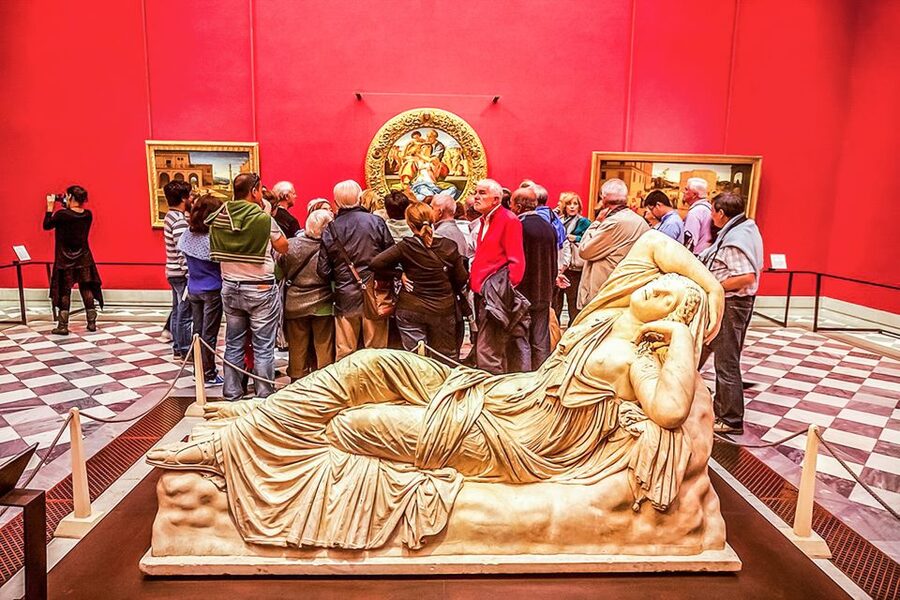
Allow time for the ancient sculpture displays. The Medici collection includes Roman copies of Greek sculptures that no longer survive in their original form. These statues and busts line the corridors, so they are easy to see even if you do not stop at every one.
What the visit feels like after the famous paintings

The Uffizi can be overwhelming. Even a carefully chosen list of masterpieces leaves many other rooms untouched, and trying to see everything may turn the final hour into a blur of frames and labels.
I would allow two hours for the main highlights and three to four hours for a more relaxed visit. The route is marked, with arrows over doorways helping you move from one area to the next. The building naturally leads you through much of the collection, though a dedicated map would make planning easier.
There are steps on the way up to the starting level, with one visitor estimating roughly 120 steps. An elevator is available for going down. The museum is wheelchair accessible, but if you need specific assistance, confirm the current route when booking.
A small café on a terrace offers a useful pause. From there, you may be able to leave or continue through the collection, giving you a natural point to judge your energy and remaining time.
Inside, you may bring one water bottle of up to 500 milliliters per person. Large bags and luggage are not allowed, so do not arrive with a suitcase or a bulky day bag. Pets are also not permitted.
Walking outside the Vasari Corridor afterward
After leaving the Uffizi, take a short walk along the outside of the Vasari Corridor. This historic passage connects the Uffizi with the Pitti Palace and gives you a different view of Florence’s streets and architecture.
The experience does not include entry into the corridor. Think of this as an optional follow-up walk, not another museum section. It is a good way to let the paintings settle before moving on to the next sight.
The route also keeps the Medici story in view. The Uffizi, the corridor, and the Pitti Palace were linked by power, family, and practical movement through the city. Even a brief look from outside adds useful context to the museum visit.
Who will get the most from this ticket

This is a strong fit if you have limited time in Florence, dislike ticket queues, or want help choosing the major artworks without committing to a live group tour. Families and independent visitors may appreciate the ability to stop, skip, and return to the app as needed.
It also suits people who enjoy learning in small pieces. You can listen to a track on Botticelli, read the next one, and move at your own speed. The visit feels less formal than a traditional guided tour.
I would think twice if you want detailed, personal discussion with an art expert. The host gets you inside, but the standard arrangement does not include a live guide. The app is useful and focused, though some people may find it basic or wish it included a clearer map and fuller commentary.
Should you book the Uffizi audio app experience?
Book it if your main goals are a reserved entry time, help finding the correct entrance, and a self-guided route through Florence’s essential art. At $31, it is not the cheapest way into the Uffizi, but the time saved and the reduced arrival confusion can justify the difference, especially during crowded periods.
Skip it if you already have museum tickets, prefer to browse without audio, or want a live art specialist. If you do book, install the app the day before, charge your phone, pack headphones, arrive 15 minutes early, and plan at least two hours inside.
FAQ
Where is the meeting point for the Uffizi ticket?
Meet at the corner of the Uffizi Gallery ticket office and Via Lambertesca, under or near the Loggia by the Benvenuto Cellini statue. Look for an ACCORD staff member wearing a yellow vest.
How early should I arrive?
Arrive 15 minutes before your reserved entry time. This allows time to find the host, collect your ticket, and join the entry process.
Does the ticket skip the security check?
No. Every visitor must pass through museum security. At busy times, the security wait can take approximately 10 to 15 minutes.
Is there a live guide?
No live guide is included. An English-speaking or Italian-speaking host helps with ticket collection and entry, while the museum visit uses the mobile audio app.
Which languages are available in the audio app?
The app is available in English, Italian, Turkish, Spanish, French, German, Chinese, Portuguese, Polish, Japanese, Russian, Dutch, Korean, Hungarian, Greek, Croatian, Romanian, and Ukrainian.
Do I need to bring headphones?
Yes. Earphones are not included, so bring your own headphones if you want to listen to the audio guide.
Can I bring luggage into the Uffizi?
Large bags and luggage are not allowed. You may bring one water bottle per person, with a maximum capacity of 500 milliliters.
Is the Uffizi accessible by wheelchair?
Yes, the activity is listed as wheelchair accessible. The museum also has an elevator for going down after the stairs leading to the upper starting level.
More Uffizi Visits
- Florence: Skip-the-Line Uffizi Small Group Tour
★ 4.6 · 5,926 reviews - Uffizi Gallery Small Group Tour with Guide
★ 4.5 · 4,923 reviews - Skip the line: Uffizi and Accademia Small Group Walking Tour
★ 4.5 · 3,135 reviews - Florence: Uffizi Gallery and Accademia Gallery Guided Tour
★ 4.8 · 2,028 reviews
Just added around Florence
- Walking Food Tour of Florence with Tastings and Wine★ 5.0 · 518 reviews
- Uffizi Gallery Timed Entry Admission Tickets★ 4.0 · 392 reviews
- Uffizi Gallery Small Group Tour with Guide★ 4.5 · 879 reviews
- Florence Accademia Guided Tour – Shared, Private & Combo Options★ 4.5 · 370 reviews
- Early Access Guided Uffizi Gallery Tour Skip-the-Line Small Group★ 4.5 · 707 reviews
- Uffizi and Accademia Small Group Guided Tour★ 4.5 · 449 reviews
- Florence Central Market Food Tour with Eating Europe★ 5.0 · 224 reviews
- Truffle Hunting Experience with Lunch in San Miniato★ 5.0 · 383 reviews
Uffizi Gallery Tours, compared.

Skip-The-Line Uffizi Gallery Timed Entry Ticket
Read our review →

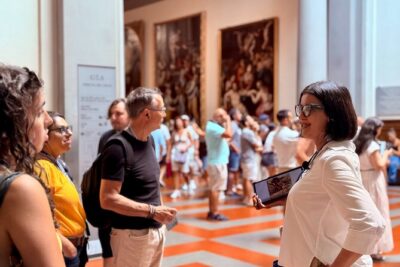
Skip the line: Uffizi and Accademia Small Group Walking Tour
Read our review →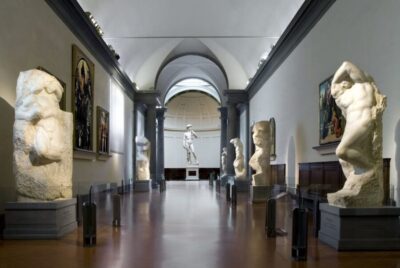
Uffizi Gallery and Accademia Gallery Guided Tour
Read our review →
Uffizi Gallery Small-Group Guided Tour with Ticket
Read our review →
Michelangelo’s David, Accademia & Uffizi Small Group Tour
Read our review →
Accademia & Uffizi Museums: Small Group Tour with Optional Lunch
Read our review →Browse the lists this tour appears in