
Reviewed · UMBRIA TOURS
Small Group Tour of Assisi and St. Francis Basilica
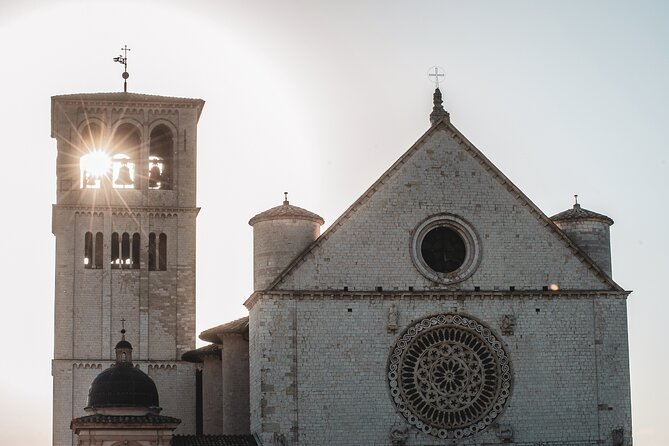
Assisi’s greatest treasure is not one single church. It is the way Roman ruins, medieval streets, Franciscan devotion, and world-famous frescoes fit together on one steep Umbrian hill. This tour gives you that full picture, ending at the Basilica of St. Francis, where Giotto and other 13th and 14th-century painters transformed stone walls into a visual lesson in faith.
I like the route’s strong sense of place, from the former Roman amphitheater to Piazza del Comune and its ancient Temple of Minerva. I also like the small-group limit of 15, which makes it easier to ask questions and keep up with a guide such as Alessandra, Francesca, or Barbara. The main drawback is the uphill walking, steep stairs, and lengthy time on your feet, along with some uncertainty about audio headsets and small extra entrance charges.
Key points to know before booking
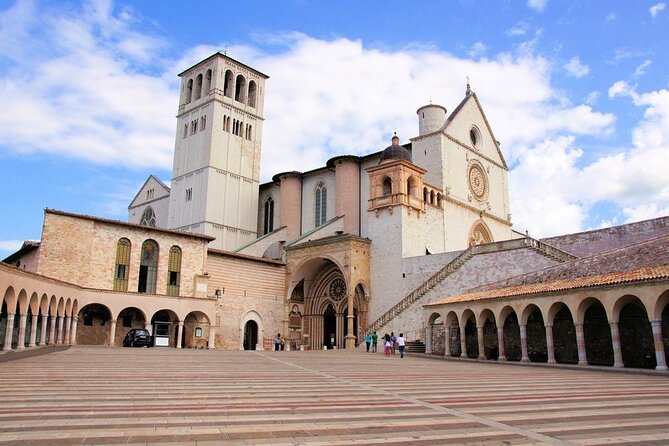
- The route connects Roman, medieval, and Franciscan Assisi instead of treating the basilica as an isolated sight.
- The tour ends at St. Francis Basilica, with time for both the shadowy Lower Church and bright Upper Church.
- Groups are limited to 15 people, though the practical experience can vary if audio equipment is not available.
- Expect hills, narrow lanes, and steep steps, making this a poor fit for anyone with serious mobility limits.
- Dress modestly for churches: knees and shoulders must be covered for both men and women.
- Sunday, religious holiday, and closure rules matter, especially if your main goal is a guided visit inside the basilica.
Why this route makes sense in Assisi
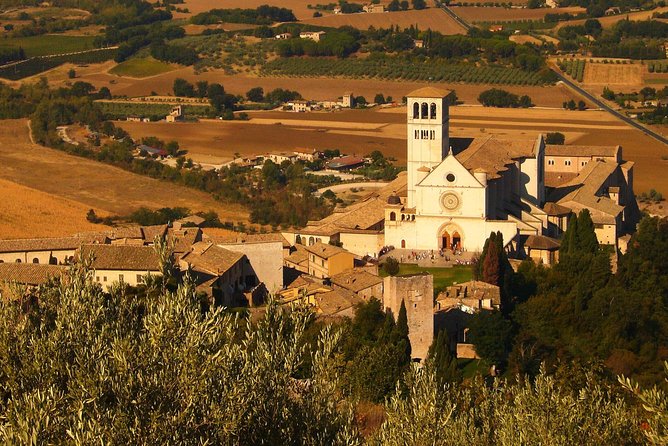
Assisi is easy to underestimate on a map. The historic center looks compact, but it rises and falls across a hillside, and its streets often turn into stairs or sharp inclines. A guide helps you read the town instead of simply walking from one church to another.
The tour begins at 10:30 a.m. near the Matteotti parking area and moves downhill through the old center toward St. Francis Basilica. That direction is useful: you see the town’s major churches and civic spaces first, then finish with Assisi’s grandest artistic achievement.
The meeting point needs care. The Matteotti parking lot is closed for renovation, and no parking is available there, even though it remains the stated meeting location. If you are driving, do not assume the name means you can leave your car at the start. The directions have caused trouble for some people, so arrive early and confirm the exact spot before the 10:30 start.
The route ends at the Papal Basilica and Sacred Convent of St. Francis. That is convenient if you want to stay for more time inside, attend to personal prayer, or continue exploring the lower part of town afterward.
A few more Umbria half-days worth a look
- From Rome: Bagnoregio & Orvieto Day Trip with Wines & Lunch
★ 4.6 · 1,075 reviews - Assisi and Orvieto Guided Day Tour from Rome with Lunch
★ 4.0 · 1,031 reviews - Perugia: Entry Ticket and Guided Tour of Perugia Underground
★ 4.6 · 579 reviews
Roman ruins and the view toward Rocca Maggiore
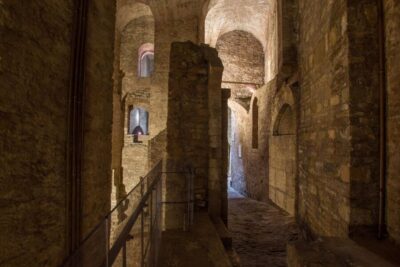
Your first stop is the old Roman amphitheater. What makes it interesting is not only the ancient structure itself, but its later life. In the Middle Ages, local builders reused the amphitheater as a stone quarry. Houses were built into and around the remains, turning a public Roman space into a private neighborhood.
This is a fine opening because it shows how Assisi was built layer by layer. You are not looking at a perfectly preserved ruin separated from daily life. You are seeing how later residents adapted older stone and absorbed it into the town.
From here, you get one of the best views toward Rocca Maggiore, the medieval castle above Assisi. The view helps you understand the town’s defensive position and its steep arrangement on the side of Mount Subasio. Bring a camera, but also pause for the explanation. The guide uses this early stop to place the churches and streets ahead into a larger story.
St. Rufino Cathedral and St. Clare’s Basilica
The walk continues through narrow alleys and medieval squares to the Cathedral of San Rufino. Assisi’s cathedral is dedicated to Rufinus of Assisi, and it is one of the town’s major churches. Its place on the route gives you a useful contrast with the later Franciscan buildings.
Next comes the Basilica of St. Clare, built with the pink stone quarried from Mount Subasio. Its single nave leads toward a transept and polygonal apse, and the interior contains frescoes dating from the 12th through 14th centuries.
The most meaningful object here is the crucifix in the chapel on the right. Tradition holds that it spoke to St. Francis at San Damiano and called him to rebuild the Church. The guide can explain how this story links Francis and Clare, whose lives and religious work are central to Assisi.
The listed visit gives about 15 minutes at St. Clare’s Basilica. That is enough for orientation and a focused look, but not enough for a slow study of every chapel or artwork. If St. Clare is your main reason for coming to Assisi, plan to return on your own after the tour.
Chiesa Nuova and the story of St. Francis
Chiesa Nuova was built in 1615 on the supposed site of St. Francis’s birthplace, the house of his father, Pietro di Bernardone. Its name simply means New Church, since it was the last church built in Assisi at that time.
The stop lasts about 15 minutes and adds a personal detail to the saint’s story. Instead of hearing only about Francis as a medieval religious figure, you see the place connected with his family and early life.
This is one of the tour’s quieter stops. It does not carry the same artistic weight as the two basilicas, but it fills in the human side of the visit. The guide’s explanation is especially useful here because the significance depends more on the site’s tradition and context than on a single famous object.
Same city, a completely different sort of day:
- Assisi & Orvieto Day Trip from Rome
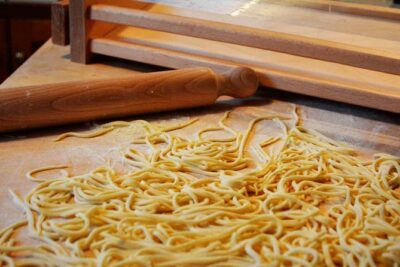
★ 4.5 · 341 reviews - Hands on Italian Cooking Classes
★ 5.0 · 313 reviews - Perugia: Old Town Walking Tour, Piazza IV Novembre
★ 4.8 · 304 reviews - Heart of Italy Day Trip: Visit Perugia and Assisi from Florence
★ 4.0 · 287 reviews
Piazza del Comune and the Temple of Minerva
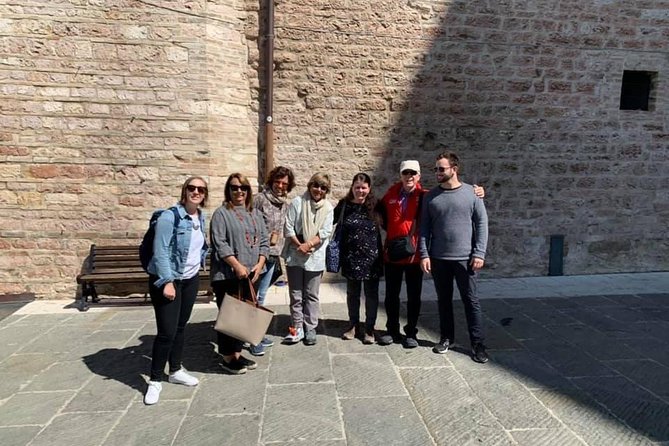
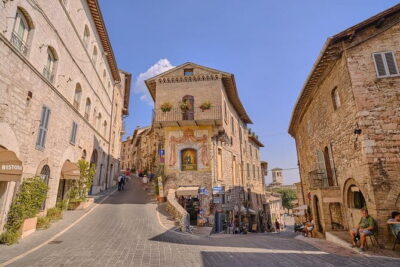
The route then reaches Piazza del Comune, Assisi’s main city square. This is the civic heart of the town, surrounded by imposing medieval government buildings and the ancient Temple of Minerva.
The Temple of Minerva is one of the best-preserved Roman temples in Italy. Its classical columns are easy to spot, but the building has had another life: it now houses Santa Maria sopra Minerva, a church built in 1539 and later renovated in Baroque style during the 17th century.
That mix is classic Assisi. Roman architecture remains in place, medieval civic buildings press around it, and a Christian church occupies the ancient temple. The 15-minute stop is short, but the square gives you a clear lesson in how the town changed without erasing everything that came before.
I particularly like this section because it keeps Assisi from becoming only a pilgrimage destination. You see a functioning Italian town with a Roman center, medieval government buildings, churches, shops, and steep lanes.
The Lower Basilica: a darker setting for St. Francis
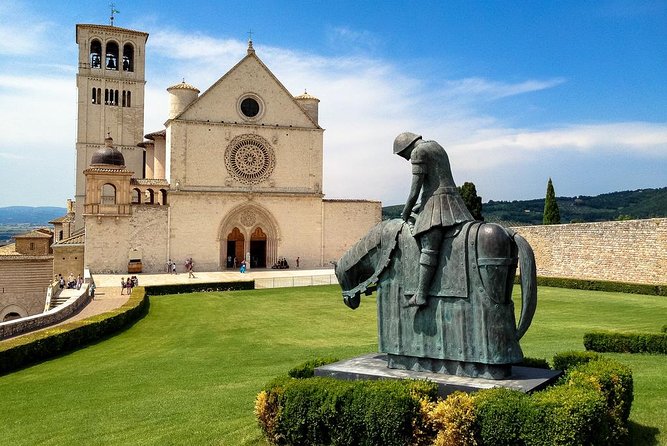
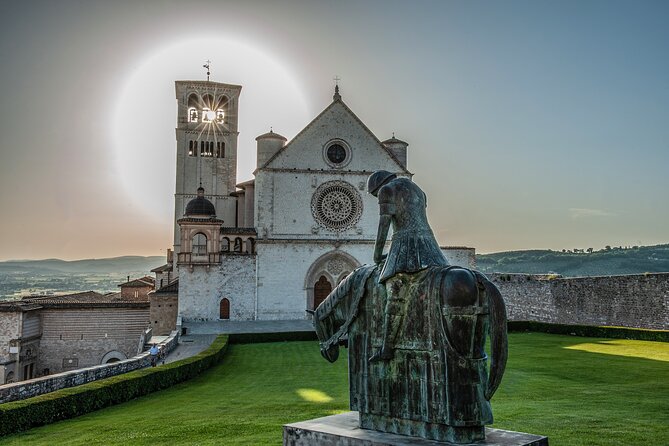
The tour continues downhill to the Basilica of St. Francis, a UNESCO World Heritage site. Construction began in 1228, only two years after Francis died, under the direction of Brother Elias, the order’s vicar general and architect. The basilica was designed to receive the saint’s remains.
The visit includes both the Lower and Upper Churches, with roughly 30 minutes assigned to each. The Lower Church feels solemn and dark, encouraging quiet and reflection. Its atmosphere is very different from the open streets and busy civic square you have just left.
Your guide explains the artworks rather than leaving you to face a wall of unfamiliar paintings. This matters because the frescoes are not just decoration. Their scenes, placement, and scale help tell the story of Francis and the ideals of the Franciscan order.
The basilica is a place where a good guide earns the fee. Names such as Giotto carry weight, but the experience improves when you understand what you are looking at and why it mattered in its own time. Guides including Barbara and Alessandra have been praised for making the frescoes easier to read and connecting the paintings to the life of St. Francis.
The basilica also requires quiet behavior. On Sundays, major Catholic holidays, and national holidays, guides are not allowed to conduct the usual interior explanation. In that case, the guide explains the church from outside, and you enter alone in silence. That is still worthwhile, but it is not the same experience as having the guide interpret the interior with you.
On October 4, the basilica is closed. Access is also suspended from February 15 through April 6, 2026, because relics of St. Francis will be on public display. During that period, the explanation takes place outside the basilica. Check the date carefully if St. Francis Basilica is your main reason for booking.
The Upper Church and Giotto’s frescoes
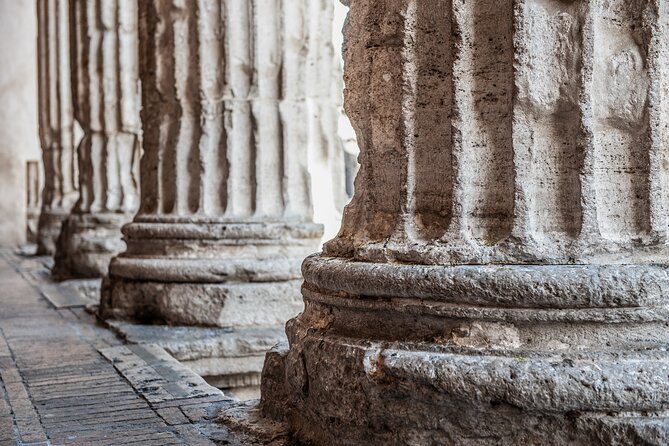
The Upper Church changes the mood at once. While the Lower Church is dark and solemn, the Upper Church rises higher and feels brighter and more open.
Its Gothic design has French influences, with four bays, cross vaulting, and a polygonal transept and apse. The vertical space draws your eyes upward, while the frescoes bring the walls into the story.
Giotto is the best-known name connected with the cycle, though he was one of several important Italian painters working in the 13th and 14th centuries. The guide’s job is to help you distinguish the artistic program and notice how the images work together.
Thirty minutes is enough for a guided introduction, especially when the guide keeps the group moving and focused. It is not enough for a detailed art study. If you already know the paintings well or want time for quiet observation, stay after the tour ends and look again on your own.
Headsets are the one practical weak point. The booking information indicates that headsets must be purchased at the Basilica of St. Francis, rather than being included from the start. One past participant found it hard to hear without an audio system, while another found the provided earpieces uncomfortable.
The group size is capped at 15, and some departures may use two guides to create smaller subgroups. Still, you should ask at the start how you will hear the guide inside the churches. A small extra charge of about €2.50 has also been reported for entry to one sanctuary, so carrying a little cash is sensible even though the basilica admission is included.
How much value do you get for $72.59?
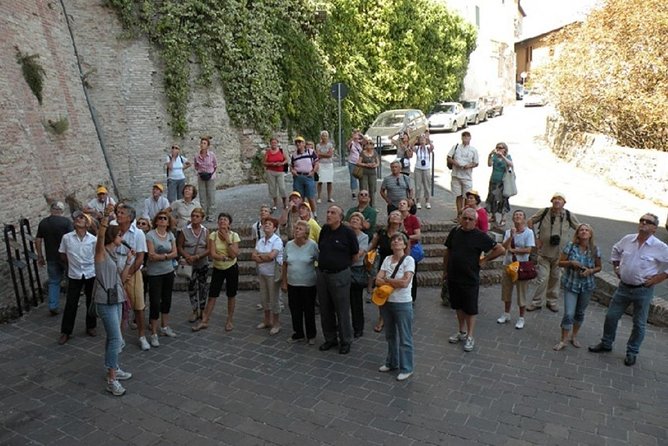
At $72.59 per person, this is not the cheapest way to walk around Assisi. You are paying for an English-speaking official guide, a planned route through the historic center, and admission to St. Francis Basilica.
The value is strongest if you have only a few hours in town or want a clear first visit. In 2.5 hours, you cover the Roman amphitheater, Rocca Maggiore viewpoint, St. Rufino Cathedral, St. Clare’s Basilica, Chiesa Nuova, Piazza del Comune, the Temple of Minerva, and both churches within the Basilica of St. Francis.
A private guide would cost more, while exploring alone costs less but leaves you to sort out the churches and their meaning. The small group gives you a middle choice. You get personal attention without paying private-tour prices, especially when the group is closer to seven or eleven people.
The price is less attractive if you want long stretches of free time, detailed art study, or an easygoing pace. The route is efficient by design. You see the major pieces, hear the story, and then decide what deserves a second visit.
Walking demands, clothing, and timing
You should be ready for a sustained walk through a hill town. There are uphill sections, downhill sections, narrow lanes, and steep stairs. A participant with a bad back had to leave before the end, and another noted that the route is not suited to people with mobility problems.
Wear shoes with solid support. Keep your bag light, since you will be moving through churches and crowded medieval lanes. The tour is not described as wheelchair accessible, and the physical demands make it a poor choice if stairs and inclines are difficult for you.
Church dress rules are firm. Men and women must cover knees and shoulders, and entry may be refused if you arrive in shorts or a sleeveless top. It is easier to dress correctly for the whole morning than to hope a church makes an exception.
The tour is offered in English. Confirmation arrives at booking, and most people can participate, but the route’s physical nature is the key condition.
Who will enjoy this tour most?
I would choose this tour for a first visit to Assisi, particularly if you want both the town and the Franciscan story. It works well for adults, older children, and teenagers who can handle 2.5 hours of walking. One family found that children aged 11, 14, and 17 stayed interested because the guide connected the art with the life of St. Francis.
It also suits anyone who likes to ask questions. The best guides on this route do more than recite dates. Alessandra has been especially effective at explaining what the group will and will not see, while Francesca and Emmanuela have been praised for warmth and clear storytelling. Those individual guide assignments can change, but the experience depends heavily on who leads your departure.
I would hesitate if you have a bad back, serious mobility limits, young children who tire quickly, or a strong need for silence and independent art viewing. I would also avoid booking on a date when the basilica is closed or when interior guiding is restricted, unless you are content with an exterior explanation and a silent self-guided visit.
Should you book the Assisi small-group tour?
Book it if you want an efficient introduction to Assisi that combines Roman remains, medieval streets, St. Clare, St. Francis, and the great basilica in one morning. The route is well chosen, the group limit is sensible, and the strongest guides turn the frescoes into something you can understand rather than simply admire.
Skip it if you need a gentle pace, have difficulty with hills and stairs, or want to spend most of your time studying art alone. Before paying, check the meeting point, dress for church entry, ask about the headset arrangement, and verify that the basilica will be open and fully guided on your date. For most first-time visitors who can manage the walking, $72.59 buys a useful, well-shaped introduction to Assisi.
FAQ
How long does the Assisi tour last?
The tour lasts approximately 2 hours and 30 minutes. It begins at 10:30 a.m.
Where does the tour start?
The meeting point is listed as Parcheggio Saba Matteotti at Piazza Giacomo Matteotti in Assisi. The parking lot is closed for renovation, so parking is not available there.
Where does the tour end?
The tour ends at the Papal Basilica and Sacred Convent of Saint Francis in Assisi, at Piazza Inferiore di San Francesco 2.
Is admission to St. Francis Basilica included?
Yes. Admission to St. Francis Basilica is included in the tour price.
Is the tour offered in English?
Yes. The tour is conducted in English by an official English-speaking guide.
How many people are in the group?
The group has a maximum of 15 participants. Some departures may use two guides to create smaller groups.
What should I wear to enter the churches?
You must cover your knees and shoulders. Shorts and sleeveless tops are not allowed for men or women, and you may be refused entry if you do not follow the dress code.
Can the tour enter St. Francis Basilica on Sundays and holidays?
On Sundays, major Catholic holidays, and national holidays, guided tours inside the basilica are not allowed. The guide explains the church from outside, and you enter alone in silence. The basilica is closed on October 4, and access is suspended from February 15 through April 6, 2026.
Just added around Umbria
- Assisi: Panoramic Tuk Tuk Tour★ 4.9 · 220 reviews
- Assisi: Walking Tour with St. Francis Basilica Visit★ 4.8 · 259 reviews
- From Florence: Orvieto and Perugia Tour with Church Visits★ 4.3 · 216 reviews
- Orvieto: Pozzo della Cava Entry Ticket★ 4.4 · 188 reviews
- Perugia: Old Town Walking Tour, Piazza IV Novembre★ 4.8 · 304 reviews
- Assisi: Private Walking Tour with St. Francis Basilica★ 4.8 · 201 reviews
- Heart of Italy Day Trip: Visit Perugia and Assisi from Florence★ 4.0 · 287 reviews
- Professional hot air balloon rides at Assisi, Trasimeno in Umbria★ 5.0 · 206 reviews
Umbria Tours, compared.
From Rome: Bagnoregio & Orvieto Day Trip with Wines & Lunch
Read our review →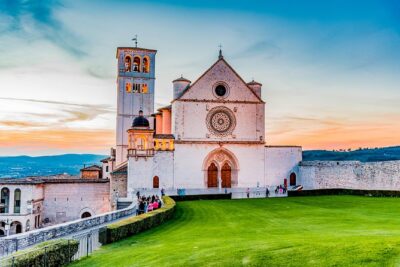
Assisi and Orvieto Guided Day Tour from Rome with Lunch
Read our review →
Entry Ticket and Guided Tour of Perugia Underground
Read our review →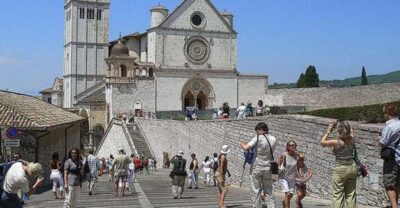
Heart of Italy Day Trip: Visit Perugia and Assisi from Florence
Read our review →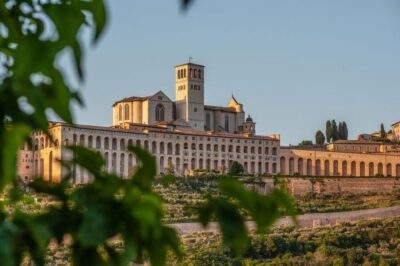
Browse the lists this tour appears in