

Reviewed · WALKING TOURS
Rome: Jewish Ghetto Walking Tour
Rome’s Jewish Ghetto is one of the few places where ancient Rome, medieval faith, wartime courage, and modern city life meet within a short walk. This 2.5-hour tour links the Theater of Marcellus, Portico d’Ottavia, Great Synagogue, and Tiber Island, showing you how the neighborhood changed across more than 2,000 years.
I like the way the walk begins with broad Roman history before focusing on the Jewish community. I also like the small Kosher gelato or coffee stop, which gives the tour a welcome pause. The main limitation is that the route appears to view the Great Synagogue from outside, so anyone hoping to go inside should make separate plans.
Key points to know before you book

- Ancient Rome before the Ghetto: Start near Trajan’s Column, then see the Theater of Marcellus, an older Roman structure than the Colosseum.
- A story-filled walking route: The Turtle Fountain, Portico d’Ottavia, old Ghetto wall, and Tiber Island each add a different layer of history.
- Strong English-speaking guides: Angela, James, Tom, Daniel, Maria, and others are praised for clear explanations, lively stories, and thoughtful answers.
- Kosher gelato included: You receive homemade Kosher gelato or coffee during the walk.
- Small groups can be especially rewarding: Several bookings became private tours when no one else joined, while other small groups allowed easy questions and a comfortable pace.
- Plan for outdoor conditions: Tours run in all weather, and late arrivals are not accommodated.
Why this corner of Rome matters
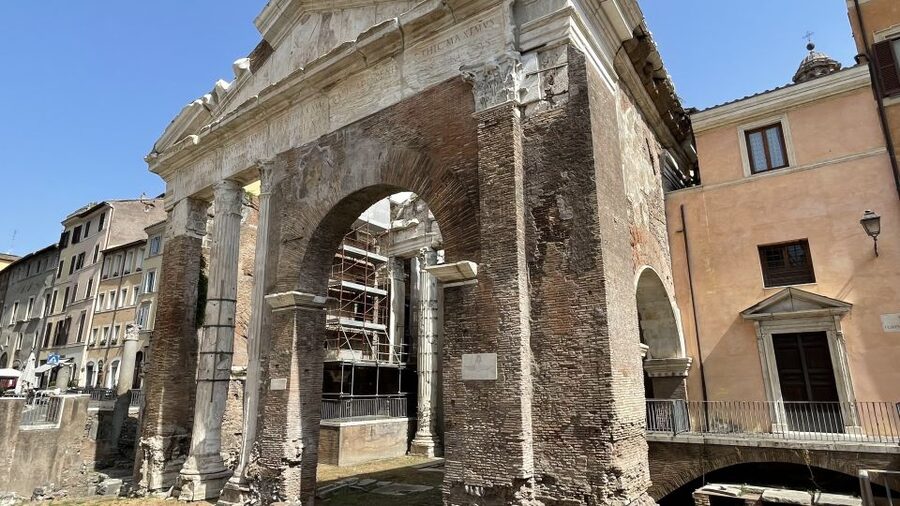
The Jewish Ghetto is not a single monument you check off a list. It is a compact neighborhood where layers of Rome sit almost on top of one another. Ancient ruins were reused, religious buildings changed purpose, and streets that once confined a community now form part of an open city center.
The tour helps you connect those pieces. You begin at Trajan’s Column, walk toward the Theater of Marcellus, pass through the historic Jewish quarter, and finish on Tiber Island. That order matters. You first see the Roman setting, then learn how Jewish life developed within it, and finally hear stories connected with the island’s temple and hospital.
I especially value the focus on lived experience. This is not only a tour of stones and dates. Your guide explains the pressures faced by Rome’s Jewish community, the wall that restricted the neighborhood for centuries, and the resilience that carried the community through difficult periods.
The subject can be serious, particularly when the tour reaches the persecution and wartime history of Rome’s Jews. The best guides handle that material with care while still keeping the walk accessible. Names repeatedly praised for this balance include Angela, James, Tom, Daniel, and Maria. The exact guide depends on the date, but the experience is designed around a live English-speaking guide rather than an audio recording.
More Walking Tours in Rome
- Rome: Trastevere & Campo de Fiori Street Food Walking Tour
★ 4.9 · 2,768 reviews - Rome: Paranormal Night Walking Tour & Secret Backstreets
★ 4.9 · 1,921 reviews - Rome by Night Walking Tour – Legends & Criminal Stories
★ 4.5 · 1,003 reviews
From Trajan’s Column to the Theater of Marcellus
The meeting point is at Foro Traiano, 84, near Trajan’s Column. Look for the orange Roman Vacations sign. Arrive early. The tour cannot wait for late arrivals, and missed tours are not refunded.
From there, the group heads toward the Theater of Marcellus for about 20 minutes of guided sightseeing. This is an excellent opening stop because many visitors know the Colosseum but overlook this older theater. Its surviving arches give you an immediate sense of how Rome reused and adapted its ancient structures.
The stop also sets up the tour’s larger theme: Rome is not arranged in neat historical boxes. Ancient remains still shape modern streets, homes, and public spaces. You are not simply looking at an isolated ruin. You are seeing how old Roman buildings remained part of the city long after their first purpose disappeared.
A guide who can explain this clearly makes a real difference. Several guides have backgrounds in Roman history or teaching, and the strongest part of their approach is turning a long timeline into stories you can follow. James, for example, is praised for making history engaging for teenagers and for answering detailed questions. Tom is often singled out for placing Roman history and Jewish history in context.
The Turtle Fountain and a story of unrequited love
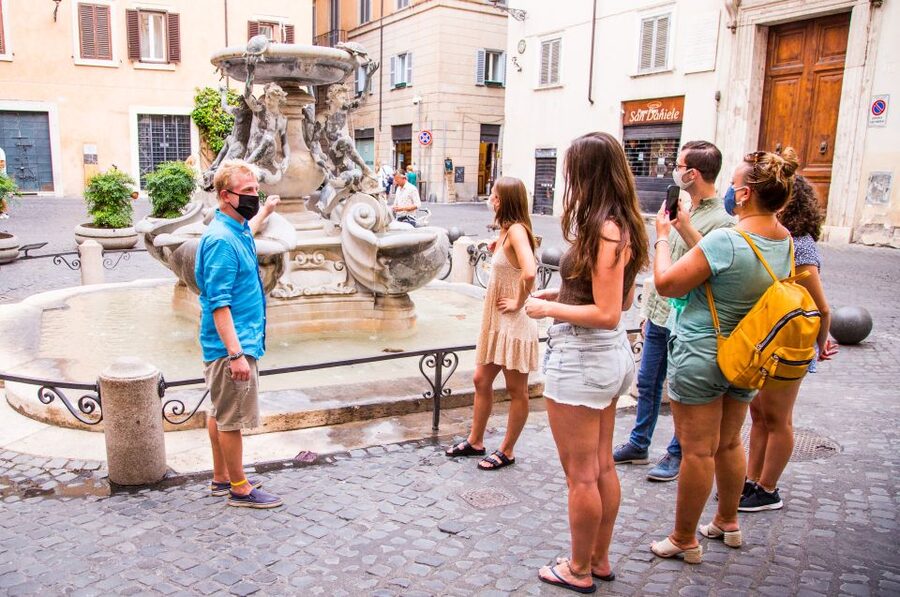
Next comes Piazza Mattei and the Fontana delle Tartarughe, or Turtle Fountain. The guided stop lasts about 20 minutes, giving your guide time to explain both the fountain and the story of unrequited love connected with it.
This is a useful change of pace. After the ancient theater, the fountain brings you into a more intimate urban setting. You are looking at a small work of art in a piazza rather than a huge archaeological site, so details matter more. Listen closely as your guide points out the turtles and explains the story attached to the fountain.
I like this kind of stop because it helps you notice Rome’s smaller sights. Without context, you could walk through Piazza Mattei, take a photograph, and move on. With a guide, the fountain becomes part of the neighborhood’s social history and not just another pretty feature.
The piazza is also a natural place for questions. Guides such as Angela and Daniel are praised for keeping their explanations clear and welcoming, while several small groups appreciated being able to stop and ask questions without feeling rushed.
Walking through Rome’s Jewish Ghetto
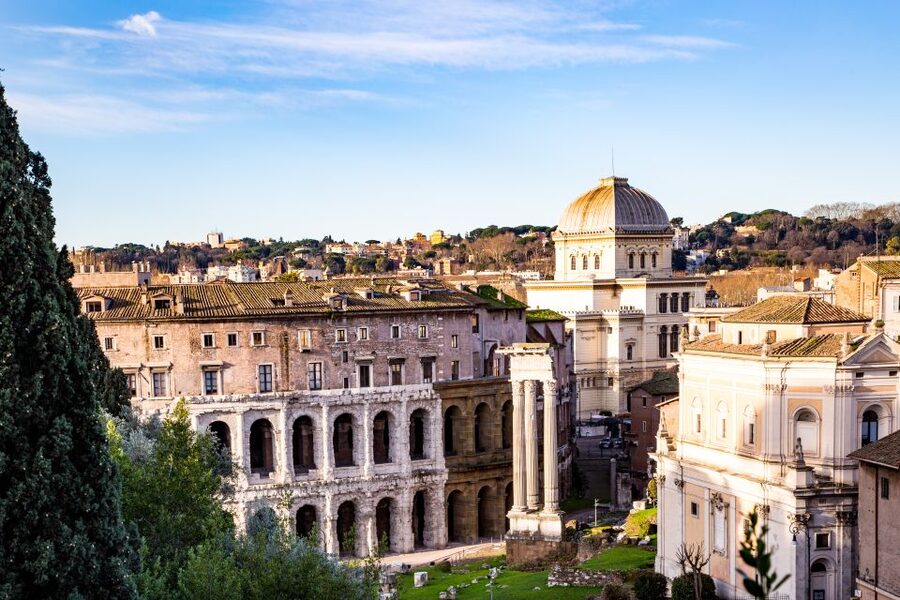
The central part of the tour focuses on the Jewish Ghetto itself. This is where the route moves from general Roman history to the story of Rome’s Jewish community, including the restrictions that shaped daily life in this area.
Your guide points out the last remaining piece of the wall that confined the community for centuries. That fragment is easy to miss if you do not know what you are seeing. It also gives the neighborhood a physical marker for a difficult chapter that might otherwise feel abstract.
The tour presents the Ghetto as a lived neighborhood, not merely a historic label. You learn about the community’s long presence in Rome, the pressures imposed on it, and the ways Jewish life continued through periods of discrimination and political upheaval.
This section is likely to be the most meaningful part of the walk for many people. You do not need to be Jewish to benefit from it. Several guide comments describe the tour as valuable for non-Jewish visitors because it explains how a specific community fits into the wider story of Rome and Italy.
At the same time, keep your expectations measured. The walk is an overview rather than a full academic seminar. It covers more than two millennia in 2.5 hours, so your guide must select the most important events and themes. The best experience comes when you treat it as a strong introduction and note down subjects you want to explore later.
Same city, a completely different sort of day:
- Vatican: Museums & Sistine Chapel Entrance Ticket
★ 4.5 · 144,003 reviews - Vatican Museums & Sistine Chapel Tour with Optional Basilica
★ 4.3 · 67,413 reviews - Colosseum, Roman Forum & Palatine Guided Tour
★ 4.7 · 63,148 reviews - Vatican Museums, Sistine Chapel & St Peter’s Basilica Guided Tour
★ 4.5 · 39,149 reviews
Portico d’Ottavia and the Great Synagogue

The Portico d’Ottavia is scheduled for about 15 minutes. These ancient remains are particularly important because they sit right beside the Jewish Ghetto, making the relationship between Roman antiquity and later Jewish life easy to see.
Your guide explains the ancient structures and the way the area changed over time. This is one of the tour’s strongest visual moments. You can look at the surviving Roman architecture while standing in a neighborhood shaped by centuries of Jewish history.
The route then passes the Great Synagogue of Rome. Its importance is central to understanding modern Jewish life in the city, and your guide discusses the synagogue along with the community’s past and resilience.
Be clear about one practical point: this tour does not promise an interior visit to the Great Synagogue. Several people specifically wished that entering the synagogue had been included. If seeing the inside is essential to you, check separately for an available visit or synagogue tour, and do not assume this walking tour provides access.
The guide may also bring up memorial markers and more recent reminders of the community’s history. Once you understand what these markers signify, you are likely to notice them during later walks through Rome. That lasting awareness is one of the tour’s best benefits: it changes how you read the neighborhood after the guide has gone.
Kosher gelato or coffee in the middle of the walk
A serving of homemade Kosher gelato or coffee is included. Extra food and drinks are not included, so this is a modest refreshment rather than a food tour.
Still, it adds something useful. Walking in Rome can be tiring, especially in warm weather, and a short stop gives you a chance to rest while keeping the focus on the neighborhood. It also connects the history lesson with present-day Jewish life and local food traditions.
Some booking comments refer to food and wine stops, but the stated inclusion for this experience is Kosher gelato or coffee. I would plan on that specific offering and treat anything beyond it as uncertain.
Bring a reusable water bottle, since the included refreshment is not a substitute for regular hydration. Comfortable shoes, sunscreen, a sun hat, weather-appropriate clothing, and an umbrella are all sensible. The tour runs in rain or shine.
Crossing to Tiber Island
The final section takes you across the oldest functioning bridge in Rome and onto Tiber Island. The island is a fitting end point because its history adds both ancient religious stories and more recent human courage.
Your guide discusses Asclepius, the ancient healing figure connected with the temple that later became a church. You also hear about the hospital on the island and its role in saving people during World War II.
This gives the tour a strong closing contrast. Earlier, you hear about confinement and persecution. Here, the focus shifts toward protection and rescue. The island is not just a scenic place to finish; it allows your guide to connect ancient beliefs, Christian history, medicine, and wartime events in one setting.
The final guided portion is about 15 minutes, though the entire walk lasts approximately 2.5 hours. The stated stop lengths are best treated as a guide rather than a rigid schedule. Questions, group size, weather, and the pace of the people in your group can affect how long each explanation takes.
What the guides do best
The strongest praise is directed at the guides’ ability to tell stories clearly. James is repeatedly described as engaging, patient, and strong at answering questions. Angela is praised for energy, warmth, and her ability to keep teenagers interested. Tom is valued for explaining long stretches of Roman history in manageable sections.
Daniel receives particular credit for adjusting the pace for a participant with difficulty walking. That does not make the tour fully accessible in a formal sense, and the route remains a walking tour through historic streets. It does show that a good guide may respond thoughtfully to the needs of the group.
Maria is praised for connecting the history of the Ghetto with the wider story of Italy and for encouraging discussion about how the past resembles the present. Other guides, including Elena, Paul, and Gabi, are also described as bringing strong preparation and personality.
You cannot select a specific guide from the information provided. The useful takeaway is that the experience depends heavily on the person leading it. If you enjoy asking questions and listening to a guide build a story, this format should suit you well.
Price, pace, and overall value
At $65 per person, this is not the cheapest way to walk through the Jewish Ghetto. You can see many of the streets and monuments without paying for a guide. The value comes from the connections: why the Theater of Marcellus matters, how the Ghetto’s boundaries shaped Jewish life, what the surviving wall represents, and how Tiber Island fits into the story.
For a first visit to Rome, I think the price is reasonable if you want interpretation rather than simple sightseeing. The tour covers several major stops, includes a Kosher gelato or coffee, and gives you a structured route through an area that is easy to pass through without understanding.
Small groups improve the value. Some departures have been private when no one else booked, while other groups included only a few people. That makes it easier to hear the guide and ask questions. Group size can vary, so do not count on a private tour, but the format appears suited to conversation rather than a large crowd.
The pace should work for most people who can walk for 2.5 hours with pauses. Wear shoes that handle uneven city streets. If you need a very slow pace, mention it to the guide at the start and keep your expectations realistic.
Who should book this walk?
I would choose this tour if you want more than Rome’s headline monuments. It suits people interested in Jewish history, ancient Rome, religious history, architecture, World War II, or the way different eras overlap in one neighborhood.
It is also a good choice for families with older children and teenagers, especially when the guide uses stories rather than a long list of dates. It can work well for visitors who are not Jewish and want a respectful introduction to Rome’s Jewish community.
You may want another option if your main goal is to enter the Great Synagogue, spend a long time inside museums, or focus only on ancient Roman archaeology. This route is outdoors, story-led, and spread across several sites.
Avoid booking for Friday afternoon just before the Sabbath begins, as the timing may be less suitable for this subject and neighborhood. Also leave plenty of time before the start so you can find the orange Roman Vacations sign without rushing.
Should you book the Rome Jewish Ghetto Walking Tour?
Book it if you want a thoughtful introduction to one of Rome’s most important but easily overlooked neighborhoods. The combination of ancient ruins, the Turtle Fountain, the Ghetto wall, the Great Synagogue, Kosher gelato, and Tiber Island gives you a varied half-day walk with a clear historical thread.
I would not book it expecting synagogue admission or a food-focused experience. I would book it for the guides, the stories, and the chance to understand what you are seeing instead of simply passing through it.
FAQ
How long does the Jewish Ghetto walking tour last?
The tour lasts 2.5 hours.
What is the price of the tour?
The price is $65 per person.
Where does the tour meet?
The meeting point is Foro Traiano, 84, near Trajan’s Column. Look for an orange Roman Vacations sign.
What language is the tour offered in?
The tour is offered in English with a live guide.
Which sights are included?
The route includes the Theater of Marcellus, Turtle Fountain in Piazza Mattei, the Jewish Ghetto, Portico d’Ottavia, the Great Synagogue area, and Tiber Island.
Is the Great Synagogue visited inside?
The tour passes the Great Synagogue, but an interior visit is not listed as included.
Is food included?
Kosher gelato or coffee is included. Extra food and drinks are not included.
What should I bring?
Bring comfortable shoes, a sun hat, sunscreen, an umbrella, weather-appropriate clothing, and a reusable water bottle.
Does the tour operate in bad weather?
Yes. Tours proceed in all weather conditions.
What happens if I arrive late?
The tour cannot be delayed for late arrivals, and no refund is given for a missed tour caused by arriving late.
Just added around Rome
- Boat excursion to Gaeta with a stop for swimming and snorkeling 2 HOURS★ 5.0 · 240 reviews
- Palatine Hill and Roman Forum Tour with Fast-Track Entrance★ 4.2 · 417 reviews
- Tivoli: Villa D’Este & Villa Adriana Pass & App Audioguide★ 4.4 · 364 reviews
- Tivoli: Villa D’Este Entry Ticket and App Audio Guide★ 4.3 · 191 reviews
- From Rome: Villa D’Este & Villa Adriana Day Trip with Lunch★ 4.4 · 289 reviews
- Vatican Museums & Sistine Chapel Skip-the-Line Guided Tour★ 4.6 · 254 reviews
- Rome: Capitoline Museums and Centrale Montemartini Tickets★ 4.4 · 328 reviews
- Rome: The Three Tenors at St. Paul’s Church Concert Ticket★ 4.7 · 699 reviews
Walking Tours, compared.

Guided Walking Tour & Last Supper Visit with Ticket
Read our review →
Rialto Bridge & Offbeat Unusual Venice Walking Tour
Read our review →
Private 3 hrs Venice Tour: St Mark’s, Walking tour & Boat tour
Read our review →
Skip the line: Uffizi and Accademia Small Group Walking Tour
Read our review →Browse the lists this tour appears in