
Reviewed · WALKING TOURS
Rome: Guided City Center Evening Sightseeing Walking Tour
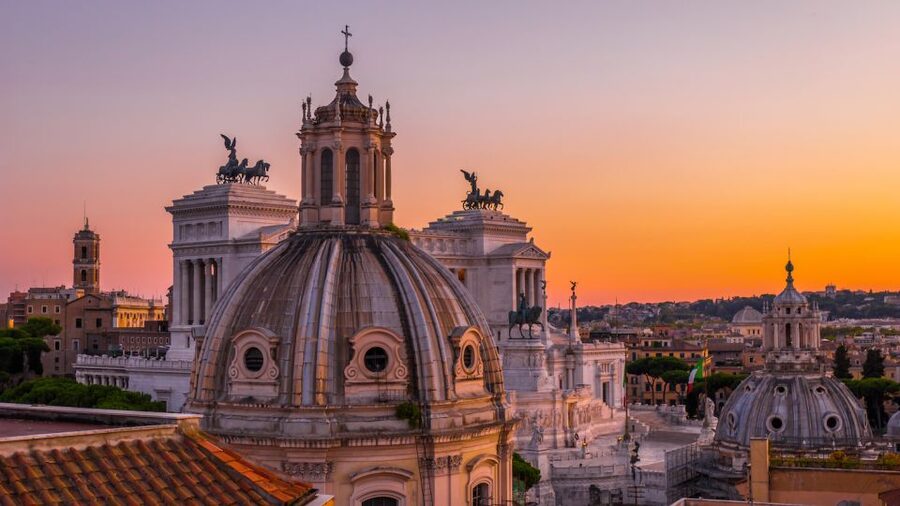
Rome is at its most atmospheric when the heat fades and the fountains glow. This three-hour evening walk links the city’s grandest public spaces, from Pincio Terrace at sunset to the Trevi Fountain, Pantheon, Piazza Navona, and Campo de’ Fiori.
I like the route for two clear reasons: it gives you a fast introduction to central Rome, and it adds the stories that turn famous monuments into meaningful places. Guides such as Andrada, Carolina, Marzia, and Ghil have been praised for making art and history easy to follow.
The main drawback is simple: you walk for nearly the full three hours, with no planned break. The opening climb to Pincio Terrace is steep, and the tour is not suitable for wheelchair users.
Key points to know before booking
- Sunset from Pincio Terrace: Begin with a view over Rome’s rooftops from above Piazza del Popolo.
- Classic central Rome route: See the Spanish Steps, Trevi Fountain, Pantheon, Piazza Navona, and Campo de’ Fiori in one evening.
- Stories, not just snapshots: Guides explain Roman history, religion, architecture, art, and local legends as you walk.
- A useful first-night tour: The route helps you get your bearings and decide where to return during the rest of your stay.
- Three hours on foot: Wear comfortable shoes and expect steps, uneven paving, and a brisk pace.
- Good evening value: At $46 per person, the price is reasonable if you want a guided overview rather than simply finding the monuments on your own.
Starting at Piazza del Popolo
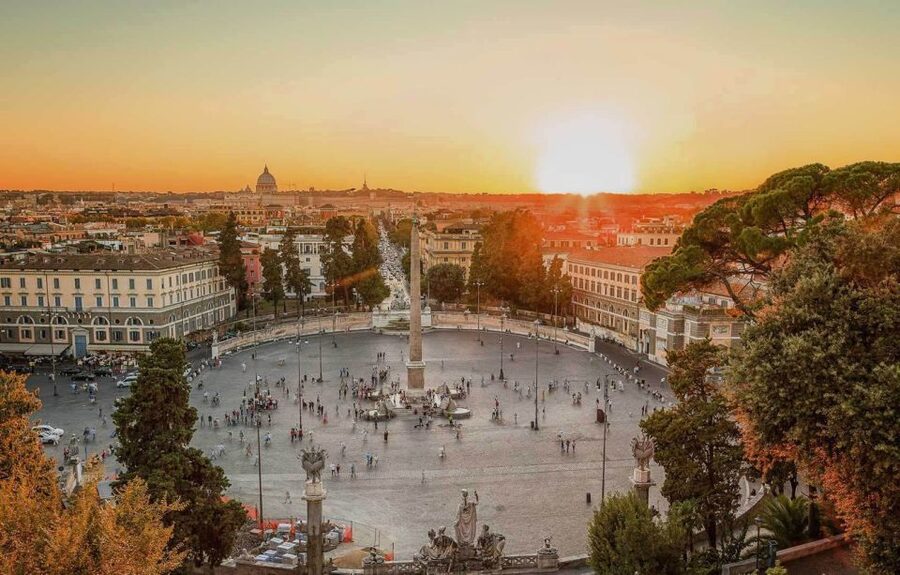
The meeting point is in front of Santa Maria del Popolo Church at Piazza del Popolo, beside the Leonardo da Vinci Museum. Look for the guide holding a Rome Your Way sign.
Piazza del Popolo is a fitting place to begin. The broad square gathers churches, fountains, monuments, and an Egyptian obelisk in one open space. You start with a setting that shows how Rome layers ancient symbols, Renaissance planning, and Baroque design without separating them into tidy museum rooms.
The meeting point can be a little confusing, so allow time to find the church and the guide. The important detail is that you are meeting at the square, not being collected from your hotel. Hotel pickup and drop-off are not included.
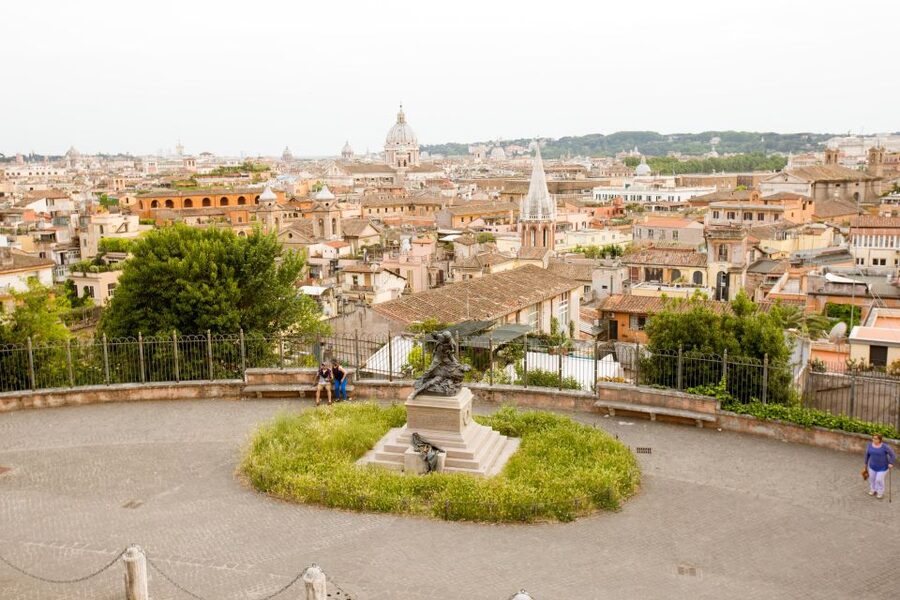
From the piazza, the group climbs toward Pincio Terrace. This is the toughest part at the start, but it pays off quickly. The terrace looks across the rooftops and domes of Rome, with Piazza del Popolo below and the city spreading toward the horizon.
The exact light depends on the season and starting time. Still, this first stop gives the tour a strong sense of place before you enter the busy streets. It also explains why an evening start can work so well in Rome: you get a cooler walk and a softer view of the city.
More Evening Tours in Rome
- Rome: City Highlights Open-Top Bus Night Tour
★ 4.1 · 2,038 reviews - Rome: Paranormal Night Walking Tour & Secret Backstreets
★ 4.9 · 1,921 reviews - Vespa Sidecar Tour By Night with Pickup
★ 5.0 · 1,803 reviews
Sunset over Rome from Pincio Terrace
Pincio Terrace is not one of Rome’s ancient monuments, but it may be the most memorable viewpoint on the route. You see the city as a whole rather than one fountain or church at a time.
Your guide can use this pause to explain the shape of Rome and point out important domes and rooftops. Several guides on this tour have been praised for connecting architecture with history and religion, rather than reciting dates without context.
Keep your expectations practical. This is a viewpoint stop, not a long rest period. The tour continues after the sunset view, so take your photos promptly and stay close to the group.
The hill also matters for anyone with limited mobility. The tour is specifically marked as unsuitable for wheelchair users, and the initial climb is the clearest reason. Comfortable shoes are essential for everyone, since Rome’s paving can be tiring even when the route itself is not technically difficult.
The Spanish Steps and Barcaccia Fountain
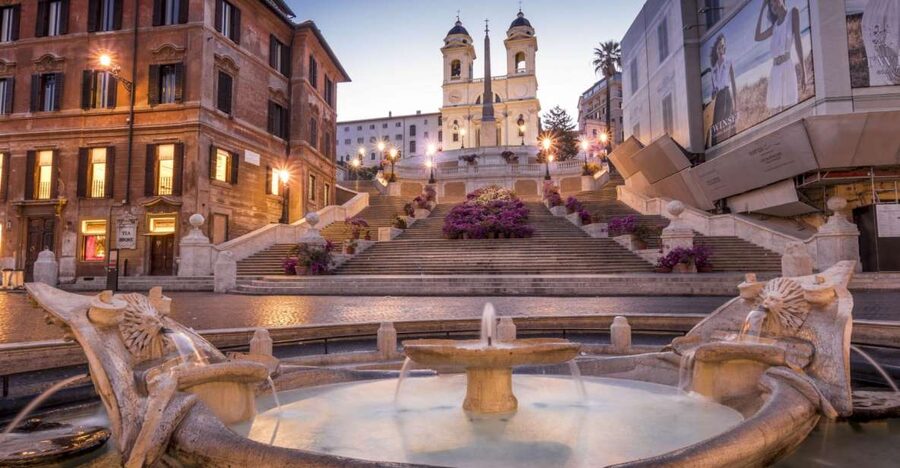
The walk continues to Piazza di Spagna, home of the Spanish Steps and Bernini’s Barcaccia Fountain. This is one of Rome’s most recognizable corners, but it can be hard to appreciate when you are focused only on taking a quick photo.
A guide adds useful context here. The steps connect the lower square with the church above, while the boat-shaped fountain gives the open space a distinctly Roman touch. You learn to look at the relationship between the steps, water, church, and surrounding buildings instead of treating each sight as an isolated attraction.
This is also one of the places where crowd levels can affect the experience. The evening setting may feel easier than the middle of a hot afternoon, but the Spanish Steps remain a popular meeting point. Stay alert when the group pauses, since it is easy to lose sight of a guide in a busy square.
The tour does not focus on entering major monuments. This is an exterior sightseeing walk, so you should not expect a visit inside Santa Maria del Popolo, the Pantheon, or the churches along the route. Its strength is the broad view of Rome’s public spaces and the connections between them.
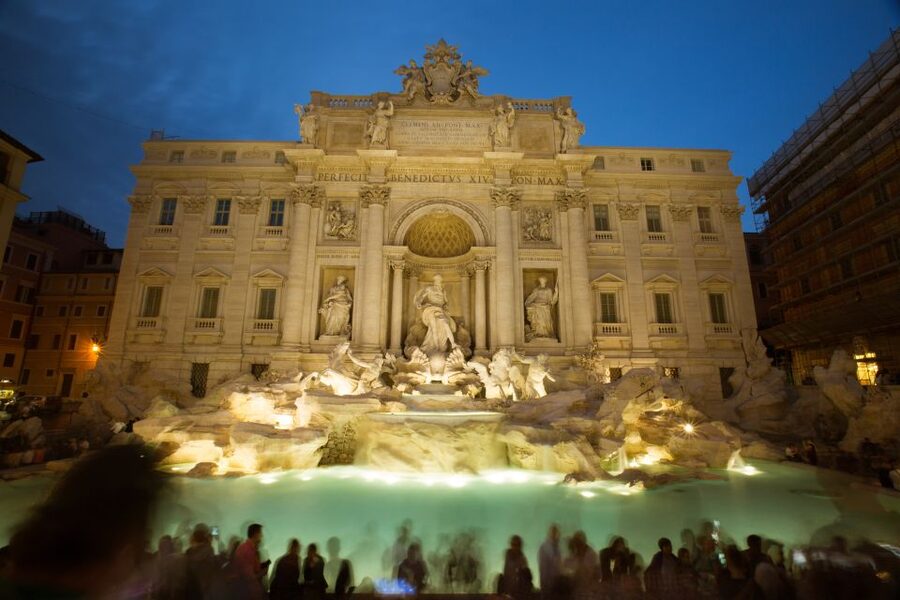
The Trevi Fountain after dark
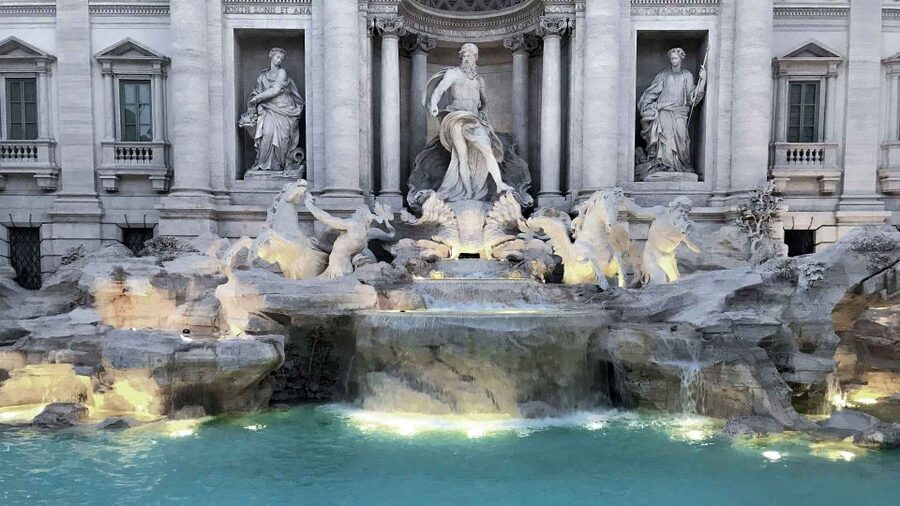
From Piazza di Spagna, the route heads to the Trevi Fountain. This is the largest Baroque fountain in Rome, and it is one of the tour’s major moments.
The fountain is crowded at many hours, but evening lighting gives the stone and water a different character. You can admire the movement of the figures, the theatrical rockwork, and the central figure of Oceanus while your guide explains the traditions surrounding the site.
The best-known custom is tossing a coin over your left shoulder into the fountain. The legend says this will bring you back to Rome. It is a small ritual, but it gives the stop a playful connection to the city. Bring a coin if you want to join in, though the tour does not require it.
Expect a short stop rather than a private viewing. This is a public square, and the guide must keep the group moving. If the fountain is high on your list, make a note to return later on your own when you can spend more time here.
One advantage of seeing it during this tour is that you receive an explanation of the monument instead of simply arriving, taking a picture, and leaving. That difference matters in Rome, where a beautiful façade can hide centuries of political, artistic, and religious change.
More Walking Tours in Rome
- Rome: Trastevere & Campo de Fiori Street Food Walking Tour
★ 4.9 · 2,768 reviews - Rome by Night Walking Tour – Legends & Criminal Stories
★ 4.5 · 1,003 reviews - Best of Rome Walking Tour including Trevi Fountain
★ 4.5 · 923 reviews - Rome: Under the Moonlight Evening Walking Tour
★ 4.8 · 852 reviews
Piazza della Rotonda and the Pantheon
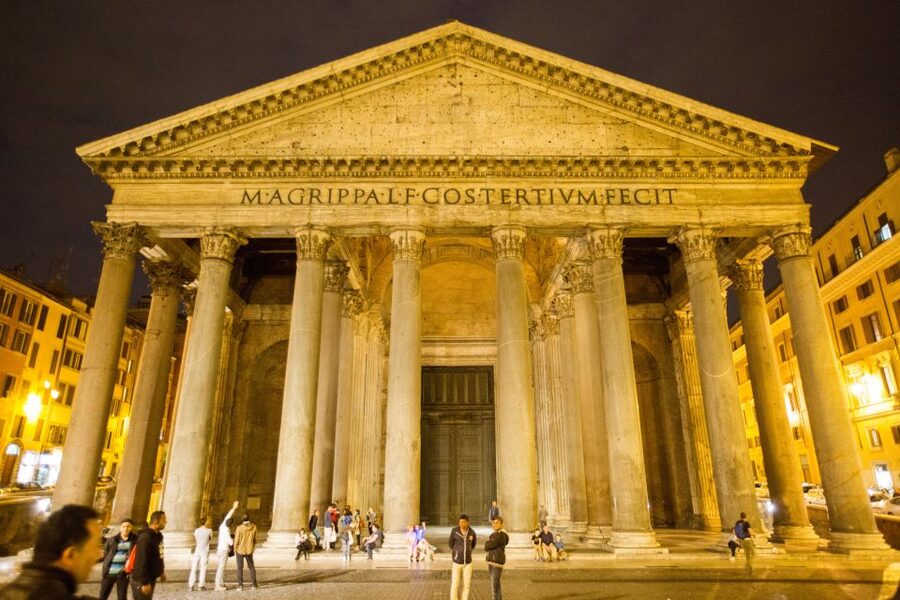
Next comes Piazza della Rotonda, where you view the exterior of the Pantheon. The building was constructed in 27 B.C. and later became a church dedicated to Mary and the martyrs.
The tour focuses on the outside, so plan a separate visit if you want to see the interior. Even from the square, the Pantheon is impressive because its massive portico and ancient columns seem almost too large for the surrounding streets.
The guide can also explain the building’s later Christian use and its connection with Renaissance art. Raphael, one of the major artists of the Renaissance, is buried inside. This makes the Pantheon a useful link between ancient Rome, Christian Rome, and the artistic world that followed.
Piazza della Rotonda gives you a good chance to pause and take in how Rome works. A nearly two-thousand-year-old building is not isolated behind a fence. It is part of an active city square, surrounded by cafés, daily life, and later architecture.
That closeness is one of the tour’s strongest features. You are not moving from one distant attraction to another by bus. You are walking through the city center and seeing how different periods sit side by side.
Bernini’s Four Rivers Fountain in Piazza Navona
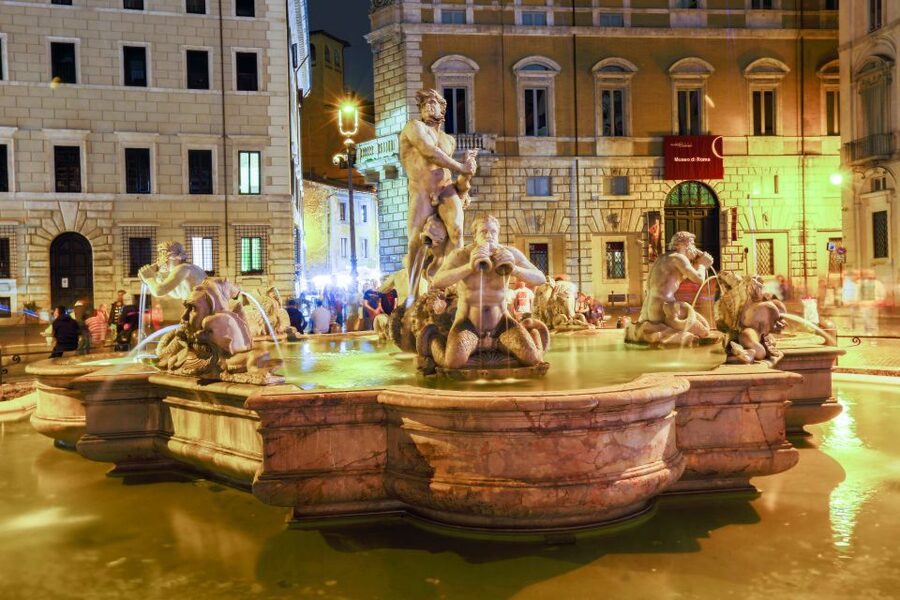
Piazza Navona is the grandest square on the route. Its long, open shape follows the outline of an ancient Roman stadium, and its central fountain is one of Gian Lorenzo Bernini’s great works.
The Four Rivers Fountain represents four major rivers, with an obelisk rising above the sculptural group. Your guide can help you read the fountain’s figures and explain the rivalry between Bernini and architect Francesco Borromini, whose Church of Sant’Agnese in Agone faces the square.
There is plenty to see beyond the centerpiece. The square includes Palazzo Pamphili, the Neptune Fountain at the northern end, and the Moor Fountain at the southern end. A good guide will help you notice these details without turning the stop into a long lecture.
Piazza Navona is also a useful place to judge your energy. By this point, you have already crossed much of central Rome. If your feet are tiring, the final stretch to Campo de’ Fiori may feel longer than expected.
The pace has received strong praise from people who found it easy to follow, but one clear warning applies: this is not a gentle stroll with frequent sitting breaks. You are on your feet for most of the three hours. If you need regular rest, the schedule may be demanding.
Ending at Campo de’ Fiori
The tour ends at Campo de’ Fiori, a square with a darker past and a lively present. It was once associated with races and public executions. The statue of Giordano Bruno in the center recalls the philosopher who was executed there in 1600.
Today, the square changes character over the course of the day. It is a market area in the morning and a place for evening activity after sunset. That makes it a practical finishing point, since you can continue your night nearby after the guide says goodbye.
The ending is not just convenient. It gives you a final example of Rome’s ability to put ordinary social life on top of a complicated past. You can finish with a meal, a drink, or a further walk, but the tour itself does not include food or restaurant reservations.
Several guides have offered restaurant suggestions during the walk, but those recommendations can vary by guide and day. Treat them as useful ideas, not part of the formal package.
What the guides add
This tour depends heavily on the guide. The route is excellent, but you can find the monuments without paying for a walking tour. The value comes from the explanations, connections, and small details you would likely miss alone.
Andrada has been singled out for her command of history and architecture, along with an easy way of explaining complex subjects. Carolina has been praised for her energy and for making the route entertaining. Marzia, described as an archaeologist, has shared historical background as well as advice on authentic Roman food.
Other guides, including Ava, Ghil, Juliano, and Elida, have also been praised for clear storytelling, humor, and answering questions. The guide assigned to your date will vary, so you should not book solely because of one name. Still, the repeated pattern is encouraging: the tour works best when the guide brings art, religion, and Roman history together.
Headsets are provided when needed. That can help when the group is spread out or the surrounding square is noisy, though you should still stay within sight of the guide.
English is the listed tour language. The experience is designed for visitors who want explanation as they walk, not a silent route with occasional directions.
Is $46 a fair price?
At $46 per person, this is not the cheapest way to see Rome’s center. You can walk the same streets for free, and many of the sights are visible without an entrance ticket.
The fair comparison is not free sightseeing versus a ticket. It is paying for three hours of interpretation, route planning, and a useful introduction to the city. If you are new to Rome, the cost can be worthwhile because the tour helps you understand what you are seeing and decide where to return.
The route also packs in a lot. You get a sunset viewpoint, several famous fountains, the Spanish Steps, the Pantheon exterior, Piazza Navona, and Campo de’ Fiori without arranging separate visits. A private guide would cost far more, while a self-guided walk requires research and careful navigation.
I would see the strongest value in booking it early in your stay. You can use the tour to get your bearings, then revisit the Trevi Fountain, Pantheon, or Piazza Navona at a slower pace later.
The value is weaker if you already know central Rome well or prefer to explore at your own speed. It is also less suitable if you dislike groups, walking continuously, or hearing a structured explanation at each stop.
Who should book this evening walk?
This tour suits first-time visitors, couples, families with older children, and anyone arriving in Rome with only a few hours to spare. It is also a practical choice if daytime heat worries you. The evening timing can make the route more comfortable, especially in summer.
Children five and younger go free, but the walking distance still matters. Young children may find three hours on foot tiring even when they do not need a ticket.
The tour is a particularly good match for curious visitors who want context. You do not need a background in Roman history or art. A strong guide can explain the main ideas in plain language and answer questions along the way.
It is less suitable for wheelchair users, anyone who needs frequent breaks, or visitors hoping to enter several monuments. This is an outdoor city walk, not an indoor sightseeing program.
The tour offers free cancellation up to 24 hours before the start, and you can reserve now and pay later. Those terms make it easier to place the walk early in your schedule while keeping some flexibility.
Should you book the Rome evening walking tour?
Book it if you want a lively introduction to central Rome, especially on your first evening. The sunset from Pincio Terrace, the fountains after dark, and the steady flow through Rome’s historic squares give you a strong sense of the city in a short time.
I would skip it if you want a slow-paced tour with plenty of sitting, or if your main goal is entering the Pantheon and other monuments. For most first-time visitors who can manage three hours of walking, $46 is a reasonable price for the route and the guide’s storytelling.
Wear good shoes, arrive early at Santa Maria del Popolo, and save a little energy for the final walk to Campo de’ Fiori. You will finish with a useful map in your head and several places worth revisiting.
FAQ
Where does the Rome evening walking tour start?
The tour starts at Piazza del Popolo, in front of Santa Maria del Popolo Church. The church is next to the Leonardo da Vinci Museum. Look for a guide holding a Rome Your Way sign.
Where does the tour end?
The walk ends at Campo de’ Fiori.
How long is the tour?
The guided walking tour lasts three hours.
What language is the tour offered in?
The live tour guide provides the tour in English.
Which major sights are included?
The route includes Pincio Terrace, the Spanish Steps, Bernini’s Barcaccia Fountain, the Trevi Fountain, Piazza della Rotonda, the exterior of the Pantheon, Piazza Navona, and Campo de’ Fiori.
Does the tour enter the Pantheon?
The itinerary specifies viewing the exterior of the Pantheon. Entry inside is not included in the tour details.
Is hotel pickup included?
No. You must make your own way to the meeting point at Piazza del Popolo, and hotel drop-off is not included.
Is the tour suitable for wheelchair users?
No. The activity is listed as unsuitable for wheelchair users.
Do children need to pay?
Children five years old and younger go free.
Can I cancel the booking?
You can cancel up to 24 hours in advance for a full refund. The reserve-now-and-pay-later option is also available.
Just added around Rome
- Boat excursion to Gaeta with a stop for swimming and snorkeling 2 HOURS★ 5.0 · 240 reviews
- Palatine Hill and Roman Forum Tour with Fast-Track Entrance★ 4.2 · 417 reviews
- Tivoli: Villa D’Este & Villa Adriana Pass & App Audioguide★ 4.4 · 364 reviews
- Tivoli: Villa D’Este Entry Ticket and App Audio Guide★ 4.3 · 191 reviews
- From Rome: Villa D’Este & Villa Adriana Day Trip with Lunch★ 4.4 · 289 reviews
- Vatican Museums & Sistine Chapel Skip-the-Line Guided Tour★ 4.6 · 254 reviews
- Rome: Capitoline Museums and Centrale Montemartini Tickets★ 4.4 · 328 reviews
- Rome: The Three Tenors at St. Paul’s Church Concert Ticket★ 4.7 · 699 reviews
Walking Tours, compared.

Guided Walking Tour & Last Supper Visit with Ticket
Read our review →
Rialto Bridge & Offbeat Unusual Venice Walking Tour
Read our review →
Private 3 hrs Venice Tour: St Mark’s, Walking tour & Boat tour
Read our review →
Skip the line: Uffizi and Accademia Small Group Walking Tour
Read our review →Browse the lists this tour appears in