
Reviewed · SKIP THE LINE
Milan: San Sepolcro Crypt Skip-the-Line Entry Ticket
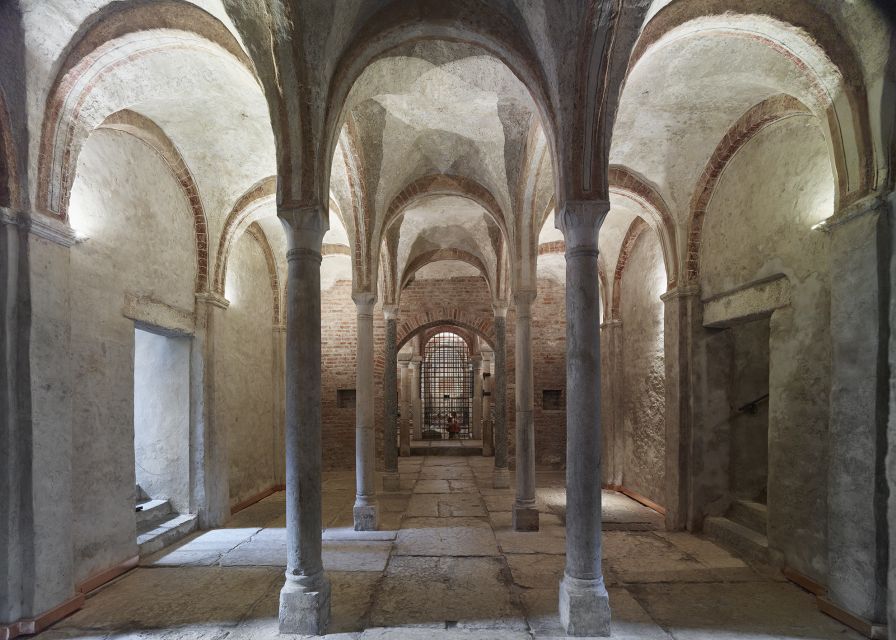
Milan’s San Sepolcro Crypt is a small underground church with a big story beneath your feet. It occupies the site of the forum of Roman Mediolanum, and its floor includes large white Verona-stone slabs taken from that ancient civic center. I love that direct physical link to Roman Milan, and I like the restored medieval frescoes overhead. This is history you can see and walk across, not just read about on a sign.
I also appreciate the low $11 price and the skip-the-ticket-line entry, especially if you are already visiting the Pinacoteca Ambrosiana nearby. The main caution is size. The crypt is compact, and some visitors spend only 10 minutes inside, even though the ticket allows about 30 minutes. If you want a grand church with many rooms, this will feel slight.
Key points to know before you go
- A Roman forum forms the floor: Walk across old slabs of white Verona stone from the 4th-century forum of Mediolanum.
- The church is entirely underground: A staircase from Piazza San Sepolcro leads into this unusual medieval space.
- The crypt dates to 1030: Its religious setting replaced a place where Roman civic and religious business once took place.
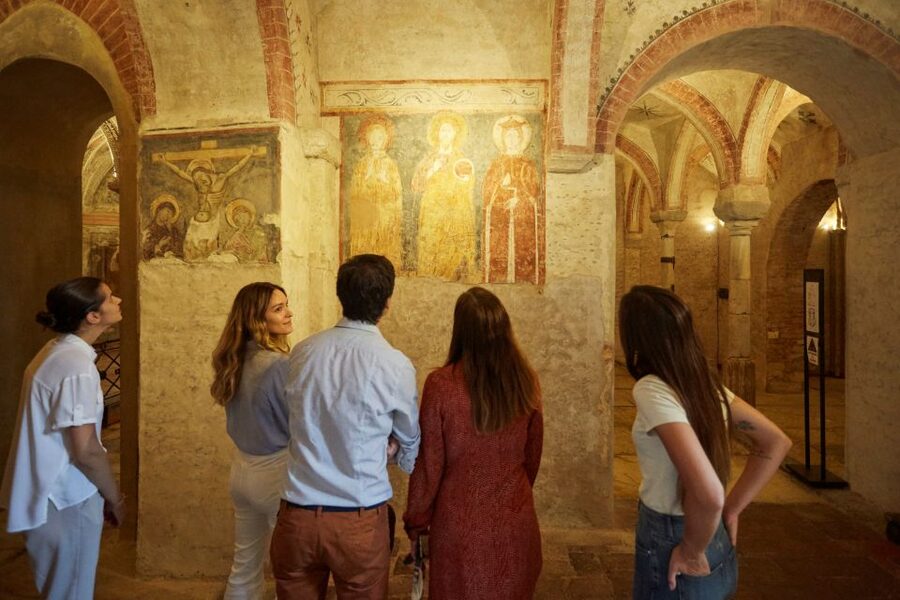
- Late 13th-century decoration survives: Look up at the recently restored vaults and frescoes.
- Thirty minutes is the planned visit: The crypt is small enough that a focused visit may take closer to 10 to 20 minutes.
- Access has limits: Baby strollers are not allowed, and the crypt is not suitable for wheelchair users.
Why this little crypt matters in Milan
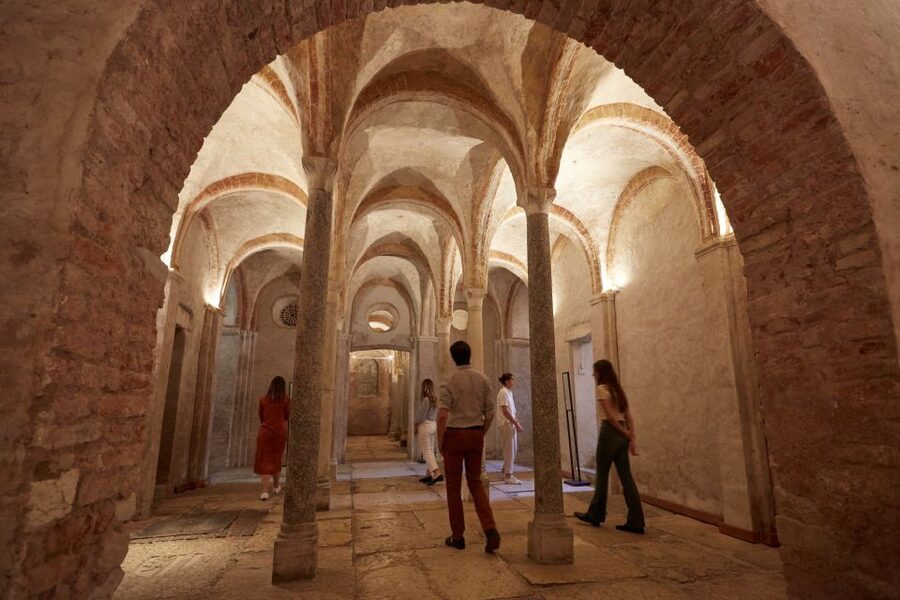
Milan is often sold through its cathedral, fashion streets, grand galleries, and aperitivo scene. San Sepolcro offers a different scale. You step below street level and enter a place tied to several layers of the city at once: Roman, medieval, religious, and artistic.
The crypt was founded in 1030, making it one of Milan’s older surviving church spaces. Its setting is especially striking because it occupies the location of the ancient Roman forum. In Roman Mediolanum, this was a central place for civil and religious activity. Centuries later, the same ground became a church.
That change in use gives the visit its appeal. You are not simply looking at an old room. You are seeing how one important city center was built over and repurposed across time. The Roman stones below and medieval decoration above make the crypt feel like a compact lesson in Milan’s past.
The atmosphere is quiet and sacred, though the visit itself is brief. I would not plan an entire morning around it. I would pair it with the Pinacoteca Ambrosiana, since the entrance route is in the same general area and the crypt’s courtyard access is located where the gallery exit is found.
More Entry Tickets in Milan
- Milan: Cathedral and Duomo’s Terraces Entrance Ticket
★ 4.6 · 61,054 reviews - Milan Cathedral: Duomo Terraces Ticket (No Church Access)
★ 4.6 · 6,111 reviews - Milan: Guided Walking Tour & Last Supper Visit with Ticket
★ 4.7 · 5,409 reviews
Finding the entrance in Piazza San Sepolcro
The entrance is easy to miss if you do not know where to look. Go to Piazza San Sepolcro, then pass through the gate into the courtyard where the exit of the Pinacoteca Ambrosiana is located.
Inside the courtyard, look for the statue of Federico Borromeo. A staircase beside the statue leads down to the crypt entrance. This is useful to know because you are not entering through a large, obvious church doorway at street level.
The ticket gives you skip-the-line entry, which removes one possible delay. That does not make the crypt a guided tour, and no guide is specified for this experience. You should expect a self-directed visit focused on the space, its surfaces, and its historical setting.
Give yourself a few extra minutes to locate the courtyard and staircase. The crypt is small, but being late or rushing to find the entrance can take away from the calm of the visit.
Going below street level into the 1030 church
The first part of the visit is the descent by staircase. That physical movement helps set the mood. Milan’s modern streets and busy center remain just above you, while the crypt feels enclosed and removed from the city.
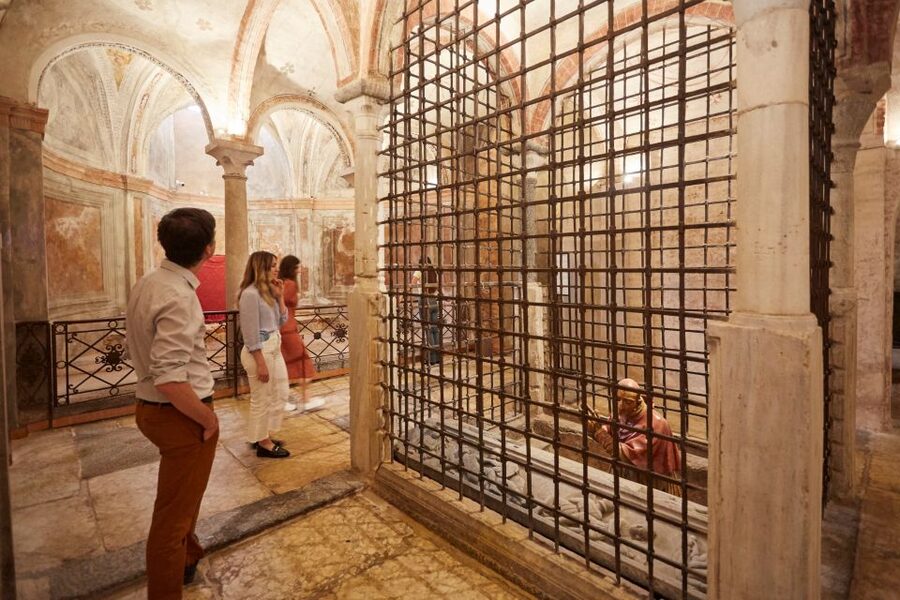
This is not a vast underground complex. You will not find a long sequence of chapels, large exhibition halls, or a maze of passageways. The space is compact, and much of what you see is concentrated along a short route through the church.
That limitation is also part of the charm. The building feels intimate rather than monumental. You can take in the basic shape quickly, then spend more time looking closely at the floor, vaults, and painted details.
I suggest slowing down at the entrance instead of walking straight through. First look at the proportions of the room. Then notice how the low underground setting changes your sense of scale. Finally, look down and up. The Roman pavement and medieval decoration are the two main visual anchors.
Walking across the old Roman forum
The most unusual feature is the pavement. Large slabs of white Verona stone came from the old Roman forum and date from the 4th century. You are walking across material that once formed part of the center of Mediolanum.
That detail gives the floor more meaning than a typical worn church surface. It was not laid for medieval worship alone. It belonged to an earlier public place where important civil and religious activities took place.
The connection with Leonardo da Vinci adds another interesting layer. The ancient paving fascinated Leonardo, tying the site not only to Roman Milan and the Middle Ages but also to one of the city’s best-known Renaissance figures.
Do not expect the paving to look like a complete Roman plaza. Inside the crypt, you see surviving slabs incorporated into the church floor. Their importance comes from their origin and continued use, not from a full reconstruction of the forum.
For me, this is the strongest reason to visit. Frescoes can be viewed in many Italian churches, but standing on surviving pavement from Milan’s Roman forum gives this small site a clear identity.
More Skip-the-Line Tickets in Milan
- Milan Duomo & The Last Supper Skip-the-Line Small Group Tour
★ 4.5 · 2,761 reviews - Historic Milan Tour with Skip-the-Line Last Supper Ticket
★ 4.5 · 1,976 reviews - Milan Super Saver: Skip-the-Line Duomo and Rooftop Guided Tour
★ 4.5 · 1,501 reviews - Milan: Last Supper Skip-the-Line Entry Ticket & Guided Tour
★ 4.8 · 1,451 reviews
Looking up at the restored medieval frescoes
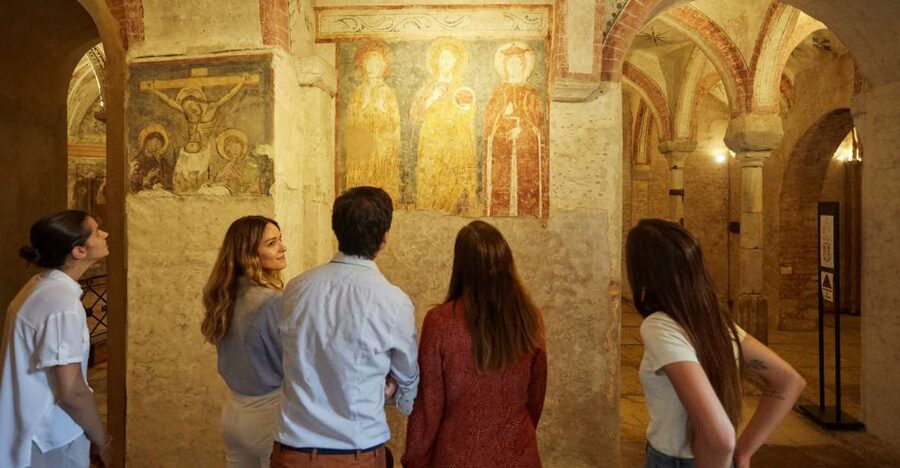
The vaults carry late 13th-century decoration, including frescoes that have recently been restored. The paintings are a major part of the visit, especially if you enjoy medieval art and church interiors.
Restoration can make old details easier to read, but it does not turn the crypt into a bright art gallery. The room remains old, enclosed, and restrained. You will want to look carefully rather than expect a grand wall-to-wall display.
Take time to examine the vaults from different points along the route. The decoration may appear quickly at first, particularly if you are focused on the Roman stones. Looking up gives the visit a second stage and helps explain why the ticket allows roughly 30 minutes.
The frescoes are also the reason this stop may appeal more to an art-minded visitor than to someone interested only in ancient Rome. The best experience comes from combining both layers: Roman pavement underfoot and medieval painting overhead.
How long the visit really takes
The advertised duration is 30 minutes. That is a sensible amount of time if you want to walk through slowly, study the frescoes, and pause to think about the site’s changing purpose.
You may need far less time if you simply want a quick look. The crypt is very small, and a focused visit can take about 10 minutes. One visitor found that the space felt more like a short corridor with a few rooms than a large church. That is a fair warning for anyone comparing this with Milan’s enormous cathedral or a full museum visit.
I would budget 20 to 30 minutes in your day, while accepting that you may finish sooner. The extra time gives you room to look properly without feeling hurried. It also prevents disappointment if the visit does not fill the full half hour.
The short length can be a benefit. You can fit the crypt between nearby sights instead of committing to a long tour. It works well as a focused historical stop, not as the main attraction of an entire day.
Is the $11 ticket good value?
At $11 per person, the ticket is reasonably priced if you care about Roman and medieval Milan. The value comes from the setting rather than the number of rooms. You are paying for access to an underground church on the site of the Roman forum, with restored frescoes and original ancient paving.
The calculation changes if you measure value by time alone. If you spend only 10 minutes inside, the price may feel high for such a compact space. If you take your time and combine the crypt with the Pinacoteca Ambrosiana area, it becomes easier to justify.
The skip-the-line feature is useful, though its importance depends on how busy the entrance is when you arrive. It saves you from waiting for a ticket and gives you a fixed way into a small but popular historic site. It does not make the visit longer or add a guide.
I would book it for the historical detail, not because it offers a large amount to see. The strongest value is for people who enjoy places where one city layer remains visible beneath another.
Who will enjoy San Sepolcro Crypt most?
This experience suits you if you like archaeology, medieval churches, sacred spaces, or unusual corners of major cities. It is also a good choice if you want a short stop near the Ambrosiana rather than another large museum or cathedral interior.
It works well for:
- People interested in Roman Milan and the ancient city of Mediolanum
- Visitors who enjoy medieval frescoes and restored church decoration
- Art and history enthusiasts who want to connect Roman and medieval periods
- Anyone building a compact itinerary around Piazza San Sepolcro
- Visitors who prefer quiet, focused sights over large attractions
You may want to skip it if you need step-free access, are traveling with a baby stroller, or want a large and varied attraction. Wheelchair users cannot use this experience, and baby strollers are not allowed.
Families with older children may find the Roman floor especially useful as a visual way to explain how cities change. Very young children may have little patience for a short underground church with no listed hands-on activities.
Practical planning for your Milan day
The crypt is easiest to add to a central Milan itinerary. Its meeting point is Piazza San Sepolcro, and the entrance is reached through the courtyard associated with the Pinacoteca Ambrosiana exit. Plan the crypt around nearby sightseeing rather than traveling across the city for this stop alone.
The skip-the-line ticket is included, but the visit is not described as a guided tour. You should be ready to explore at your own pace and read the available information on site if provided. No guide names or specific guided commentary are supplied, so do not book expecting a named art historian or a structured lecture.
Wear footwear that feels secure on old stone surfaces and be prepared for stairs. The supplied information does not give details about temperature, lighting, or restroom facilities, so I would not rely on the crypt for a long indoor break.
Free cancellation is available up to 24 hours before the visit, with a full refund. You can also reserve now and pay later, which helps if your Milan schedule is still shifting. Check the available starting times before booking, since the ticket is tied to availability.
One caution is worth taking seriously: an isolated booking report described arriving and finding no one present. Because of that, keep your confirmation details handy and make sure you have the exact entry instructions for the courtyard and staircase. The general directions are clear, but the entrance is not prominent from the piazza.
How San Sepolcro compares with bigger Milan sights
The crypt cannot compete with the Duomo for scale, the Ambrosiana for a major art collection, or Milan’s large churches for architectural drama. That is not its role.
San Sepolcro offers a short, concentrated encounter. Its appeal comes from the layers packed into one small place: a Roman civic center, a medieval church founded in 1030, late 13th-century frescoes, and a connection to Leonardo’s interest in the ancient pavement.
If you want a long cultural program, choose a museum or a larger church. If you want a 30-minute stop that gives your Milan walk a sense of time beneath the modern city, this crypt makes sense.
I especially like it as a counterpoint to grand attractions. After seeing Milan’s polished public face, you can go underground and find something older, quieter, and less obvious.
Should you book the San Sepolcro Crypt?
Book this ticket if you value authentic remains, medieval art, and the chance to walk over part of Roman Milan. At $11, it is a fair add-on for a history-focused day, especially alongside the Pinacoteca Ambrosiana.
Skip it if you expect a large underground church, a long guided tour, or enough material to fill an hour. The crypt is genuinely small, and some people will see everything in 10 minutes.
My advice is simple: treat San Sepolcro as a compact historical stop, not a headline attraction. Allow up to 30 minutes, follow the courtyard directions carefully, and spend your time looking both down at the Roman forum pavement and up at the restored medieval vaults. That combination is what makes the visit worthwhile.
FAQ
Where is the San Sepolcro Crypt?
The crypt is in Piazza San Sepolcro in Milan. Enter through the gate to the courtyard where the exit of the Pinacoteca Ambrosiana is located.
How do I find the crypt entrance?
In the courtyard, look for the statue of Federico Borromeo. A staircase beside the statue leads down to the crypt entrance.
How long does the visit take?
The stated duration is 30 minutes. Because the crypt is compact, you might see it in about 10 minutes, or spend closer to 30 minutes if you study the frescoes and Roman paving.
What is included in the ticket?
The ticket includes skip-the-line entry to the San Sepolcro Crypt.
What can I see inside the crypt?
You can see an underground medieval church founded in 1030, recently restored frescoes and vaults with late 13th-century decoration, and large white Verona-stone slabs from the old Roman forum.
Is the crypt located on an ancient Roman site?
Yes. It was built where the forum of the ancient Roman city of Mediolanum once stood.
Is the crypt accessible to wheelchair users?
No. The experience is not suitable for wheelchair users.
Can I bring a baby stroller?
No. Baby strollers are not allowed.
Can I cancel the booking?
Yes. You can cancel up to 24 hours in advance for a full refund. Reserve-now, pay-later booking is also available.
Just added around Milan
- Canyoning “Gumpenfever” – beginner Canyoningtour for everyone★ 5.0 · 391 reviews
- Bergamo: Digital guide made by a local for your walking tour★ 5.0 · 184 reviews
- Milan: City Highlights Walking Tour with The Last Supper★ 4.9 · 195 reviews
- Milan: The Milan Pass City Card★ 4.0 · 655 reviews
- Milan: Duomo & Rooftop Tour with Optional Hop-On Hop-Off Bus★ 4.5 · 262 reviews
- Milan: Skip-the-Line Guided Walk and “The Last Supper”★ 4.5 · 606 reviews
- Milan: Duomo and The Last Supper Skip-the-Line Guided Tour
- Milan: Leonardo’s Last Supper and Michelangelo’s Pietà Tour★ 4.6 · 559 reviews
Skip the Line, compared.
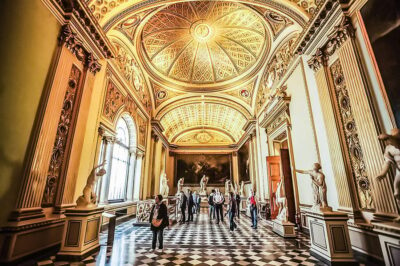
Skip-The-Line Uffizi Gallery Timed Entry Ticket
Read our review →
Vatican Museums & Sistine Chapel Skip-the-Line Entry Ticket
Read our review →
Skip-the-Line Group Tour of the Vatican, Sistine Chapel & St. Peter’s Basilica
Read our review →
Michelangelo’s David Skip-the-Line Entry Ticket
Read our review →
Vatican Museums & Sistine Chapel Skip-The-Line Ticket
Read our review →
Vatican, Sistine Chapel & St. Peter’s Skip-the-Line Tour
Read our review →
Skip-the-Line Vatican, Sistine Chapel & St. Peter’s | Small Group
Read our review →
Vatican: Vatican Museums Sistine Chapel Skip-the-Line Ticket
Read our review →Browse the lists this tour appears in