
Reviewed · WALKING TOURS
Matera: Caves and Rock Churches Walking Tour in English
Matera’s Sassi make sense only after you understand how people lived inside the rock. This 2.5-hour walking tour takes you from grand viewpoints into cave homes, old water systems, and the rock church of St. Mary of Idris, where the city’s beauty and hardship come together.
I like the relaxed pace and the way local guide Gaetano Campanile connects history with family stories from Matera. I also like the value: for $28, you get a proper introduction to the Sassi rather than a quick photo walk. The main drawback is the hill, with stairs throughout the old city, so comfortable shoes and a little stamina are needed.
Key points at a glance
- Start in Piazza S. Pietro Caveoso: Meet your guide directly in front of the church in one of Matera’s most striking squares.
- Enter an old cave home: See how families once lived in rooms cut from the limestone.
- Understand the water system: Learn how rainwater was gathered and stored, a basic need in a city built into rock.
- Visit St. Mary of Idris: Explore one of Matera’s atmospheric rock churches.
- Hear local stories from Gaetano: Expect clear English, humor, social history, and stories passed down by people from the Sassi.
- Walk at a steady, easy pace: The route includes stairs, but the guide can adjust the pace for a mixed-age group.
Why Matera makes more sense with a guide
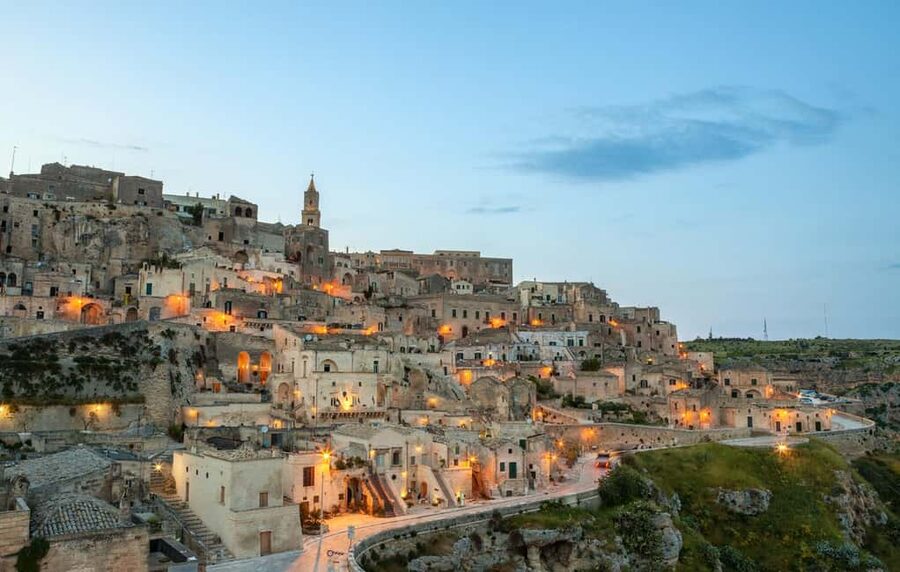
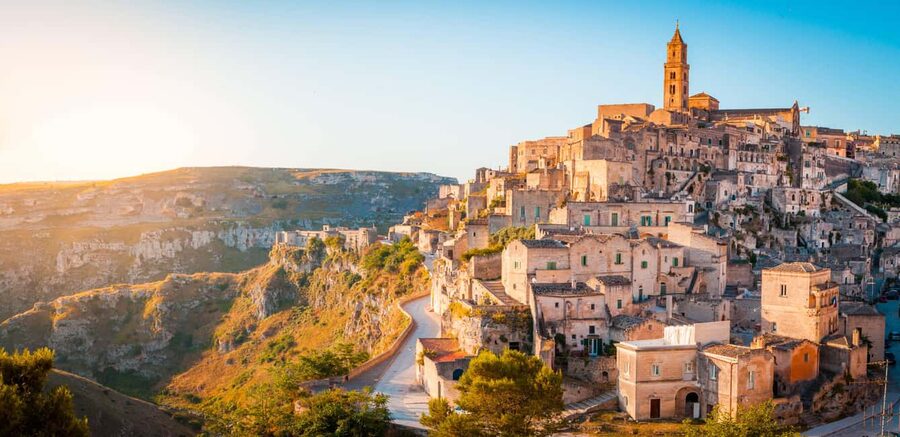
At first glance, Matera can seem almost too beautiful to be real. Pale stone homes cover the slopes, church facades seem to grow out of the rock, and narrow lanes lead to sudden views over the Sassi. It is easy to admire the setting without grasping the hard lives that shaped it.
That is where this tour earns its price. Gaetano explains the Sassi as a living settlement, not just a collection of old buildings. You learn how families shared cramped spaces, how animals could be part of the household, and how water was collected in a place where reliable supplies were essential.
I especially value the social story behind Matera. The city was once described as the shame of Italy, largely because of poverty, overcrowding, and poor living conditions in the cave districts. Later, Matera became a UNESCO site and a major symbol of Italian cultural heritage. The tour helps you understand that change instead of treating it as a simple fairy tale of decline and revival.
Gaetano’s local connection adds another layer. He is a trained historian and a native resident of Matera, and he uses stories connected to families who lived in the caves. That gives the walk a more human feel than a list of dates and architectural labels.
More Walking Tours in Matera:
- Matera’s Sassi Walking Tour – History & Culture
★ 5.0 · 476 reviews - Sassi di Matera: Guided Walking Tour with Cave House/Church
★ 4.7 · 343 reviews - Matera: Guided Walking Tour
★ 4.8 · 333 reviews
Starting at Piazza S. Pietro Caveoso
The meeting point is Piazza S. Pietro Caveoso, in front of the church. This is a useful place to begin because you are already close to the Sassi and can immediately see how Matera’s buildings, steps, and rock formations fit together.
Look for the guide in front of the church rather than waiting somewhere along the surrounding lanes. If you arrive by car, the suggested multi-level car parks are on Via Pasquale Vena and Via Rocco Scotellaro. Matera’s old districts are not the place to count on finding a convenient parking space at the last minute, so allow time to park and walk to the square.
The first moments of the tour help you get your bearings. Instead of being pushed straight into a maze of alleys, you begin with the broader shape of the city. From there, the route moves between open viewpoints and narrower passages.
That rhythm matters. The views show you the scale of the Sassi, while the small lanes reveal how close together daily life once was. Keep your camera ready, but do not spend the whole opening stretch looking through it. The guide’s explanation gives the views their meaning.
Walking through the Sassi
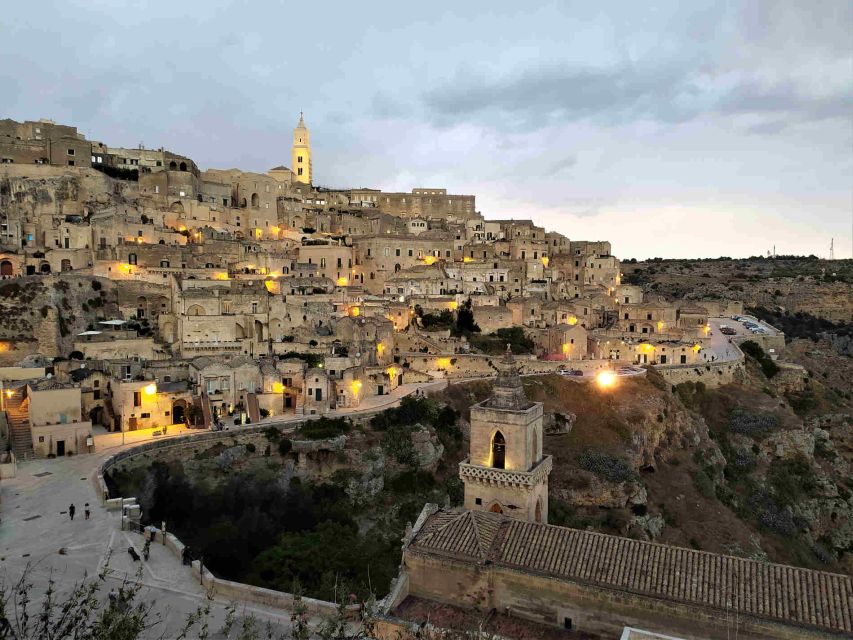
The Sassi are the ancient districts of Matera, built into and around the soft limestone of the hillside. Your walk takes you through both the obvious viewpoints and less noticeable corners that you could easily pass without understanding.
This is not a flat stroll. You will climb and descend stairs, and some parts of the old city can feel uneven. The pace is described as leisurely, and that is important for the experience. You have time to stop, listen, look across the ravine, and ask questions instead of racing from one landmark to the next.
The tour is particularly useful if this is your first time in Matera. After the walk, the Sassi’s layout becomes easier to read. You begin to notice the difference between a cave cut into the rock, a later facade placed over an older dwelling, and a church carved from the same stone.
Gaetano is praised for keeping the walk entertaining as well as informative. His English is described as excellent, and his style is relaxed enough for questions. That is useful in a place where the story can become heavy. Matera’s past involves poverty and difficult living conditions, but the tour does not treat the city as a museum of misery.
Inside an old cave home
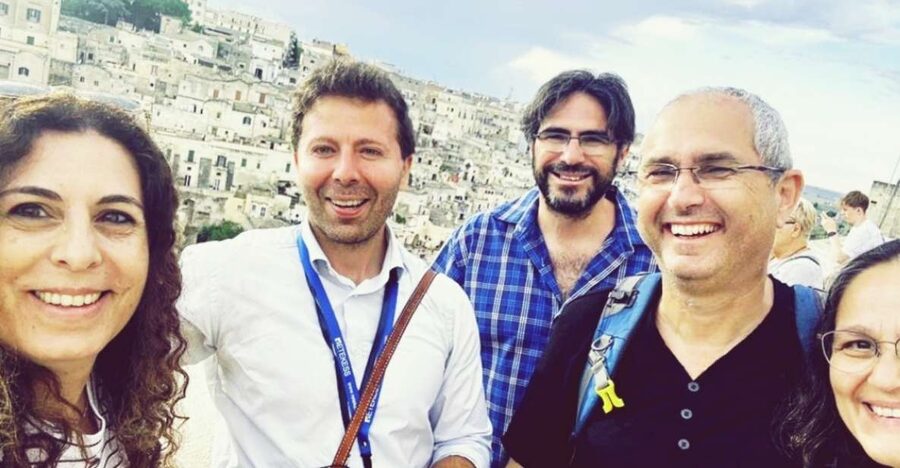
One of the most valuable stops is inside a cave house. Here you see the physical setting in which families once lived, rather than simply hearing that Matera had cave dwellings.
The cave homes were practical spaces shaped by the rock. Their appearance can seem simple, but the tour explains the systems that made life possible. You learn how families organized their rooms and how the natural stone helped form a shelter.
I would pay close attention to the scale of the space. It is one thing to see a cave from the outside. It is another to stand inside and imagine it as a family home, with daily life taking place in a confined area. The stop turns an attractive stone facade into a place connected to real people.
The guide also helps explain why the old homes should not be viewed only as quaint. The Sassi are photogenic today, but the conditions were not always comfortable or healthy. Understanding that contrast is one of the strongest reasons to take the tour rather than simply wander with a map.
A few more Matera half-days worth a look
- Matera: Sassi Tour with Cave House and Rupestrian Church
★ 4.7 · 6,618 reviews - Discover Matera, the ancient city – English tour
★ 5.0 · 1,771 reviews - Guided Tour of Matera Sassi
★ 4.5 · 1,312 reviews - Tour di Alberobello e Matera in bus privato da Bari
★ 4.8 · 701 reviews
Matera’s rainwater collection system
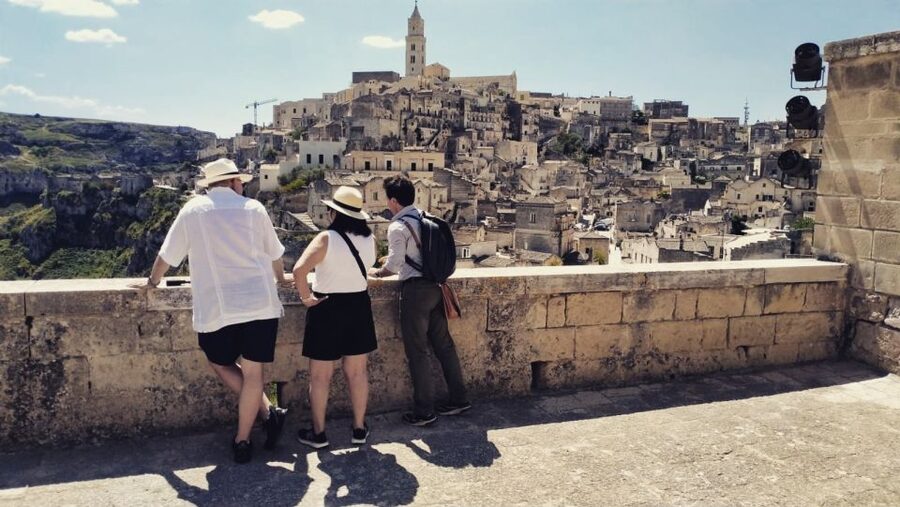
Water is one of the most important practical subjects on the walk. Matera’s ancient rainwater collection system was essential to survival, and the tour shows how residents made use of the rock beneath the city.
Rather than relying on a modern network, people collected rainwater and directed it into storage spaces. The system reflects the ingenuity required to live in a dry, rocky setting. It also helps explain why the caves and cisterns are not separate curiosities. They formed part of a larger plan for making the settlement work.
You might visit an old cistern during the route, depending on the exact path taken. This is the kind of detail that can disappear if you walk alone. The surface of Matera catches the eye, but the water infrastructure tells you how the city functioned below and behind that surface.
For me, this is the best kind of historical detail: practical, visible, and tied to ordinary life. You are not just memorizing an old date. You are learning how people obtained one of the things they needed every day.
St. Mary of Idris and the rock churches
The tour includes the rock church of St. Mary of Idris, one of the signature sights of Matera. It is carved into the rock and sits within the dramatic setting of the Sassi, making it both a religious site and a strong example of the city’s unusual architecture.
The church is worth seeing with an explanation. Without context, a rock church can look like a stark stone chamber. With a guide, you can better appreciate how religious spaces were created within the same material as the homes, paths, and cisterns.
The tour may also include other ancient churches, depending on the route. Keep in mind that church access and the exact order of stops can vary. The confirmed highlight is St. Mary of Idris, while other sites are best treated as possible additions rather than guarantees.
This part of the walk also gives you a break from the close quarters of the cave homes. The churches show another side of the Sassi, one tied to worship, art, and community life. Their plain stone interiors can be more memorable than a polished monument because they feel so closely connected to the rock around them.
From Italy’s shame to a UNESCO site
Matera’s modern story is central to the tour. The Sassi were once associated with poverty and severe overcrowding. Many residents were moved out of the old cave districts, and the area became a national symbol of backwardness.
Today, the same districts are valued as an important part of Italy’s cultural heritage and are recognized by UNESCO. That change can seem surprising when you are standing among restored stone homes and attractive viewpoints.
A good guide needs to explain both sides. Matera is not simply an ancient wonder preserved unchanged. It is a city that experienced hardship, abandonment, restoration, and a new public identity. Gaetano focuses on this social history, which gives the walk more substance than a standard sightseeing circuit.
I also appreciate that the story includes local voices. Family accounts and personal memories help prevent the past from becoming too distant. You hear about the people who actually lived in the Sassi, not only the officials, architects, and institutions that later reshaped them.
Gaetano’s guiding style
The guide can make or break a walking tour, and Gaetano receives especially strong praise for his delivery. He is described as friendly, funny, passionate, and easy to understand in English.
His background as a historian helps with the broad story, but his local connection is just as useful. He can explain the city through stories about residents and families, then connect those stories to the larger history of Italy and Matera.
The pace also seems well suited to a mixed group. People in their mid-60s, including one person with two recently replaced knees, found the walk manageable, though the stairs were still part of the experience. That does not mean the route is fully accessible or effortless. It means you are not expected to hurry.
You can also ask questions throughout the walk. Several details praised about the tour include Gaetano’s patience, humor, and willingness to adjust the level of explanation to the group. He may also offer suggestions for places to eat and other sights to see after the tour, which can be handy if you have just arrived in Matera.
Is $28 a good value?
At $28 per person, this is a strong value if you want context rather than a quick orientation. The tour lasts 2.5 hours, includes a live English-speaking guide, and covers cave homes, water collection, viewpoints, the Sassi, and St. Mary of Idris.
The price is especially fair because a good portion of Matera’s appeal is not obvious from the street. You can see the stone, but you may miss the systems and social history behind it. A local guide gives you access to that meaning without requiring you to research the city before arrival.
The value is lower if you prefer to explore silently at your own pace or have only a short time in Matera. A guided walk naturally means following someone else’s route and timing. It also ends back at the starting point, so you will not be dropped near a different part of town.
I would book it early in your stay. Once you understand the Sassi’s layout and past, the rest of your time in Matera becomes easier and more rewarding. You can return to places that caught your eye, recognize the old water systems, and choose later sights with a clearer sense of the city.
Practical details for a comfortable walk
Wear comfortable shoes. That advice is not routine filler here. The old city lies on a hill, and the tour includes stairways, slopes, and uneven surfaces.
Plan to arrive at Piazza S. Pietro Caveoso with enough time to find the guide in front of the church. If you are driving, use one of the two listed multi-level car parks and allow time to walk from the car park to the meeting point.
The activity is offered in English and lasts 2.5 hours. It ends where it begins, which makes it easy to continue exploring the Sassi or return to your accommodation afterward.
Free cancellation is available up to 24 hours before the start for a full refund. You can also reserve now and pay later, useful if your Basilicata plans are still shifting.
Who should book this Matera walk?
I would recommend this tour to first-time visitors who want to understand Matera quickly and clearly. It suits people who enjoy local stories, social history, architecture, and the practical details of old settlements.
It is also a good fit for families and mixed-age groups because the pace is steady and the guide is used to answering questions. Older walkers can manage it if they are comfortable with stairs and allow themselves time.
You may want to choose something else if you have difficulty with steps, need a completely flat route, or prefer a self-guided visit. The tour is leisurely, but leisurely does not mean stair-free.
Should you book it?
Book this tour if you want Matera to become more than a beautiful collection of stone views. Gaetano’s local stories, clear English, and focus on cave homes, water collection, and social change give you the background needed to read the city properly.
At $28, it is a sensible first activity in Matera, especially if you have 2.5 hours and can handle the hills. The stairs are the main caution, but the relaxed pace helps. For most visitors interested in the real lives behind the Sassi, this is time and money well spent.
FAQ
Where does the Matera walking tour start?
The tour starts in Piazza S. Pietro Caveoso. The guide will be waiting directly in front of the church.
Where does the tour end?
The activity ends back at the meeting point in Piazza S. Pietro Caveoso.
How long does the tour last?
The walking tour lasts 2.5 hours. Starting times depend on availability.
Is the tour conducted in English?
Yes. The tour includes a live English-speaking guide.
Does the tour include the rock church of St. Mary of Idris?
Yes. Visiting the rock church of St. Mary of Idris is one of the main tour highlights.
Are there stairs on the route?
Yes. Matera’s old city is on a hill, so you will climb stairs. The walk is taken at a leisurely pace, and comfortable shoes are recommended.
Just added around Matera
- UNESCO’s Alberobello and Matera from Bari★ 4.5 · 271 reviews
- Alberobello and Matera Bus Tour, from Bari★ 4.5 · 250 reviews
- Matera: Open Top Bus Tour with Entrance to Casa Grotta★ 4.2 · 278 reviews
- Matera: 3-hour Private Full Sassi di Matera Guided Tour★ 4.8 · 316 reviews
- Matera: Guided Walking Tour★ 4.8 · 333 reviews
- Matera: Sassi Tour with Entry to Rock Houses and Churches★ 4.6 · 622 reviews
- Sassi of Matera: Eco-Bus Open Top Tour★ 4.6 · 592 reviews
- Tour of Alberobello and Guide to Matera, from Bari★ 4.7 · 478 reviews
Walking Tours, compared.
Guided Walking Tour & Last Supper Visit with Ticket
Read our review →
Rialto Bridge & Offbeat Unusual Venice Walking Tour
Read our review →
Private 3 hrs Venice Tour: St Mark’s, Walking tour & Boat tour
Read our review →
Skip the line: Uffizi and Accademia Small Group Walking Tour
Read our review →Browse the lists this tour appears in