
Reviewed · FOOD & DRINK
From Carrara: Marble Quarries Jeep Tour with Lardo Tasting
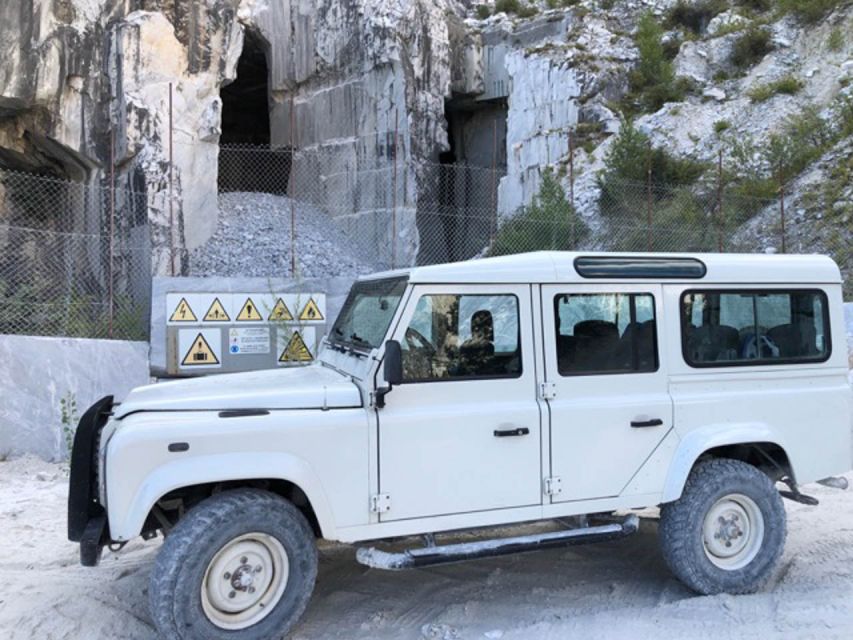
Carrara’s marble mountains are not a distant museum display. They are working quarries, cut into the Apuan Alps above town, and this tour takes you right into that world. You ride a sturdy off-road vehicle up steep quarry roads, see the white stone in place, and enter an active cave where the mountain has been opened from within.
I like the mix of big mountain views and hands-on quarry history. I also like that the tour finishes with Lardo di Colonnata, a local food tied directly to the quarry workers’ lives. The main drawback is simple: the back seats can be noisy and harder to hear, especially if the guide switches between languages.
The tour in six useful points
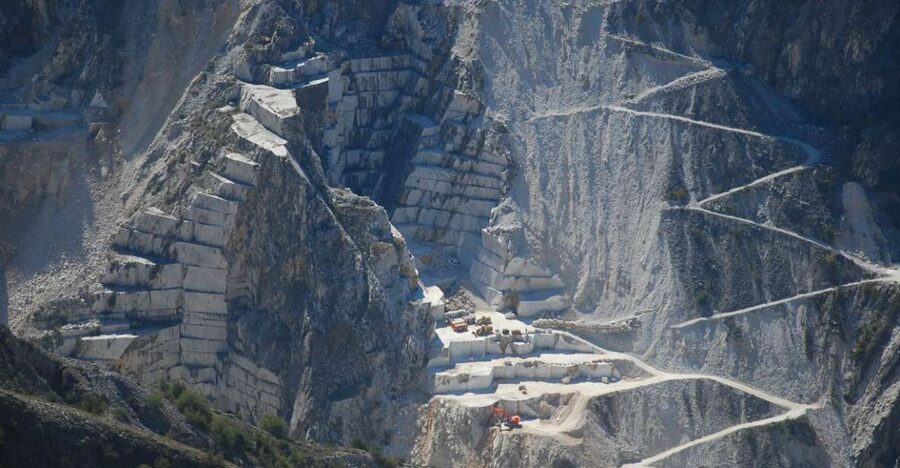
- You reach quarries at about 1,000 meters, with striking views over Carrara and the surrounding mountains.
- You see both outdoor and indoor quarry sites, including a marble cave cut into the mountain.
- You learn how quarrying changed, from Roman methods to modern extraction.
- Michelangelo’s connection gives the stone a human story, not just an impressive scale.
- Lardo di Colonnata adds a local food stop and a chance to buy a small edible souvenir.
- The group is limited to eight people, with tours offered in English, Italian, or French.
Why Carrara marble is worth the trip
Carrara is famous because its marble has been quarried for centuries and shaped some of the best-known works in Western art. The point of this tour is not simply to admire a white mountain from a road. You get to see the source material in its natural setting, then follow the path from mountain to sculpture.
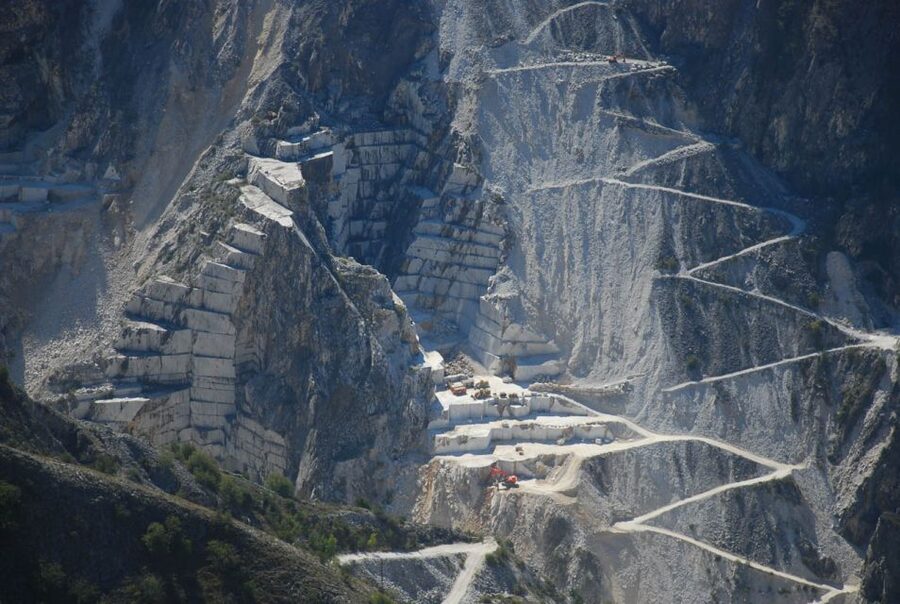
The marble is still being extracted today. That gives the experience a useful edge. You are not looking at a preserved ruin where all work stopped long ago. You are seeing a living industrial site, with the scars of cutting, ramps, exposed stone, and quarry roads built into the mountain.
Michelangelo’s name helps explain the artistic importance, but the tour also covers the practical side. The guide describes how marble removal developed from Roman-era techniques into the methods used today. That comparison makes the visit easier to understand: the mountain is beautiful, but quarrying it has always required hard work, planning, and technical skill.
For art lovers, sculptors, and anyone curious about how famous stone reaches a studio, this is a rare chance to see the starting point. For everyone else, it is a strong change of pace from Tuscany’s churches, piazzas, and wine towns.
More Food Tours in Tuscany
- Florence: Chianti Wineries Tour with Wine Tasting
★ 4.5 · 8,301 reviews - Small-Group Wine Tasting Experience in the Tuscan Countryside
★ 5.0 · 7,392 reviews - Rome: Tuscany & Montepulciano Day Trip with Lunch & Wine Tasting
★ 4.5 · 5,232 reviews
Meeting at Piazza Vittorio Veneto
The standard meeting point is Piazza Vittorio Veneto in Carrara, in front of the stadium. The listed meeting times are 9:30 in the morning and 2:30 in the afternoon, and the tour lasts about three hours.
Use these coordinates to help find the place: 44.06465148925781, 10.074934005737305. Several tours have also included a pickup at the train station, but you should confirm that option when booking rather than count on it automatically.
The meeting point matters because the quarries are not somewhere you casually wander into from Carrara’s center. You need the off-road vehicle and a driver who knows the steep access roads. Guides such as Luca, Lucca, Beatrice, Giorgio, Manuela, and Lavinia have led different departures, so the exact pairing of guide and driver can vary.
The small group limit of eight is a real advantage. It keeps the vehicle from feeling like a large excursion bus and gives you a fair chance to ask questions. If you sit in the rear, stay alert when the guide is speaking. One passenger found the back seats harder to hear, particularly when more than one language was being used.
Riding up the quarry roads
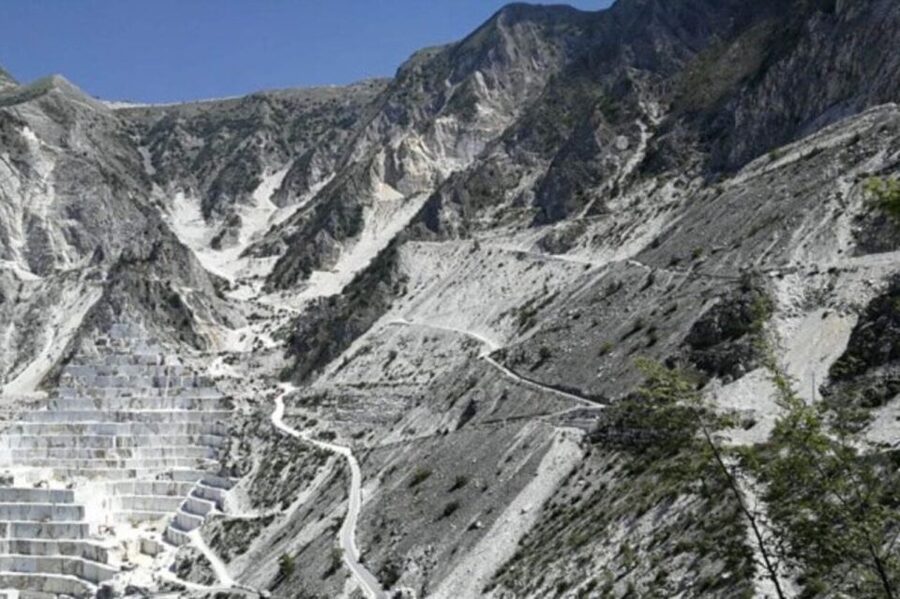
The ride is part of the experience, not just transportation. The off-road vehicle climbs from Carrara toward quarry sites as high as 1,000 meters above sea level. The road gives you a sense of the scale of the operation before you even reach the first main stop.
This is not a polished sightseeing drive. Quarry roads are built for access and work, so expect a rugged ride. That is exactly why the 4×4 is useful. You get into places a standard city vehicle could not comfortably reach, and the climb gives the tour a feeling of entering the mountain’s working zone.
The height also brings the best views. From above, the marble cuts and quarry faces form a stark pattern across the mountains. You can see how much stone has been removed and how closely the quarries are tied to the shape of the surrounding peaks.
Bring comfortable clothes, as requested. Practical shoes and clothing that can handle dust are sensible choices, although the supplied information specifically requires only comfortable clothes. The weather can feel different at elevation, so a light extra layer may be useful.
Outdoor quarries and marble in place
At the outdoor sites, your guide explains what you are seeing and how marble is separated from the mountain. The exposed faces show the scale of the work better than a finished slab in a showroom ever could.
One useful feature is the connection between the stone and the tools used to cut it. A roadside stop has included a demonstration involving a diamond saw, giving you a closer look at the equipment behind modern extraction. This is a small part of the visit, but it helps turn technical talk into something you can see.
The guide also connects quarry work with wider cultural and engineering stories. One group discussed links between Carrara excavation and projects in the United States, including the Crazy Horse monument. That kind of comparison helps you understand that marble extraction is not an isolated local craft. It is part of a much larger story about monuments, sculpture, construction, and industrial labor.
Photo opportunities can be excellent, but time is limited. One passenger wished for a few more photo stops, and that is a fair point. The tour has several things to fit into three hours, so you may need to enjoy a view quickly rather than set up a long photography session.
More Off-Road Tours in Tuscany:
- From Tuscany Carrara: Marble Quarries Tour by Jeep
★ 4.6 · 295 reviews - Catania: Sunset Jeep Tour of Mount Etna and Lava Flow Caves
★ 4.8 · 2,113 reviews - Mount Etna: Trek to 3000m with cable car and jeep
★ 4.7 · 1,978 reviews - Mount Etna: Roundtrip Cable Car and 4×4 Bus Ticket
★ 4.3 · 1,602 reviews
Going inside a marble cave
The indoor quarry is the most memorable part for many people. Instead of looking at a mountain face from the outside, you enter a space cut into the marble itself. The scale changes at once. You are surrounded by pale stone, machinery, and the marks left by extraction.
This is not presented as a claustrophobic crawl through a narrow tunnel. One passenger specifically found the indoor site safe and comfortable rather than cramped. Still, anyone sensitive to enclosed places should know that you are going inside a working quarry environment, not an open-air gallery.
Some departures have seen marble being cut fairly close up. Operations can vary, though. During a holiday shutdown, one group entered the mine even though active quarrying was paused. That means the indoor visit remains worthwhile, but you should not assume that every departure will include the same level of live industrial activity.
The inside stop gives the tour its strongest sense of place. Outdoor quarry walls show the result of extraction. Inside, you begin to understand the mountain as a material being worked from within. The contrast between the two sites is one of the best reasons to choose this tour over a simple viewpoint visit.
From Roman quarrying to modern cutting
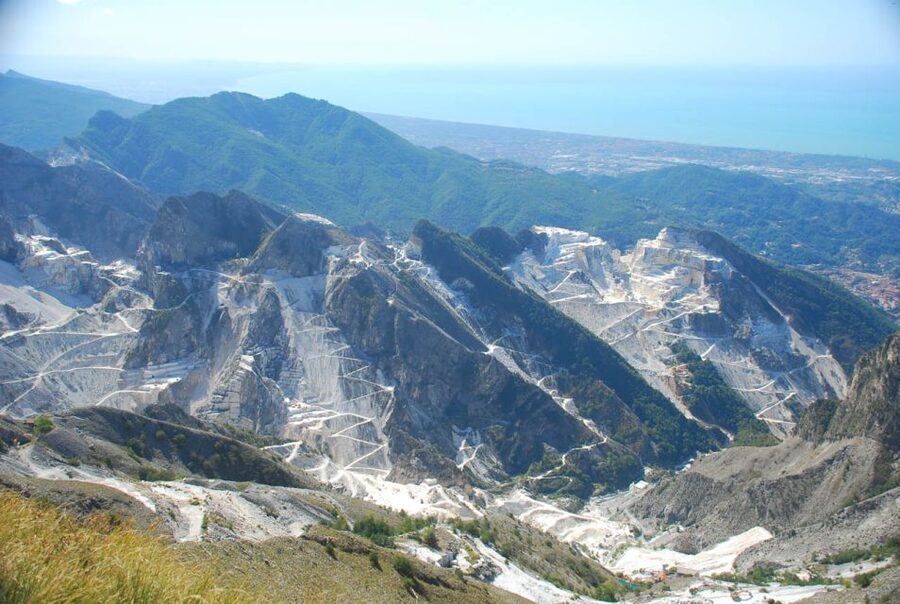
The historical explanation is a major part of the tour’s value. Carrara’s marble was quarried in Roman times, and the guide traces the changes in tools and methods across the centuries.
You will hear about the older, more labor-intensive approach and how modern machinery changed the speed and scale of extraction. The subject can sound technical, but a good guide keeps it tied to what you are looking at: cut faces, quarry roads, blocks of stone, and the marks left in the mountain.
The story also explains why Carrara matters beyond Tuscany. Marble from these mountains has shaped art and architecture for centuries. Michelangelo selected stone here for his sculptures, and the tour points out the quarry connected with his work.
That connection is especially meaningful if you sculpt, study art, or simply want to understand how a famous masterpiece begins. You are not seeing the finished David or Pietà. You are seeing the raw material before an artist gives it a human form.
Tasting Lardo di Colonnata
After the quarries, the tour turns from stone to food at a lard factory. Lardo di Colonnata is a traditional product associated with the local quarry workers and their diet.
The tasting is not a full meal. Think of it as a focused local food stop, with time to sample the product, order a drink, and browse for souvenirs. The stop adds a useful human detail to the quarry story. Workers needed food that could provide energy in a demanding environment, and lardo became part of the local tradition.
If you enjoy trying regional specialties, this is a good fit. The flavor is distinctive, so it is not a food everyone will love. Still, tasting it in Colonnata gives the product a much stronger context than buying an anonymous package in a supermarket.
It is also an easy place to pick up a small souvenir. The product is relatively inexpensive, according to one account, and practical to carry home if you like it. The tasting usually has enough time for you to make that decision without feeling rushed.
Guide quality and the small-group feel
The guide can shape this tour more than the scenery does. Luca and Lucca have been singled out for clear explanations, friendly conversation, and confident driving. Beatrice was described as charming and engaging, while Manuela led an informative visit through the mines. Lavinia has also provided an enthusiastic introduction to the quarry process.
The strongest guides do more than recite dates. They answer questions about mining, explain what the machines are doing, and connect Carrara to art and construction elsewhere. That is particularly useful because the quarry itself can be visually overwhelming. Without explanation, you may see a huge white cut in the mountain but miss why it matters.
Language is worth considering. Tours are offered in English, Italian, and French. On a multilingual departure, information may be repeated or divided between languages, which can reduce the amount of time available in each language. One passenger felt left out when the guide spoke Italian to another participant, though a translator helped.
If you want the clearest possible commentary, choose a departure conducted in your preferred language when that option is available. Sit near the guide if you can, especially if hearing conversation from the back of a moving 4×4 may be difficult.
Is the three-hour length good value?
The tour packs a lot into three hours: transport from the meeting point, the mountain climb, outdoor quarry stops, an indoor cave, historical explanation, and a lardo tasting. That makes it a practical choice if you have only part of a day in Carrara.
The value comes from access as much as from time. You are paying for a vehicle capable of reaching the quarry roads, a driver familiar with the route, and a guide who can explain the stone and its uses. A self-guided visit would not give you the same access or context.
The short duration also has a limit. You will not have hours to linger at every viewpoint, and the tasting is modest rather than a long food tour. If your main goal is landscape photography, a longer private outing might suit you better. If your goal is to understand Carrara and see the quarries efficiently, three hours works well.
The rating is 4.8 from 309 reviews, which fits the experience’s strongest qualities: impressive scenery, guides who know the subject, an unusual indoor quarry visit, and a local tasting that feels connected to the place.
Who should book this Carrara quarry tour?
I would choose this tour if you want something beyond the usual Tuscan circuit of churches, squares, and wineries. It suits art fans, sculptors, geology enthusiasts, industrial-history buffs, cruise passengers, and curious families with older children.
It is also a good choice for visitors staying in Carrara or arriving by train who want a guided introduction without committing a full day. The small group keeps the outing personal, and the off-road vehicle solves the problem of reaching high quarry sites.
You may want to reconsider if you dislike rugged vehicle rides, enclosed industrial spaces, or tastings based on rich pork products. You should also keep your expectations realistic about photography time and live quarry activity. The quarries are working places, so conditions and access can vary.
For most people, I would book it. The combination of Michelangelo’s marble, an active quarry setting, and Lardo di Colonnata is hard to reproduce on your own. Choose the morning or afternoon slot that fits your plans, wear comfortable clothes, and aim for a departure in your strongest language.
FAQ
How long does the Carrara marble quarry tour last?
The tour lasts three hours.
Where does the tour meet?
Meet your guide at Piazza Vittorio Veneto in Carrara, in front of the stadium. The listed coordinates are 44.06465148925781, 10.074934005737305.
What time does the tour start?
The listed departure times are 9:30 in the morning and 2:30 in the afternoon. Check availability for the exact date and starting time.
Which languages are available?
The tour is offered with a live guide in English, Italian, or French.
How many people are in each group?
The group is limited to eight participants.
What should I bring?
Wear comfortable clothes. The tour includes an off-road ride and visits to outdoor and indoor quarry sites.
Just added around Tuscany
- Florence Sunset Food Tour with Wine & Dine at a Tuscan farmhouse★ 5.0 · 194 reviews
- Wine Tasting Experience in Ponte Vecchio: Best Tuscany selection!★ 5.0 · 197 reviews
- Val d’Orcia Brunello Wine Tour with Montalcino and Montepulciano★ 4.5 · 359 reviews
- Wine Experience In Chianti Hills from Florence★ 4.5 · 195 reviews
- Tuscany Vespa Tour: Lunch & Wine Tasting, Countryside Roads★ 5.0 · 614 reviews
- Tuscany Vespa Tours Through the Hills of Chianti★ 5.0 · 515 reviews
- Tuscany Vespa Tour from Florence with Wine Tasting★ 5.0 · 425 reviews
- Tuscany Bike Tours Through the Chianti Hills with Wine Tasting★ 5.0 · 1,300 reviews
Food & Drink, compared.
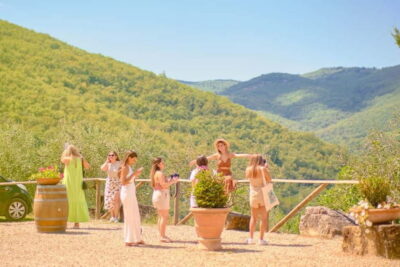
Small-Group Wine Tasting Experience in the Tuscan Countryside
Read our review →
Tuscany & Montepulciano Day Trip with Lunch & Wine Tasting
Read our review →
Winner 2025 Rome Twilight Trastevere Food Tour by Eating Europe
Read our review →
SMALL-GROUP Wine Safaris: Tuscan Wine Tasting Tours from Florence
Read our review →
Winner 2025 Florence Sunset Food & Wine Tour by Eating Europe
Read our review →
Cooking Class and Lunch at a Tuscan Farmhouse with Local Market Tour from Florence
Read our review →
San Gimignano, Siena, Monteriggioni, Chianti Day Trip with Lunch & Wine Tasting
Read our review →Browse the lists this tour appears in