
Reviewed · WALKING TOURS
Verona Highlights Walking Tour in Small-group
Verona’s best sights are packed into a walkable old center, and this two-hour small-group tour gives you a useful first look without turning the morning into a forced march. You’ll trace Roman, medieval, and Shakespearean Verona, from the Arena and Piazza Bra to Castelvecchio, Juliet’s courtyard, and the grand squares around the old city center.
I like the relaxed pace and the chance to ask questions as you go. I also like the range of stops: you get major sights, such as the Roman Arena, along with less obvious details like the Arch of Gavi and remnants of the old Roman city. The main consideration is that the listed visits to the Arena and Juliet’s House are short exterior or courtyard stops, and admission is not included.
Key points to know before you book
- A compact history lesson: The route covers Roman Verona, the medieval Scaliger rulers, Venetian-era buildings, and the city’s Shakespeare connection.
- A maximum of 16 people: The group size is small enough for questions and easier listening in narrow streets.
- The Arena is viewed briefly: You receive context about its construction and opera tradition, but the admission ticket is not included.
- Juliet’s House is a short stop: You see the Capuleti courtyard, while access to the balcony may require a separate ticket during the specified holiday period.
- The route begins and ends in Piazza Bra: That makes it easy to continue sightseeing, stop for lunch, or visit the Arena independently.
- A good first-day tour: It helps you understand Verona’s layout before returning to the sights you want to explore inside.
Why this walk works well as a first look at Verona

Verona can seem almost too pretty to organize. Medieval lanes open onto broad squares, Roman remains appear beside modern shops, and the Adige River curls around the old center. A guide helps you connect those pieces instead of treating them as unrelated photo stops.
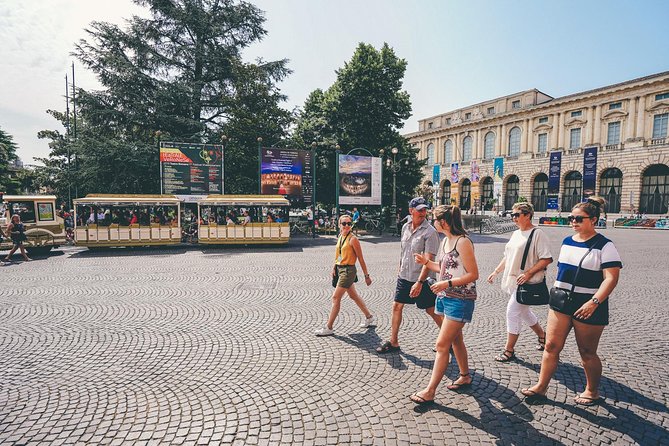
The group meets in Piazza Bra, Verona’s largest square, and returns there at the end. That simple arrangement matters. You do not have to find your way back through unfamiliar streets, and you finish beside cafés, restaurants, public transport, and the Arena.
The tour is offered in English and lasts about two hours. The maximum group size is 16, though some departures can be much smaller. One account describes a group of only four, which would make the experience feel close to a private walk. The tour runs rain or shine, so bring suitable shoes and a light rain layer if the forecast looks uncertain.
The guides are a major part of the experience. Frank is described as funny, friendly, and especially good at using stories and small facts to keep the walk moving. Isabella is praised for explaining architecture and culture with energy, while Priscilla brings deep local familiarity and was especially attentive to an older member of one group. Your assigned guide may be someone else, but these examples show the tone to expect: clear English, local perspective, and plenty of room for questions.
More Walking Tours in Verona
- Verona: History and Hidden Gems Guided Walking Tour
★ 5.0 · 1,379 reviews - Verona: Small Group Guided Walking Tour with Arena Tickets
★ 4.9 · 848 reviews
Castelvecchio and Scaligero Bridge set the tone
The route begins around Castelvecchio, Verona’s late-medieval castle. You generally see the castle from outside rather than touring its museum rooms. That is a limitation if you want a full art and architecture visit, but it keeps the walk moving and gives you a strong introduction to Verona’s medieval power.
The adjoining Scaligero Bridge crosses toward the left bank of the Adige. Built as part of the castle defenses, it was almost destroyed during wartime bombing and later rebuilt to match the original design. That rebuilding story gives the structure more meaning than its handsome brick arches alone suggest.
I like this opening because it immediately shows how Verona’s monuments have changed over time. You are not looking at a perfectly untouched medieval city. You are seeing a place that has been damaged, repaired, adapted, and kept in daily use.
Nearby, you may hear about the Arch of Gavi, a first-century Roman monument linked to the Gavia family. Napoleon demolished it in 1805, and it was later reconstructed in its present location. The stop is a useful reminder that Verona’s Roman past was not always treated gently by later rulers.
Roman Verona appears in ordinary streets
One of the tour’s strongest features is the way ancient remains turn up in places you might otherwise pass without a thought. The route includes the area around Porta Borsari, once a major Roman city gate. Today, the marble front survives, while much of the original brickwork and the upper towers have disappeared.
You may also see Roman wall remains and part of an ancient home incorporated into a modern Benetton store. That is exactly the sort of detail a guide can point out and a map usually cannot. Verona’s past is not confined to one archaeological park. It is built into the commercial streets you walk every day.
This portion should appeal to you if you enjoy seeing how old and new cities overlap. It is less satisfying if you want long pauses for close architectural study. The guide has a lot of ground to cover, and the stop is designed to explain the remains rather than provide an extended archaeological visit.
Piazza delle Erbe and Piazza dei Signori reveal old civic Verona
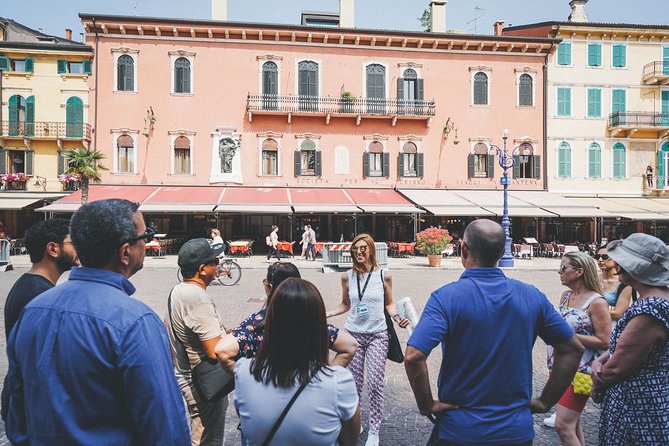
The walk continues through Piazza delle Erbe, a square that served as Verona’s Roman Forum and later became a center of civic and market life. Its fountain and monuments reflect the changing rulers of the city, including the Scaliger family.
The square is also one of the best places to notice Verona’s layered appearance. Roman planning, medieval power, later palaces, and painted façades all meet in one lively space. Your guide can help you read those layers instead of seeing only an attractive square lined with cafés.
From there, the route turns toward Piazza dei Signori, once the city’s political center. A statue of Dante Alighieri has dominated the square since 1865, giving it the informal name Piazza Dante. The surrounding buildings create a more formal mood than Piazza delle Erbe, with the architecture reflecting Verona’s long ties to regional powers and Venetian rule.
The stop is brief, usually around five minutes at each piazza. That is enough for orientation and photographs, but not enough to study every façade or climb the nearby Torre dei Lamberti. If you want time for detailed sightseeing, mark these squares on your map and return after the tour.
Same city, a completely different sort of day:
- Verona: Hop-on Hop-off Tour 24 or 48-Hour Ticket
★ 4.4 · 2,010 reviews - Verona: Priority Access Arena Guided Tour
★ 4.6 · 1,152 reviews - Verona: Juliet’s House Fast-Track Entry Ticket & Audio Guide
★ 4.2 · 1,121 reviews - Verona: Arena di Verona Opera Ticket
★ 4.6 · 721 reviews
The Scaliger tombs show medieval Verona at its grandest
The Arche Scaligere are among the most striking stops on the route. This outdoor cemetery holds the monumental tombs of Verona’s ruling Scaliger family. The three most famous Gothic arches honor Cangrande I, Mastino II, and Cansignorio.
The tombs are enclosed and viewed from outside, with admission not included. Still, the short stop gives you a clear sense of how the Scaliger rulers used architecture to project authority. These are not modest graves tucked away in a church. They are elaborate public statements placed in the center of medieval Verona.
I find this stop especially useful because it adds political context to the pretty streets. The castles, bridges, palaces, and tombs are connected to the same ruling family. Once you understand that, Verona’s medieval center feels less like a collection of beautiful buildings and more like a carefully staged seat of power.
Juliet’s House offers romance, history, and a little theater
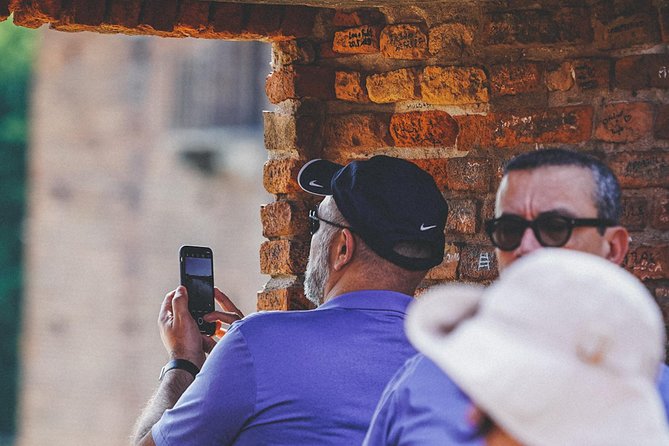
At Casa di Giulietta, you enter the courtyard associated with the Capuleti family and Shakespeare’s Juliet. The stop lasts about five minutes, and admission is not included.
You should approach this place with the right expectations. The house is tied to literary legend rather than proven biography, and parts of the attraction were shaped for modern tourism. The balcony is particularly famous, but the building and courtyard should not be treated as a simple, untouched Shakespeare site.
That does not make the stop worthless. It is part of Verona’s modern identity, and the guide can explain how the story of Romeo and Juliet became linked to this particular house. You can take in the courtyard, hear the local context, and decide later if you want to return for a longer visit.
There is also a brief exterior view of Romeo’s house, a medieval palace traditionally linked with the Montecchi family. It is private and inhabited, so you see it from the outside only. That short look is a useful counterpoint to Juliet’s more developed attraction.
From December 6, 2025, through January 6, 2026, access to Juliet’s Balcony is not included as usual because the city requires a separate ticket during the busy holiday period. The tour company can provide information about buying that ticket, but does not buy it for you.
Piazza Bra and the Roman Arena finish the walk
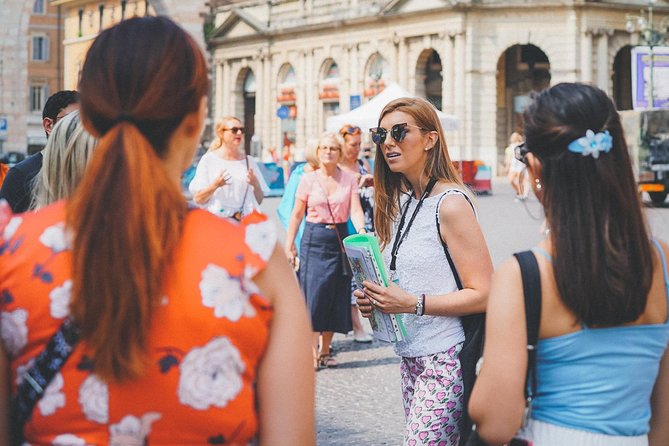
The tour returns to Piazza Bra, where you get a broad view of Verona’s social center. Cafés, restaurants, and handsome buildings line the square, making it a practical place to pause after the walk.
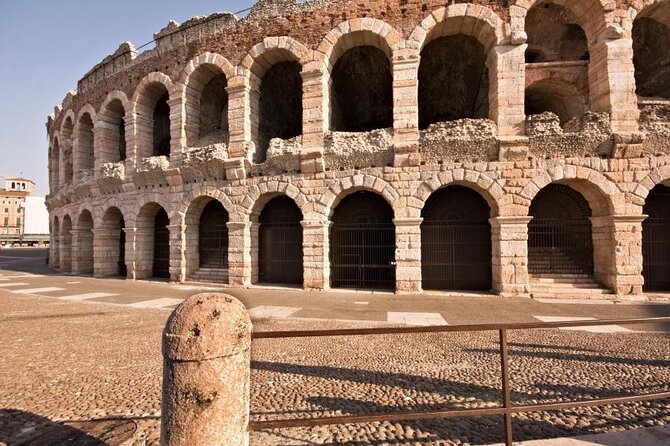
The final major sight is the Arena di Verona, built in the first century AD, during the Augustan period. The amphitheater predates Rome’s Colosseum by roughly 30 years and remains remarkably imposing despite the loss of its outer tier.
Your guide explains how the Arena once held up to 30,000 people and how it continues to serve as a performance venue. Its summer opera season, known as the Verona Arena Festival, brings classical music audiences to the city, while concerts also draw international performers.
The scheduled stop is about 10 minutes, and the admission ticket is not included. That is the most important value point to understand. This tour gives you the Arena’s setting, story, and exterior photographs, but it is not a substitute for an Arena visit.
If entering the amphitheater is high on your list, plan a separate ticket or consider a combined option if one is available for your date. One account specifically valued a two-part booking that included guided entry to both the Arena and Juliet’s House. Do not assume that the basic walking tour includes those admissions or skip-the-line access.
What the $42.33 price really buys you
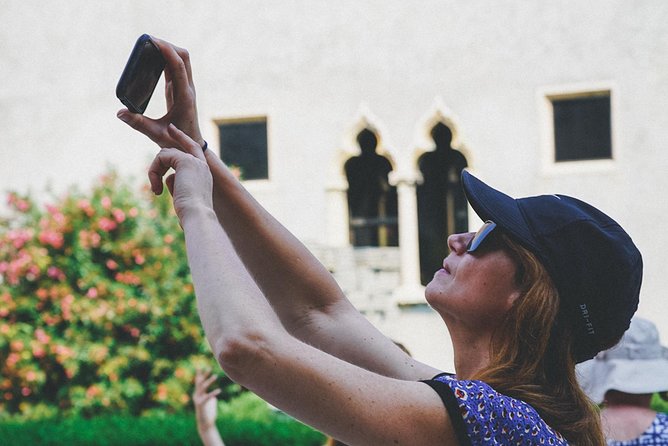
At $42.33 per person, this is not the cheapest way to stroll around Verona. You can walk through Piazza Bra, Piazza delle Erbe, Piazza dei Signori, and the streets between them without paying anything.
The value comes from the explanation. In two hours, you get a city framework that covers Roman remains, medieval rulers, literary legend, architecture, wartime rebuilding, and the continuing use of the Arena. You also save time finding the less obvious details, such as Roman remains incorporated into a modern store.
The price makes the most sense on your first day, especially if you have limited time. It can also be worthwhile if you prefer a social walk with questions rather than an audio guide. I would not book it mainly for interior access, because the listed stops at the Arena, Juliet’s House, and the Scaliger tombs do not include admission.
Walking pace, weather, and accessibility
The route is not described as difficult, but it involves steady walking through the historic center. One account advises being able to walk somewhat quickly, and another describes the amount of walking as manageable. Wear comfortable shoes and expect uneven historic streets, crowded corners, and time spent standing.
Most people can take part, and service animals are allowed. Some portions may not be easy for people with reduced mobility or other disabilities, so contact the operator before booking if that affects your plans.
The tour runs in rain and other ordinary poor weather. In severe storms, unusual events, sudden monument closures, or major transport problems, a full refund is not guaranteed. The experience requires at least two participants, and if that minimum is not reached, you are offered another date or experience, or a full refund.
You can cancel for a full refund up to 24 hours before the start time. Changes or cancellations made less than 24 hours ahead are not accepted for a refund.
Who will get the most from this Verona tour
I would choose this walk if you are visiting Verona for the first time, have only a day or two, or want a clear introduction before choosing which monuments deserve your return time.
It suits couples interested in the Romeo and Juliet story, families who want history delivered through short stories, and older visitors who appreciate a guide who keeps the group together and explains the route clearly. It is also a good fit for anyone who likes Roman remains but does not want a full archaeology lecture.
You may want something else if your main goal is entering monuments, spending long periods inside churches and museums, or getting a specialist-level study of Roman architecture. The tour gives breadth more than extended depth.
Should you book the Verona Highlights Walking Tour?
Book it if you want a friendly, well-paced introduction to Verona’s main sights and a few easy-to-miss Roman details. The small group, central meeting point, short duration, and strong guide-led storytelling make it a practical first activity.
Just be clear about what you are buying. The Arena and Juliet’s House are important stops, but their admissions are separate, and the schedule allows only brief visits. I would take this tour early in your stay, listen for the guide’s restaurant and sightseeing suggestions, then return on your own to the Arena, Castelvecchio, or Juliet’s House if one of them deserves more time.
FAQ
Where does the Verona walking tour start and end?
The tour starts and ends in Piazza Bra in Verona. This is convenient for reaching the Arena, nearby cafés and restaurants, and public transportation.
How long does the tour last?
The walking tour lasts approximately two hours.
Is the tour offered in English?
Yes. The experience is offered in English and includes a local tour guide.
Are admission tickets included?
No. Admission to the Arena di Verona, Casa di Giulietta, and Arche Scaligere is not included. Piazza Bra, Piazza delle Erbe, and Piazza dei Signori are listed as free stops.
How large is the group?
The tour has a maximum of 16 participants. It requires at least two participants to operate.
Can I cancel for a full refund?
Yes, if you cancel at least 24 hours before the experience begins. Cancellations made less than 24 hours before the start time are not refunded.
Just added around Verona
- Guided Food Tour with Wine Tasting in Verona★ 4.3 · 229 reviews
- From Milan: Venice and Verona Full-Day Tour by Train★ 4.1 · 217 reviews
- Verona: Hands-on Fresh Pasta and Tiramisù Cooking Class★ 4.9 · 295 reviews
- Verona: Montresor Winery Visit with Wine Tasting and Snacks★ 4.6 · 217 reviews
- From Verona: Valpolicella and Amarone Wine Tasting Tour★ 4.9 · 560 reviews
- Highlights and hidden gems Verona Bike Tour★ 5.0 · 393 reviews
- Verona: Pasta and Tiramisu Cooking Class With Free Flowing Wine★ 5.0 · 575 reviews
- Verona: Pasta and Tiramisu Cooking Class with Fine Wine★ 4.8 · 633 reviews
Walking Tours, compared.
Guided Walking Tour & Last Supper Visit with Ticket
Read our review →
Rialto Bridge & Offbeat Unusual Venice Walking Tour
Read our review →
Private 3 hrs Venice Tour: St Mark’s, Walking tour & Boat tour
Read our review →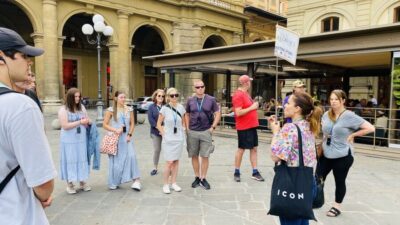
Skip the line: Uffizi and Accademia Small Group Walking Tour
Read our review →Browse the lists this tour appears in