
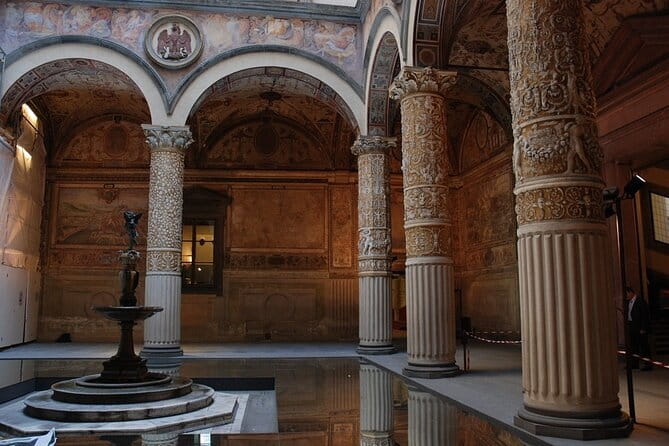
Reviewed · GHOST & MYSTERY TOURS
Medici Legends & Renaissance Wonders: Florence Small Group Tour
Florence’s famous sights make more sense when you follow the Medici trail. This 1-hour-45-minute walk links churches, palaces, bridges, and public squares to the family that shaped the city’s politics, art, and architecture. You get the broad story quickly, with guides such as Manuel, Martina, Amanda, and Giacomo bringing plenty of local character to the route.
I like the small maximum of 15 people, which gives the guide a fair chance to answer questions and keep the group together. I also like the way the walk connects places you might otherwise see as separate monuments, from the Medici tombs at San Lorenzo to their former home at Palazzo Pitti.
The main point to understand is that admission tickets are not included, and the listed stops are brief, roughly five minutes each. If you want to tour the Medici Chapels, climb Brunelleschi’s Dome, or spend hours inside the Uffizi, you’ll need separate tickets and more time.
Fourteen stops that tell one Florence story

- The Medici family provides the thread: You see Florence through the rise of a banking dynasty that became Tuscany’s ruling house.
- The route covers the city center efficiently: San Lorenzo, the Duomo, Piazza della Signoria, Ponte Vecchio, and the Uffizi all fit into one compact walk.
- The tour is built for first-time visitors: It gives you a useful map of central Florence and the main facts before you explore museums on your own.
- Guides add the human side: Manuel is praised for his local insight, Martina for her passion and memorable details, and Amanda for her humor and command of the subject.
- The group stays small: No more than 15 people are allowed, and a whisper system helps the guide speak over street noise.
- It works best as an orientation walk: Plan to return to the sights you want to enter, since admission is not part of the $119.77 price.
Starting at San Lorenzo, where the Medici story takes root
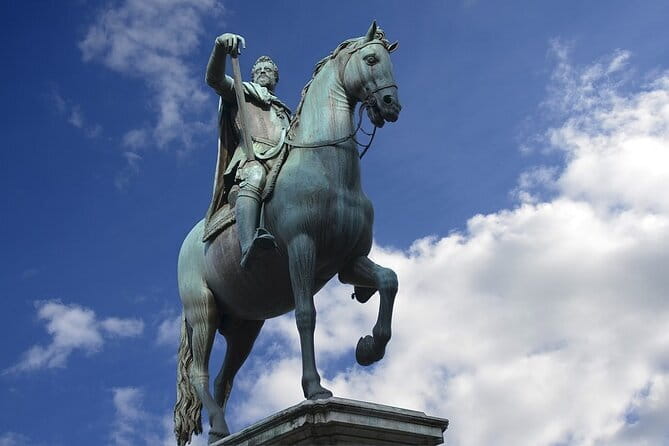
Meet at Caffè Scudieri Firenze, at Piazza di San Giovanni 19R, for a 12:15 pm start. That puts you right beside the Duomo area, but the walk begins with the Medici connection at the Basilica di San Lorenzo.
San Lorenzo is one of Florence’s largest churches and the burial place of principal Medici family members from Cosimo de’ Medici through Cosimo III. That detail gives the tour an immediate focus: this is not just a list of beautiful buildings. It is a walk through the family’s public image, private power, and long reach.
The stop is scheduled for about five minutes, so expect an explanation outside or a short orientation rather than a full church visit. If you want to see the interior, tombs, and artwork at a slower pace, arrange a separate admission and return later.
Next comes the Biblioteca Medicea Laurenziana, or Laurentian Library. The library was supported by Medici Pope Clement VII and held manuscripts and books from the family’s private collection. Its purpose was not only practical. It helped present the Medicis as educated patrons and members of intellectual and church circles, rather than merely successful merchants.
Michelangelo designed the library, and its Mannerist architecture is one of the stop’s main points. Again, the five-minute schedule means you should treat this as a short introduction. The tour tells you why the building matters, while a separate visit would be needed for a close look inside.
More Ghost Tours in Florence:
- The Dark Side of Florence: Mysteries and Legends
★ 5.0 · 2,785 reviews - Florence: Dark Mysteries and Legends Guided Walking Tour
★ 4.6 · 1,081 reviews - Florence: Mysteries of the Medici Guided Walking Tour
★ 4.4 · 940 reviews
Michelangelo, family memory, and Palazzo Medici Riccardi
The Cappelle Medicee, or Medici Chapels, sharpen the family’s desire for grandeur. Built in the 16th and 17th centuries as additions to Brunelleschi’s earlier church, the chapels were meant to honor the Medici as patrons and Grand Dukes of Tuscany.
The New Sacristy was designed by Michelangelo. That single fact makes this a major stop for anyone interested in Renaissance sculpture and architecture. But the tour’s short timing is important. You will learn the connection and see the setting, not receive the full museum experience.
At Palazzo Medici Riccardi, the story turns from burial and religious patronage to home life and political power. Cosimo de’ Medici commissioned the palace, built between 1444 and 1484. Its scale and design helped establish the family as a force in Florence long before it formally ruled Tuscany.
This is one of the places where a good guide can make a difference. The building is more than an old palace facade. It represents the point at which wealth began to look like authority. Guides including Manuel have been praised for explaining how Florence developed through its buildings, which is exactly the useful approach here.
The Duomo complex in five-minute chapters
The route then reaches the heart of Florence: the Duomo, the Baptistery, Brunelleschi’s Cupola, and Giotto’s Campanile. These sights sit close together, but seeing them through one historical thread helps you understand the competition, ambition, and technical skill behind them.
Florence Cathedral, formally Santa Maria del Fiore, began in 1296 in the Gothic style under Arnolfo di Cambio. Its facade uses white, green, and pink marble, while the full cathedral complex includes the Baptistery and Campanile. The historic center is part of a UNESCO World Heritage Site, and this is the section where the tour feels most like a classic Florence introduction.
The Baptistery of Saint John is one of the city’s oldest buildings, constructed between 1059 and 1128 in the Florentine Romanesque style. Located across from the cathedral and bell tower, it gives you a useful reminder that Florence’s major monuments belong to different periods. The city’s story was built in layers, not all at once.
Brunelleschi’s dome is the star of the group. It was the largest dome in the world when completed and remains the largest brick dome ever built. The tour presents it as one of architecture’s great puzzles, which is a fair reason to pay close attention even if you do not plan to climb it.
The Campanile di Giotto adds another angle. Designed by Giotto, the tower is known for Florentine Gothic decoration, sculpture, and colored marble. You see how the cathedral complex combines engineering, religious purpose, and civic pride in one tight area.
The itinerary lists the cathedral twice, with each stop lasting about five minutes. Think of this as several viewpoints and explanations around the same complex, not two separate cathedral visits. You are unlikely to get enough time here for a full interior tour, so use the guide’s comments to decide what deserves your return visit.
Palazzo Vecchio and the public face of Florence
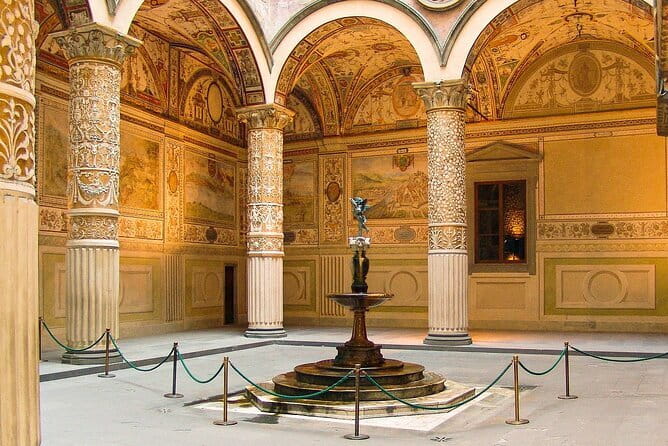
From the Duomo area, the walk continues to Palazzo Vecchio and Piazza della Signoria. The Palazzo Vecchio is Florence’s town hall, built like a fortress and still one of Tuscany’s most imposing civic buildings.
Its position matters. This is where Florence’s public government, ceremonies, and political messages played out. The square in front holds a copy of Michelangelo’s David, while the nearby Loggia dei Lanzi displays a group of major statues. Even without entering the palace, you can read the square as an outdoor history lesson.
Piazza della Signoria is an L-shaped meeting place and a gateway toward the Uffizi. It is also one of the tour’s strongest locations for understanding how art served public life. The sculptures were not placed here simply for decoration. They helped communicate ideas about strength, civic identity, and authority.
This is another point where your guide’s storytelling can turn a quick stop into something memorable. Manuel has been praised for answering many questions and showing details that are easy to miss. Martina is especially noted for making the Medici subject lively, including the changing family crest. If you enjoy spotting symbols after a guide points them out, keep watching for Medici emblems as you continue through Florence.
A few more Florence half-days worth a look
- Florence: Skip-The-Line Uffizi Gallery Timed Entry Ticket
★ 4.5 · 27,832 reviews - Florence: Timed Entrance Ticket to Michelangelo’s David
★ 4.6 · 16,983 reviews - Florence: Michelangelo’s David Skip-the-Line Entry Ticket
★ 4.5 · 12,764 reviews - The Best tour in Florence: Renaissance & Medici Tales – guided by a STORYTELLER
★ 5.0 · 12,316 reviews
Ponte Vecchio and the Medici move across the Arno
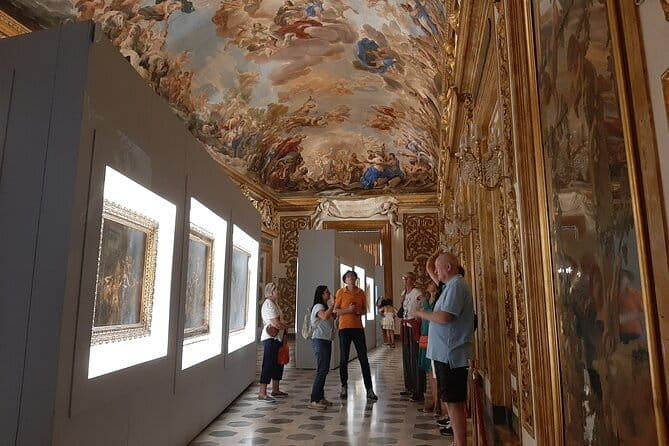
Ponte Vecchio is the only stop listed with free admission, and it is also the natural midpoint between Florence’s central political district and the Medici world across the Arno.
The medieval bridge is the oldest bridge over the Arno in Florence. Shops have lined it for centuries. Butchers, tanners, and farmers once occupied them; today, jewelers and art dealers fill the storefronts. The change tells you something about Florence’s shifting economy and the bridge’s lasting importance as a public thoroughfare.
The tour ends in the Ponte Vecchio area, though the precise endpoint can vary slightly within that area. This makes the bridge a practical place to continue exploring on foot after the guide says goodbye.
Palazzo Pitti and the Medici collection
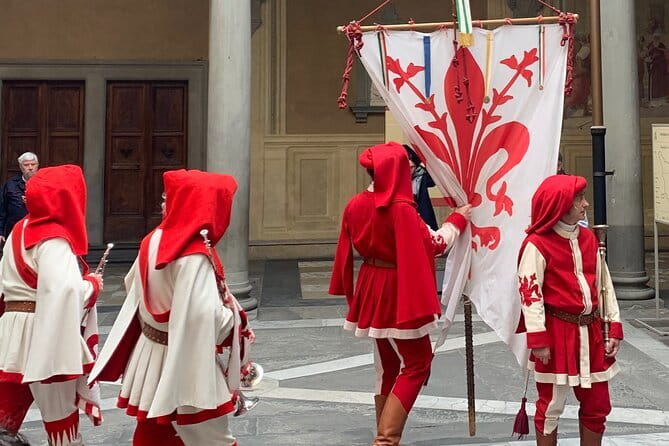
Across the river, Palazzo Pitti shows what happened after the Medici family moved from influential bankers to ruling royalty. The family bought the palace in 1549, and it became the main residence of the ruling families of the Grand Duchy of Tuscany.
Over time, it grew into a storehouse for paintings, plates, jewelry, and luxurious possessions. The palace helps explain that Medici power was not limited to Florence’s old center. Their influence reached across the river and into the daily spaces of court life.
The listed stop is brief and does not include admission. If you have limited time in Florence, the outside explanation can help you decide if the palace belongs on your museum list. If you already know you want to see the collections, plan a separate visit rather than expecting this walking tour to cover them in detail.
The Uffizi as the final art-history connection
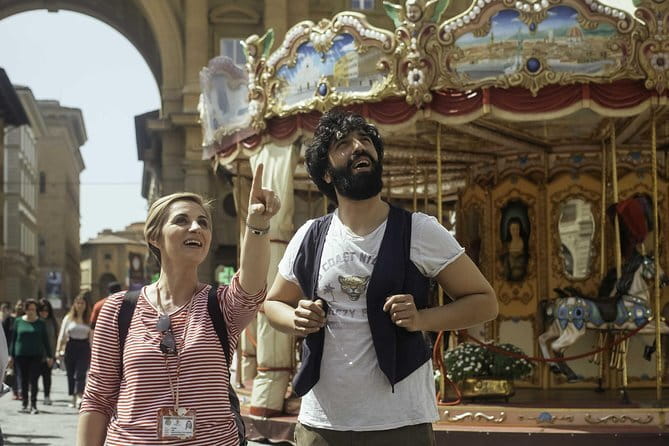
The Uffizi is the final listed stop and one of the biggest reasons art lovers may consider this tour. Its collection covers major Renaissance works by Michelangelo, Leonardo da Vinci, Raphael, Botticelli, and other masters, with galleries ranging from the 12th through the 16th centuries.
The value here is the connection. You hear about the Medici as patrons, see their buildings, and finish at the museum that holds so much of the art their family supported and collected. That makes the Uffizi more meaningful than a stand-alone museum name on a sightseeing checklist.
But do not mistake the five-minute stop for a Uffizi visit. Admission is not included, and the tour does not give you time to work through more than 80 halls of art. I would use the guide’s introduction to plan a separate museum visit, especially if Botticelli, Michelangelo, or Renaissance painting is a priority.
What the $119.77 price really buys
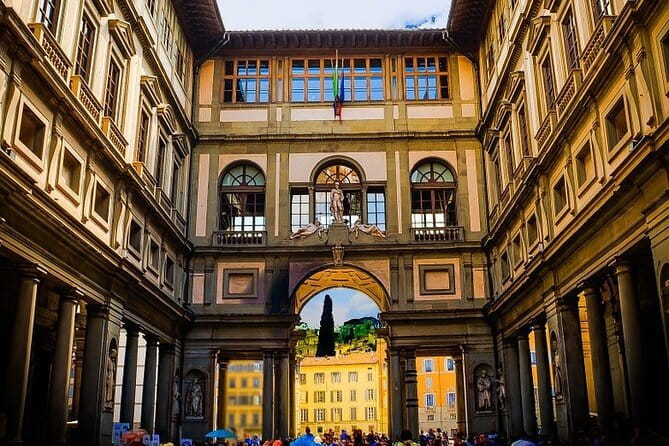
At $119.77 per person, this is not the cheapest way to get a quick look at Florence. The price pays for a licensed English-speaking guide, a small group capped at 15, and a whisper system. It does not pay for admission to the Basilica di San Lorenzo, Laurentian Library, Medici Chapels, Palazzo Medici Riccardi, the Duomo complex, Palazzo Vecchio, Palazzo Pitti, or the Uffizi.
I see the value mainly in the guide’s structure and interpretation. In less than two hours, you get a city map, the major Medici connections, and a set of stories that can guide the rest of your stay. Several guides have made a strong impression, including Manuel, Martina, Amanda, and Giacomo. Their strengths include clear storytelling, humor, local insight, and willingness to answer questions.
The tour has received a 5 out of 5 rating from 205 reviews, with 99 percent of customers recommending it. That is strong evidence that the experience usually delivers what it promises as a guided overview. Still, one important criticism is fair: the Medici family is not always the sole focus. At times, this is a general Florence history walk told through the Medici connection.
Pace, sound, and practical comfort
The route moves through central Florence and uses public streets, so wear comfortable shoes. Most people can participate, and the meeting point is near public transportation. The 12:15 pm start can work well after a morning arrival in the city, though you should allow time to find Caffè Scudieri in the busy Duomo area.
The whisper system is included, which should help you hear the guide while walking. Still, sound quality can vary in noisy streets. One older participant found that much of the commentary was lost while the guide was moving, even with the system. If hearing is a concern, tell the guide early and ask to stand close during explanations. Manuel has been especially attentive about checking whether people with hearing aids can follow.
The pace is generally gentle and informative rather than rushed. It suits first-time visitors, families with children around age 10 and older, and anyone who wants a clear introduction before choosing which interiors to visit. It may feel too basic if you have already spent a lot of time studying Florence and want a specialist-level lecture.
Free cancellation is available up to 24 hours before the start time. The tour can also be canceled for poor weather or if the minimum number of participants is not met, with a different date or a full refund offered in those cases.
Who should book this Florence walk?
I would book it near the beginning of a Florence stay. The route gives you a mental map quickly, and the Medici thread helps you notice symbols, buildings, and political connections later. One memorable benefit is learning to recognize the family crest as you continue around the city.
This tour is a good fit if you:
- Have roughly two hours and want the main historic center
- Prefer stories and connections to a silent monument checklist
- Want a small group rather than a large crowd
- Are interested in the Medici family, Renaissance art, or Florence’s political past
- Plan to visit museums separately
- Enjoy asking a guide questions as you walk
I would look elsewhere if your main goal is to enter several museums, climb Brunelleschi’s Dome, or spend an hour inside the Medici Chapels. The admission costs would be extra, and the schedule leaves only a few minutes at each location.
Should you book Medici Legends & Renaissance Wonders?
Book this tour if you want a fast, well-organized introduction to Florence, especially on your first day. The strongest guides turn the city into a connected story, and the small group keeps the walk more personal than a large city tour.
Skip it if you expect a full Medici museum tour or detailed interior visits. For the best result, treat this as your orientation, then return to the Medici Chapels, Palazzo Vecchio, Palazzo Pitti, or Uffizi with separate tickets and enough time to look properly.
FAQ
How long is the Medici Legends & Renaissance Wonders tour?
The tour lasts approximately 1 hour and 45 minutes.
What time does the tour start?
The scheduled start time is 12:15 pm.
Where does the tour begin?
It begins at Caffè Scudieri Firenze, Piazza di San Giovanni, 19R, 50123 Firenze FI, Italy.
Where does the tour end?
It ends in the Ponte Vecchio area. The exact endpoint may vary slightly within the indicated area.
How large is the group?
The maximum group size is 15 people.
Is the tour offered in English?
Yes. The tour is offered in English.
Are museum and monument admission tickets included?
No. Admission tickets are not included for the listed churches, chapels, palaces, cathedral complex, or Uffizi. Ponte Vecchio is listed with free admission.
Is a guide included?
Yes. The experience includes a licensed tour guide.
Is a whisper system provided?
Yes. A whisper system is included to help you hear the guide during the walk.
Can I cancel for a full refund?
Yes. You can cancel up to 24 hours before the experience start time for a full refund. Cancellations or changes made less than 24 hours in advance are not refunded.
Just added around Florence
- Walking Food Tour of Florence with Tastings and Wine★ 5.0 · 518 reviews
- Uffizi Gallery Timed Entry Admission Tickets★ 4.0 · 392 reviews
- Uffizi Gallery Small Group Tour with Guide★ 4.5 · 879 reviews
- Florence Accademia Guided Tour – Shared, Private & Combo Options★ 4.5 · 370 reviews
- Early Access Guided Uffizi Gallery Tour Skip-the-Line Small Group★ 4.5 · 707 reviews
- Uffizi and Accademia Small Group Guided Tour★ 4.5 · 449 reviews
- Florence Central Market Food Tour with Eating Europe★ 5.0 · 224 reviews
- Truffle Hunting Experience with Lunch in San Miniato★ 5.0 · 383 reviews
Ghost & Mystery Tours, compared.
The Dark Side of Florence: Mysteries and Legends
Read our review →
Dark Mysteries and Legends Guided Walking Tour
Read our review →
Rome by Night Walking Tour – Legends & Criminal Stories
Read our review →

Rome After Dark: Explore the Eternal City Under the Moonlight
Read our review →

Browse the lists this tour appears in