
Reviewed · WALKING TOURS
Florence Walking Tour
Florence is easy to admire and surprisingly easy to misunderstand. This two-and-a-half-hour walk gives you the city’s basic story in the right order, from Medici power to Renaissance art, while linking the famous sights on foot. Guides such as Armando, Alessandro, Gino, and Barbara add local advice about food, shopping, public toilets, opening hours, and places worth returning to.
I like the way the tour covers a lot without charging an expensive upfront fee. I also like the small maximum of four people, which should make it easier to hear the guide and ask questions. The main caution is that the experience depends heavily on the individual guide, and a few people found a strong accent, quick delivery, or poor microphone made parts of the commentary hard to follow.
Key points at a glance
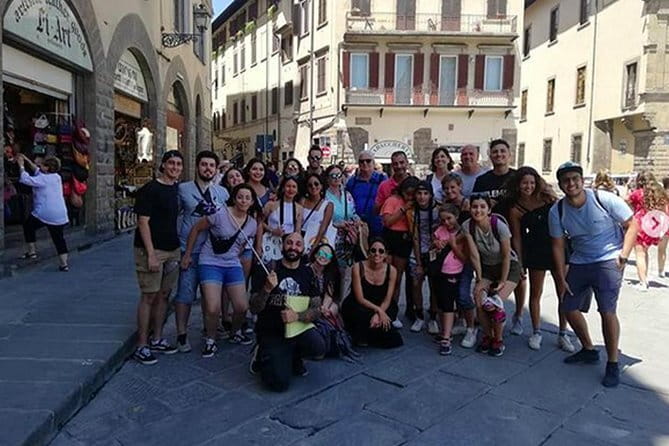
- See Florence’s core sights in 2.5 hours: The route includes the Duomo, Baptistery, Uffizi exterior, Ponte Vecchio, and Santa Croce.
- Start with useful orientation: Book it near the beginning of your stay so the guide can help you choose museums, restaurants, and neighborhoods to revisit.
- Small group format: The maximum group size is four people, a real advantage on crowded central streets.
- Low-cost structure: The listed price is $3.63 per person, with a voluntary tip at the end.
- Guides add practical local advice: Armando, Alessandro, Gino, and others have offered suggestions on food, opening hours, shopping, and getting around.
- Plan for an outdoor walk: Admission to the listed stops is not included because this is a city walk with exterior visits, and good weather is required.
Why this Florence walk works best at the start of your trip
I see this tour as an orientation walk rather than a full art tour. You are not going inside every church, palace, or museum. Instead, you move through Florence’s historic center, learn what each major building means, and decide where you want to spend more time later.
That distinction matters. Florence can tempt you into a frantic checklist of the Duomo, Uffizi, Ponte Vecchio, and Santa Croce without giving you much sense of how they fit together. A guide helps turn separate monuments into a readable city.
The timing is especially useful. At two hours and 30 minutes, the tour is long enough to cover the main core but short enough to leave room for lunch, a museum, or an afternoon reservation. I would schedule it on your first or second day, when advice about restaurants, museums, shopping, and public transport can shape the rest of your visit.
More Walking Tours in Florence
- Florence: Guided Walking Tour
★ 4.5 · 3,334 reviews - Skip the line: Uffizi and Accademia Small Group Walking Tour
★ 4.5 · 3,135 reviews - Florence: Guided Walking Tour
★ 4.6 · 1,602 reviews
From Piazza dell’Unità Italiana to the Medici quarter
The walk begins at Piazza dell’Unità Italiana, near Florence’s central railway area. That is a practical starting point if you arrive by train or are staying near the station. Confirmation is provided when you book, so check the meeting details carefully, especially if the time changes.
The early part of the route introduces the Medici side of Florence. You see the Medici Chapel, San Lorenzo Market, Medici Riccardi Palace, and San Lorenzo Church. Together, these places explain how one family shaped the city’s politics, buildings, art, and public life.
The Medici Chapel is an important exterior landmark even if you do not enter. It points toward Florence’s long connection with the Medici family and their role as patrons of artists and architects. The nearby market gives the district a more everyday feel, while the palace shows how power could be expressed through a private residence.
San Lorenzo Church adds another layer. A guide can help you see that Florence is not simply a collection of beautiful façades. Religious buildings, markets, family chapels, and political residences sit close together because the city grew through overlapping systems of faith, trade, and power.
You should not expect a long indoor visit at this stage. The listed admission cost is free because the experience is an outdoor walking tour, not a package that includes museum or church tickets. If the Medici Chapel or another interior catches your eye, you can make a separate plan.
The Duomo, Baptistery, and Florence’s big first impression
The route continues to the Duomo Cathedral and the Baptistery. This is the moment when Florence’s scale and ambition become hard to miss. The cathedral complex is one of the city’s essential sights, and seeing it with context is more useful than simply arriving, taking a photograph, and moving on.
The Baptistery helps you understand the importance of the cathedral square as a religious center. The guide’s job here is not only to identify the buildings but to explain how their parts relate to one another. That basic orientation can save you time later if you plan to return for an interior visit or a ticketed climb.
One practical point: you should expect the group to pause often for explanation. Several comments praise the guides for stopping regularly and sharing stories rather than rushing from one landmark to the next. That is good for anyone who wants history in manageable portions, though it also means the walk may feel less like a fast city circuit.
The central streets can be noisy. One person found a microphone and speaker system garbled, while another had trouble following a guide who spoke quickly. In a group of up to four, you can usually move closer and ask for a repeat, but it is still worth telling the guide early if you cannot hear.
Repubblica Square and the commercial heart of Florence

From the cathedral area, the walk reaches Repubblica Square. This broad urban space helps you see a different Florence, one shaped not only by medieval lanes and Renaissance palaces but also by later city planning and commerce.
The square is useful as a reference point. It sits near several major shopping streets and connects the cathedral district with the Arno and the political center. A good guide can help you understand how to use it as a landmark when you explore independently.
The tour also includes Orsanmichele Church. Its position and exterior make it a fine example of Florence’s overlap between religious and civic life. The route is not just a list of famous names. It gives you a sequence of places that shows how the city’s streets, churches, markets, and public squares connect.
You may hear local stories here rather than only formal art facts. That is one of the strengths of this format. Armando, in particular, is praised for mixing historical explanation with humor and personal insight. Other guides, including Alessandro and Gino, are described as lively and passionate about Florence.
Same city, a completely different sort of day:
- Florence: Skip-The-Line Uffizi Gallery Timed Entry Ticket
★ 4.5 · 27,832 reviews - Florence: Timed Entrance Ticket to Michelangelo’s David
★ 4.6 · 16,983 reviews - Florence: Michelangelo’s David Skip-the-Line Entry Ticket
★ 4.5 · 12,764 reviews - The Best tour in Florence: Renaissance & Medici Tales – guided by a STORYTELLER
★ 5.0 · 12,316 reviews
Porcellino and the route toward Signoria Square
The walk then reaches Porcellino, the well-known bronze boar near the Mercato Nuovo. This is a short stop, but it adds a bit of local character to a route otherwise filled with grand buildings. The area also helps you see Florence as a working commercial city, not just an open-air museum.
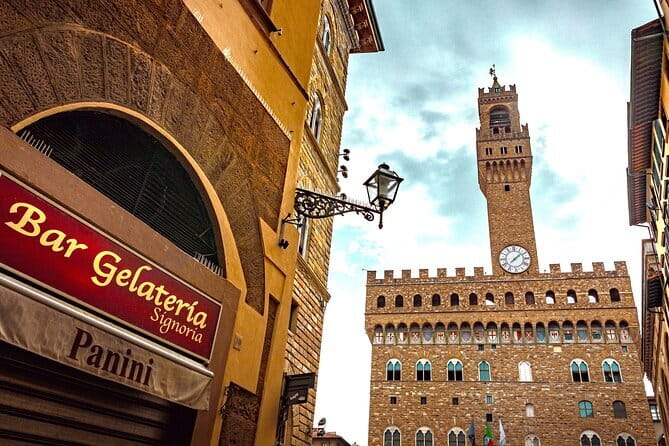
From there, you continue to Signoria Square. This is one of the best places on the route for understanding Florence’s political identity. The square is lined with major buildings and sculpture, and it brings the city’s public power into view.
I like this part of the itinerary because it balances the Medici district and the cathedral complex. You have already seen religious authority and private family power. In Signoria Square, the emphasis shifts to civic life and public display.
The guide’s commentary matters here. Without context, a square full of statues can blur into a collection of impressive objects. With a clear explanation, you can better understand why the square mattered and why Florence placed such powerful images in public view.
The Uffizi exterior and Ponte Vecchio
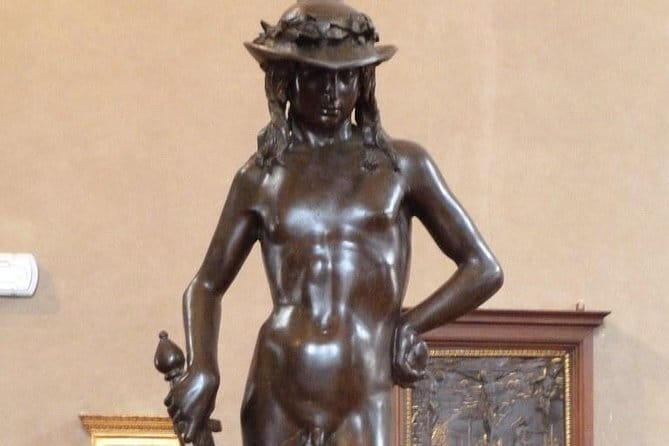
The tour passes the Uffizi from outside. This is important to understand before booking: you receive an introduction to the building and its place in Florence, but the experience does not include admission to the gallery.
That is still useful. The Uffizi is one of Florence’s major art destinations, and a guide can help you decide if it deserves a separate visit during your stay. If you plan to go inside, you will need to arrange that independently.
Next comes Ponte Vecchio, perhaps Florence’s most instantly recognizable bridge. The walk gives you a chance to see how the bridge links the two sides of the Arno and how it fits into the larger route through the historic center.
This is also a good point to think about timing. The bridge can be busy, and a small group is easier to keep together than a large one. Stay close to the guide and listen for the next meeting point if the crowd spreads out.
The route’s value here is its connection between landmarks. You are not being dropped at Ponte Vecchio with no idea where to go next. You have walked from the cathedral and civic center toward the river, building a mental map that will help when you return on your own.
Ending near Santa Croce Square
The walk finishes at Santa Croce Square, in a different location from the starting point. The exact ending details are supplied with the booking information, so check them before you set out and allow time afterward to find your way to your next stop.
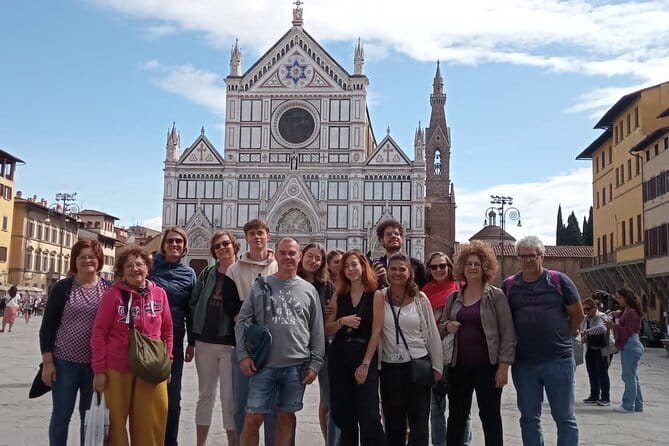
Santa Croce is a fitting end because it gives you one more major Florence landmark without trying to turn the tour into an indoor museum visit. By this point, you have crossed much of the central area and should have a clearer idea of the city’s shape.
Several guides also use the end of the walk for practical advice. You may receive suggestions for places to eat, sandwich shops, gelato, shopping, public toilets, opening and closing times, and sights that deserve a closer visit. That information can be more useful than another ten minutes of dates and names.
If you are unsure how to plan Florence, ask direct questions at the end. The small group limit should make it easier to get advice tailored to your schedule, though the quality and detail will depend on the guide leading your departure.
What the $3.63 price really means
At $3.63 per person, this is an unusually inexpensive way to get a structured introduction to central Florence. The low listed price makes sense because the main service is the guided walk, the stops are free to view from outside, and a voluntary tip is expected at the end rather than built into the ticket.
Think of the price as an entry point, not the total measure of the guide’s work. If you find the walk useful, bring enough cash or another suitable way to offer a tip. The amount is voluntary, and you can judge it based on the time, clarity, and practical help you receive.
The value is strongest if you use the walk to improve the rest of your stay. A short introduction can help you avoid wandering between major sights, choose which museums deserve your money, and find places to eat with more confidence.
It is less valuable if you want long indoor visits or detailed art lectures. You will need separate admission and separate time for the Duomo, Medici Chapel, Uffizi, or any other interior you decide to explore.
The guides make the biggest difference
The strongest praise is directed at the guides’ energy, storytelling, and local advice. Armando is repeatedly singled out for being funny, patient, thorough, and enthusiastic. He has helped people understand the sights, find restaurants, locate public toilets, and plan opening times.
Alessandro is praised for his long connection with Florence and for recommending sandwich and gelato stops. Gino is described as friendly and passionate, with useful food and restaurant suggestions. Barbara is noted for making the walk friendly and inclusive, while Simone and Deb are praised for telling interesting stories and explaining the city clearly.
That variety is a positive, but it also explains the main weakness. A walking tour is only as good as the person holding the group together and speaking to it. One guide may be especially witty, another more focused on facts, and another better at practical advice.
Communication can also vary. Two comments mention difficulty with a heavy accent, fast speech, or poor sound equipment. If you have hearing concerns, stand near the guide, ask for slower delivery, and do not hesitate to say that you missed a point.
Who should book this Florence tour?
I would choose this walk if you want a broad introduction before buying museum tickets or planning your own route. It suits first-time visitors, people with only a few days in Florence, and anyone who prefers a guide to a map.
It is also a good choice for people who value small groups. The maximum of four is unusually intimate for a low-cost city walk. Families, couples, and solo visitors may find it easier to ask questions than on a large group tour.
You should think twice if you want guaranteed indoor access, an art specialist, or a leisurely visit inside each major monument. This tour moves through many sights in a limited time, and its purpose is orientation rather than detailed study.
The walk requires good weather. Most people can participate, service animals are allowed, and the meeting point is near public transportation. Free cancellation is available up to 24 hours before the start time. Cancellations or changes made less than 24 hours before departure are not refunded or accepted, and a weather or minimum-number cancellation may lead to another date or a full refund.
Should you book it?
Book this Florence Walking Tour if you want to get your bearings fast, learn the city’s basic story, and collect useful advice before exploring alone. The route covers an impressive set of landmarks for two and a half hours, and the $3.63 starting price leaves room in your budget for the museums and churches you choose afterward.
I would book it near the beginning of your stay and pay close attention to the confirmed time. Expect an outdoor overview, not admission to the sights. If you can accept that limit, the small group, central route, and practical guidance make this a smart first look at Florence.
FAQ
How long does the Florence Walking Tour last?
The tour lasts approximately 2 hours and 30 minutes.
Where does the tour begin?
It begins at Piazza dell’Unità Italiana, 50123 Firenze FI, Italy.
Where does the tour end?
The activity ends at a different location from the starting point. The specific ending details are provided with the booking information.
What sights are included on the walk?
The route includes the Medici Chapel, San Lorenzo Market, Medici Riccardi Palace, San Lorenzo Church, Duomo Cathedral, Baptistery, Repubblica Square, Orsanmichele Church, Porcellino, Signoria Square, the exterior of the Uffizi, Ponte Vecchio, and Santa Croce Square.
Does the tour include admission to the attractions?
No. The listed stops have free admission for this activity because it is a walking tour with exterior visits. You would need to arrange and pay separately for any interior visits.
How many people can join the tour?
The activity has a maximum of four participants.
Can I cancel for a refund?
Yes. You can cancel at least 24 hours before the start time for a full refund. Cancellations or changes made less than 24 hours before the start time are not accepted or refunded.
Just added around Florence
- Walking Food Tour of Florence with Tastings and Wine★ 5.0 · 518 reviews
- Uffizi Gallery Small Group Tour with Guide★ 4.5 · 879 reviews
- Florence Accademia Guided Tour – Shared, Private & Combo Options★ 4.5 · 370 reviews
- Uffizi Gallery Timed Entry Admission Tickets★ 4.0 · 392 reviews
- Early Access Guided Uffizi Gallery Tour Skip-the-Line Small Group★ 4.5 · 707 reviews
- Uffizi and Accademia Small Group Guided Tour★ 4.5 · 449 reviews
- Florence Central Market Food Tour with Eating Europe★ 5.0 · 224 reviews
- Truffle Hunting Experience with Lunch in San Miniato★ 5.0 · 383 reviews
Walking Tours, compared.

Guided Walking Tour & Last Supper Visit with Ticket
Read our review →
Rialto Bridge & Offbeat Unusual Venice Walking Tour
Read our review →
Private 3 hrs Venice Tour: St Mark’s, Walking tour & Boat tour
Read our review →
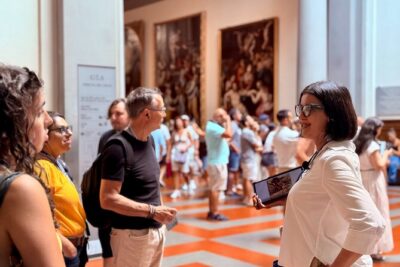
Skip the line: Uffizi and Accademia Small Group Walking Tour
Read our review →Browse the lists this tour appears in